
If you are planning a Tiruchendur Murugan Temple visit in 2026, the most useful details to know are the darshan timings, opening and closing time, special darshan options, pooja schedule, Abhishekam booking, Nazhikkinaru visit, festival crowd pattern, and the best time to reach the temple.
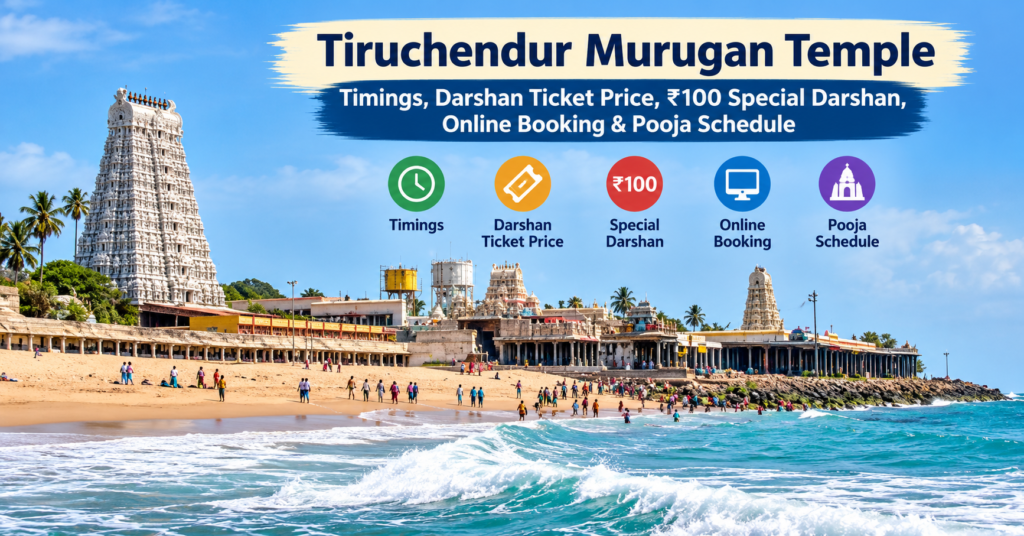
Tiruchendur Murugan Temple, officially known as Arulmigu Subramania Swamy Temple, is one of the six sacred Arupadai Veedu temples of Lord Murugan and one of Tamil Nadu’s most important pilgrimage centres. The temple is located on the seashore in Thoothukudi district, directly beside the Bay of Bengal.
Tiruchendur is especially distinctive because, unlike many major Murugan shrines built on hills, this temple stands close to the sea. Devotees come here for Lord Murugan darshan, daily poojas, Abhishekam, Nazhikkinaru, Skanda Sashti, Vaikasi Visakam, and other important temple festivals.
For a normal visit, the temple generally follows a long daily schedule of approximately 4:00 AM to 9:00 PM, although poojas and ritual periods can briefly affect normal darshan flow during the day.
General darshan is available without a special-entry charge, while devotees may also find paid temple services such as special darshan, Abhishekam, Golden Car Seva, and other official poojas depending on current availability.
This guide explains the complete Tiruchendur Temple darshan process in 2026, including today’s timings, opening and closing time, special darshan ticket price, online booking, pooja and Abhishekam charges, dress code, Nazhikkinaru, festival schedules, accommodation, crowd planning, and how to reach Tiruchendur.
Tiruchendur Murugan Temple 2026: Quick Information
A visit to Tiruchendur Murugan Temple is easiest to plan when you separate free general darshan from separately charged temple services such as Special Darshan, Abhishekam, Golden Car Seva, and other poojas.
| Tiruchendur Temple Detail | 2026 Information |
|---|---|
| Official Name | Arulmigu Subramania Swamy Temple |
| Popular Name | Tiruchendur Murugan Temple |
| Location | Tiruchendur, Thoothukudi, Tamil Nadu |
| Main Deity | Lord Subramania Swamy / Murugan |
| Religious Importance | One of the Six Arupadai Veedu |
| Regular Opening Time | 4:00 AM |
| Regular Closing Time | Around 9:00 PM |
| General Darshan | Free |
| Quick / Special Darshan | ₹100 |
| Abhishekam | ₹1,500 |
| Golden Car Seva | ₹2,500 |
| Shanmugar Archanai | ₹5,000 |
| Major Festival | Kanda Sashti / Skanda Sashti |
| Other Important Festivals | Vaikasi Visakam, Panguni Uthiram, Thai Poosam |
| Nearest Railway Station | Tiruchendur Railway Station |
| Nearest Practical Airport | Thoothukudi Airport |
| Official Website | tiruchendurmurugan.hrce.tn.gov.in |
The most useful planning point is that Tiruchendur Temple opens very early, making morning darshan one of the best options for first-time visitors. Reaching soon after opening can mean cooler weather, easier movement through the temple complex, and more time to visit Nazhikkinaru and the seashore area afterward.
For devotees interested in paid services, the ₹100 Special Darshan, ₹1,500 Abhishekam, ₹2,500 Golden Car Seva, and ₹5,000 Shanmugar Archanai are separate offerings and should not be treated as one combined ticket.
During Skanda Sashti, Vaikasi Visakam, Panguni Uthiram, Thai Poosam, weekends, and other major pilgrimage periods, crowd levels and service availability can be very different from a normal weekday. For a simpler first visit, an early non-festival morning is usually the most practical choice.
Tiruchendur Murugan Temple Timings 2026
The Tiruchendur Murugan Temple timings give devotees a long daily darshan window compared with many major Tamil Nadu temples. On a normal non-festival day, Arulmigu Subramania Swamy Temple generally opens around 4:00 AM and closes around 9:00 PM.
| Tiruchendur Temple Schedule | Regular Timing |
|---|---|
| Temple Opening Time | 4:00 AM |
| Morning Temple Hours | 4:00 AM–12:00 PM |
| Afternoon & Evening Hours | 12:00 PM–9:00 PM |
| Temple Closing Time | Around 9:00 PM–9:05 PM |
The key practical point is that Tiruchendur does not normally follow a long afternoon closure. Devotees can usually plan darshan across the day, although access may pause briefly during important poojas, Naivedyam, or internal rituals.
Tiruchendur Murugan Temple Timings Today
For an ordinary day, the practical Tiruchendur Temple timings today are:
Opening: around 4:00 AM
Darshan: available through most of the day, subject to pooja arrangements
Closing: around 9:00 PM
Festival days such as Skanda Sashti, Vaikasi Visakam, Panguni Uthiram, and Thai Poosam can have different crowd-control and ritual arrangements, so visitors should not rely only on the normal daily schedule during major celebrations.
Tiruchendur Temple Opening Time
The regular Tiruchendur Murugan Temple opening time is around 4:00 AM.
This very early opening is especially useful for pilgrims who want to combine darshan with Nazhikkinaru, seashore worship, or other temple activities before the hotter part of the day.
A practical early-morning window is:
4:30 AM–7:00 AM
At this time, temperatures are usually more comfortable and the temple area can be easier to navigate than later in the day.
Tiruchendur Temple Closing Time
The normal Tiruchendur Temple closing time is around 9:00 PM, with the final ritual sequence taking place near the end of the day.
Visitors should avoid treating 9:00 PM as the latest safe arrival time. Security checks, queues, final poojas, and entry restrictions can begin earlier.
For evening darshan, reaching by around 7:00–8:00 PM is a more practical choice.
Best Time for Tiruchendur Murugan Temple Darshan
For most first-time visitors, the best darshan periods are:
Early morning: 5:00 AM–8:00 AM
Evening: 5:00 PM–8:00 PM
Early morning is usually better for devotees who want:
- Cooler weather
- A quieter temple atmosphere
- Access to important morning poojas
- Time to visit Nazhikkinaru afterward
- Less exposure to midday coastal heat
Evening darshan is a good alternative for travellers arriving later in the day, but crowd levels can increase around major aarti and pooja periods.
Morning Darshan Timings
Morning is one of the most important worship periods at Tiruchendur because several major daily rituals take place during the early hours.
A practical morning darshan window is:
5:00 AM–8:00 AM
This period is especially relevant for devotees interested in rituals such as Viswaroopa Pooja and Kalasandhi Pooja.
Visitors who want only regular darshan can still use this window without needing to attend every pooja.
Afternoon Darshan Timings
Under the normal schedule, Tiruchendur Temple remains open through the afternoon, which is useful for visitors arriving by train, bus, or road later in the morning.
Afternoon darshan can suit:
- Families checking into accommodation first
- Pilgrims arriving after a long journey
- Visitors with flexible schedules
- Devotees who miss the morning period
However, because Tiruchendur is a coastal town, midday heat and humidity can make afternoon visits less comfortable than morning or evening.
Evening Darshan Timings
The evening worship period becomes more active around Sayaraksha Pooja at approximately 5:00 PM.
A practical evening darshan window is:
5:00 PM–8:00 PM
This period combines cooler weather with a stronger evening temple atmosphere and is often more comfortable than midday.
The final Palliarai Pooja is performed closer to closing time, so visitors wanting normal darshan should reach well before the last ritual period.
Tiruchendur Temple Festival Timings
The Tiruchendur Murugan Temple festival timings can differ significantly from the normal 4:00 AM opening schedule. On major Murugan festival days, the temple may open much earlier to handle special rituals and extremely heavy devotee traffic.
This is particularly important during Vaikasi Visakam, Kanda Sashti, Thai Poosam, and Panguni Uthiram, when normal-day queue expectations and darshan patterns do not apply.
Vaikasi Visakam Timings
On Vaikasi Visakam, Tiruchendur Temple can open as early as approximately 1:00 AM and continue through the day until around 9:00 PM.
Vaikasi Visakam is one of the major annual celebrations associated with Lord Murugan, so devotees should expect:
- Very early temple activity
- Special poojas and festival rituals
- Larger darshan queues
- Heavier traffic around Tiruchendur
- Longer waiting at Nazhikkinaru and other pilgrimage points
Visitors planning specifically for Vaikasi Visakam should follow the current festival-day notice rather than the regular 4:00 AM opening time.
Kanda Sashti Timings
Kanda Sashti at Tiruchendur is one of the temple’s most important annual festival periods and draws exceptionally large crowds.
On key Kanda Sashti days, temple activity can begin from around 1:00 AM.
The practical point is that the festival should be treated as a major pilgrimage event, not an ordinary temple visit.
During Kanda Sashti, devotees should expect:
- Very long darshan queues
- Separate crowd-control arrangements
- Special ritual schedules
- Heavy local transport demand
- Longer travel and waiting times
- Significant crowd around the seashore and temple approach
Ordinary weekday waiting-time estimates should not be applied during Kanda Sashti.
Thai Poosam Timings
On Thai Poosam, the temple can also open around 1:00 AM to accommodate festival worship and the increased number of devotees.
Pilgrims visiting for Thai Poosam should plan around the special festival schedule and allow extra time for entry, darshan, pooja, and local movement.
Panguni Uthiram Timings
For Panguni Uthiram, Tiruchendur Temple generally opens around 4:00 AM, with the day continuing through its special festival programme.
Although the opening may resemble the normal schedule, the crowd level, ritual sequence, and darshan flow can be very different from an ordinary day.
The safest approach for any major festival is:
Check the festival schedule → note early pooja timings → arrive well in advance → allow extra queue time
Tiruchendur Murugan Temple Pooja Timings 2026
The Tiruchendur Murugan Temple daily pooja schedule begins before sunrise and continues until the final closing ritual at night.
For devotees who want more than regular darshan, planning around a particular pooja can make the visit much more meaningful.
| Tiruchendur Daily Pooja | Approximate Time |
|---|---|
| Temple Opening / Thirukappu | 4:00 AM |
| Subrapatham Pooja | 5:10 AM–5:25 AM |
| Viswaroopa Pooja | 5:30 AM–5:35 AM |
| Kalasandhi Pooja | 8:00 AM–8:30 AM |
| Uchikkala Pooja | 12:00 PM–12:15 PM |
| Sayaraksha Pooja | 5:00 PM–5:15 PM |
| Palliarai Pooja | 8:45 PM–9:00 PM |
| Final Closing | Around 9:00 PM–9:05 PM |
These timings are best treated as the normal daily ritual sequence. Festival days can follow separate arrangements.
Viswaroopa Darshan and Pooja
The Tiruchendur Viswaroopa Pooja takes place around 5:30 AM and is one of the most popular early-morning worship periods.
Because the temple opens earlier, devotees can reach the complex before the Viswaroopa ritual and prepare for darshan without rushing.
This timing is especially suitable for pilgrims who want:
- Early morning worship
- Cooler weather
- A quieter temple atmosphere
- Time to visit Nazhikkinaru afterward
Kalasandhi Pooja
Kalasandhi Pooja is performed around 8:00 AM–8:30 AM.
This is a useful option for devotees who cannot reach Tiruchendur before sunrise but still want to attend an important morning pooja.
It also fits well for families staying overnight in Tiruchendur who prefer a slightly later start.
Uchikkala Pooja
The Uchikkala Pooja takes place around 12:00 PM.
This midday ritual can be convenient for travellers reaching Tiruchendur in the late morning.
However, because midday temperatures can be high, especially in the coastal climate, visitors should allow time for hydration and rest if they plan a longer temple visit.
Sayaraksha Pooja
The Sayaraksha Pooja is performed around 5:00 PM and marks the beginning of the main evening worship period.
For many visitors, this is one of the most comfortable times for darshan because the afternoon heat begins to ease and the temple atmosphere becomes more active again.
Palliarai Pooja
The final major ritual of the day is the Palliarai Pooja, generally performed around 8:45 PM–9:00 PM.
The temple closes shortly afterward.
Visitors who want normal evening darshan should therefore arrive well before the Palliarai period rather than treating 9:00 PM as a safe queue-entry time.
For a first-time visitor interested in pooja as well as darshan, the strongest practical choices are Viswaroopa Pooja around 5:30 AM, Kalasandhi around 8:00 AM, or Sayaraksha around 5:00 PM.
Tiruchendur Murugan Temple Darshan Ticket Price 2026
Tiruchendur Murugan Temple darshan is available through both a free public queue and a paid special-entry option. For most visitors, the important distinction is between free general darshan and the ₹100 Special / Quick Darshan.
| Tiruchendur Darshan / Service | Price |
|---|---|
| General Darshan | Free |
| Quick / Special Darshan | ₹100 |
| Abhishekam | ₹1,500 |
| Golden Car Seva | ₹2,500 |
| Shanmugar Archanai | ₹5,000 |
The higher ₹1,500–₹5,000 amounts are charges for specific poojas and sevas, not higher levels of VIP darshan.
That distinction matters because devotees searching for Tiruchendur VIP darshan price, fast darshan ticket, special entry ticket, or premium darshan may otherwise confuse ritual charges with paid queue access.
Tiruchendur Free Darshan
General darshan at Tiruchendur Murugan Temple is free and is suitable for devotees who have enough time to use the normal public queue.
Free darshan is a good choice when:
- Visiting on an ordinary weekday
- Arriving early in the morning
- The general queue is moving smoothly
- You have a flexible schedule
- You prefer not to pay for special entry
Queue length can increase significantly on weekends, public holidays, Skanda Sashti, Vaikasi Visakam, Thai Poosam, Panguni Uthiram, and other major pilgrimage dates.
Tiruchendur ₹100 Special Darshan
The main paid public entry option is the ₹100 Tiruchendur Special Darshan / Quick Darshan.
It provides a separate paid route from the general queue and can be useful when devotees want a more convenient entry process.
This option can be particularly helpful for:
- Senior citizens
- Families with young children
- Visitors with limited time
- Weekend pilgrims
- Travellers combining Tiruchendur with other places
- Devotees visiting when the free queue is already long
However, the ₹100 ticket should not be described as instant darshan. Waiting time still depends on the crowd, pooja schedule, security movement, and festival arrangements.
During Kanda Sashti or another major festival, even the Special Darshan queue can take considerably longer than on an ordinary weekday.
Tiruchendur VIP Darshan 2026
Searches for Tiruchendur VIP Darshan, VIP ticket price, fast darshan, and priority entry are common, but the public ticket structure is much simpler.
For an ordinary devotee looking for a faster paid route, the practical option is:
₹100 Special / Quick Darshan
Visitors should not assume that Abhishekam, Golden Car Seva, or Shanmugar Archanai are progressively more expensive VIP tickets. Those are separate religious services.
Free Darshan vs ₹100 Special Darshan: Which Should You Choose?
Choose free darshan if:
- You are visiting early on a normal weekday
- The general queue is manageable
- You have enough time
- You do not need a paid-entry route
Choose the ₹100 Special Darshan if:
- Your available time is limited
- You are travelling with senior citizens or children
- The general queue is already heavy
- You are visiting during a busier period
- You prefer a more organised paid-entry route
On an ordinary early weekday morning, the free queue may already be practical enough for many devotees.
Tiruchendur Temple Online Booking 2026
The official Tiruchendur temple portal provides access to available darshan tickets, pooja bookings, Abhishekam, sevas, and other religious services.
Official portal:
Tiruchendur Murugan Temple Online Services
Using the official HR&CE portal is preferable to relying on an unrelated third-party booking page, especially when payment and devotee details are involved.
How to Book Tiruchendur Temple Tickets Online
Step 1: Open the Official Temple Website
Visit the official Arulmigu Subramania Swamy Temple, Tiruchendur HR&CE website.
Look for the online services, booking, or e-services section.
Step 2: Check the Services Currently Available
Depending on the live booking system, options may include:
- Special Darshan
- Pooja booking
- Abhishekam
- Golden Car Seva
- Other temple sevas
- Additional religious services
Not every service or date is guaranteed to remain available throughout the year.
Step 3: Choose the Correct Service
Select the service you actually need.
For example:
₹100 Special Darshan = paid darshan entry
₹1,500 Abhishekam = religious ritual
₹2,500 Golden Car Seva = separate temple seva
This helps prevent paying for the wrong service because of similar-looking booking labels.
Step 4: Select an Available Date
Choose the intended date of the temple visit.
Festival dates and weekends can have much greater booking demand, so advance booking can be more useful during busy periods.
Step 5: Enter Devotee Details
Fill in the requested information carefully.
Where identification details are requested, make sure the name and document information match the person who will use the booking.
Step 6: Complete Online Payment
Pay the exact ticket or seva amount displayed by the official system.
Do not rely on an old screenshot or third-party tariff if the live portal shows a different amount.
Step 7: Save the Booking Confirmation
Download or save the booking acknowledgement, receipt, or e-ticket after successful payment.
Keep:
- Booking confirmation
- Payment receipt
- Screenshot or PDF backup
- Required identification
ready when reporting at the temple.
For time-specific poojas or sevas, devotees should arrive early enough to complete any verification and reporting formalities before the scheduled ritual begins.
Tiruchendur Temple Offline Ticket Booking
Devotees who do not book online can also enquire about Tiruchendur Temple paid darshan and seva tickets at the temple counters, subject to the service being available on that day.
Offline booking can work well on an ordinary weekday when demand is lower, especially for visitors who reach Tiruchendur without a fixed advance plan.
However, relying entirely on a last-minute counter is less practical during:
- Kanda Sashti
- Vaikasi Visakam
- Thai Poosam
- Panguni Uthiram
- Weekends
- Public holidays
- Other high-crowd pilgrimage periods
If you already know the date of your visit and want a paid service such as ₹100 Special Darshan, Abhishekam, or another temple seva, checking online availability before travelling is the safer approach.
Tiruchendur Temple Abhishekam and Seva Prices
Beyond regular darshan, Tiruchendur Murugan Temple offers several paid religious services for devotees who want to participate in a specific ritual.
These charges are separate from the free public queue and should not be confused with VIP-darshan pricing.
| Tiruchendur Seva | Price |
|---|---|
| Abhishekam | ₹1,500 |
| Golden Car Seva | ₹2,500 |
| Shanmugar Archanai | ₹5,000 |
Tiruchendur Abhishekam – ₹1,500
The Tiruchendur Abhishekam price is ₹1,500.
This amount applies to the ritual service itself and is separate from:
- Free general darshan
- ₹100 Special Darshan
- Other poojas or sevas
Devotees booking Abhishekam should follow the date, reporting time, and service instructions shown by the temple system.
Tiruchendur Golden Car Seva – ₹2,500
The Golden Car Seva at Tiruchendur costs ₹2,500.
This is a distinct temple seva with its own religious purpose and should not be described as a premium or VIP darshan ticket.
Visitors interested in Golden Car Seva should check the current booking availability because seva schedules can vary on festival and high-demand dates.
Tiruchendur Shanmugar Archanai – ₹5,000
The Shanmugar Archanai price is ₹5,000.
This is a higher-value ritual service and is separate from the normal darshan queue.
Devotees should confirm the service timing and reporting instructions when booking rather than assuming that the amount includes faster or unrestricted temple entry.
Tiruchendur Temple Crowd and Waiting Time
Tiruchendur darshan waiting time can vary dramatically depending on the weekday, season, and festival calendar.
A practical crowd pattern is:
| Visit Period | Expected Crowd |
|---|---|
| Ordinary weekday, early morning | Low to Moderate |
| Ordinary weekday, evening | Moderate |
| Weekend | Moderate to High |
| Vaikasi Visakam | Very High |
| Thai Poosam | Very High |
| Panguni Uthiram | Very High |
| Kanda Sashti | Extremely High |
For this reason, no fixed claim such as “30-minute darshan” or “one-hour waiting” should be treated as reliable throughout the year.
Actual queue time depends on:
- Number of devotees
- Free vs Special Darshan queue
- Pooja interruptions
- Security movement
- Festival arrangements
- Time of arrival
Best Time for a Shorter Tiruchendur Darshan Queue
For devotees mainly interested in a smoother temple visit, one of the best choices is:
Ordinary weekday + early morning
A practical window is approximately:
5:00 AM–7:00 AM
This also allows visitors to combine darshan with early poojas and then continue toward Nazhikkinaru and the seashore area before the strongest daytime heat.
Tiruchendur Weekend Darshan
Saturday and Sunday are generally busier because many families and short-trip pilgrims arrive from nearby towns and districts.
If visiting on a weekend, reaching early in the morning is usually much better than arriving in the late morning or afternoon.
The ₹100 Special Darshan may also become more useful when the normal public queue is already heavy.
Tiruchendur Temple Dress Code
Visitors should wear modest clothing suitable for an active Hindu temple.
Traditional attire is a good choice, especially for devotees attending Abhishekam, Archanai, or another booked pooja, but the main requirement is respectful and appropriate clothing.
Dress Code for Men
Suitable options include:
- Veshti or dhoti
- Kurta
- Shirt with full-length trousers
- Other modest clothing
Dress Code for Women
Suitable choices include:
- Saree
- Salwar-kameez
- Kurta with full-length bottoms
- Other modest traditional clothing
Visitors should avoid clothing that is inappropriate for a place of worship.
Mobile Phones and Photography at Tiruchendur Temple
Temple rules around mobile phones, cameras, and photography should be followed carefully, especially near the sanctum and other restricted sacred areas.
Visitors should not assume that photography is permitted everywhere simply because Tiruchendur is also a coastal pilgrimage destination.
The temple interior and sanctum rules are separate from the beach or exterior public areas.
Footwear and Bags
Footwear should be removed before entering the designated temple area and left at the appropriate footwear facility.
For easier movement through security and darshan queues, carry only essential belongings.
This becomes especially important during Kanda Sashti and other major festival periods, when the temple complex can become extremely crowded and carrying large bags can make the visit more difficult.
Nazhikkinaru at Tiruchendur Temple
One of the most distinctive pilgrimage features of Tiruchendur Murugan Temple is Nazhikkinaru, a sacred freshwater spring located very close to the Bay of Bengal.
Its importance comes from the unusual presence of fresh water beside the salty sea, and it has become deeply connected with Tiruchendur’s religious tradition.
Many devotees follow a pilgrimage sequence such as:
Sea visit or ritual bath → Nazhikkinaru → Tiruchendur Murugan Temple Darshan
This order is especially common among pilgrims who want to include both the seashore and sacred spring in the visit.
Because the area can become crowded, particularly on weekends, Kanda Sashti, Vaikasi Visakam, Thai Poosam, and other festival days, visitors should follow the current temple arrangements and avoid rushing into congested water areas.
Tiruchendur Beach and Sea Bath
Tiruchendur Temple stands directly beside the Bay of Bengal, which gives the shrine a very different setting from the other major Arupadai Veedu temples.
Many devotees visit the seashore before temple darshan as part of the traditional pilgrimage experience.
However, the sea should be treated carefully. Conditions can change with waves, weather, and tides.
Extra caution is important for:
- Children
- Senior citizens
- Non-swimmers
- Visitors unfamiliar with sea conditions
- Families travelling during crowded festival periods
The beach can be an important part of the Tiruchendur pilgrimage, but safety should take priority over completing a ritual bath when conditions are not suitable.
Why Tiruchendur Murugan Temple Is Famous
Tiruchendur Murugan Temple is famous for combining major Murugan mythology, Arupadai Veedu significance, seashore worship, Nazhikkinaru, and large-scale festivals in one pilgrimage centre.
It is especially known for:
- Being one of the Six Arupadai Veedu
- Lord Murugan’s victory over Surapadman
- Kanda Sashti and Soorasamharam
- Its rare coastal temple setting
- Nazhikkinaru sacred spring
- Ancient Tamil Murugan worship
- Daily Abhishekam and pooja traditions
- Large annual pilgrimage festivals
Unlike several other major Murugan shrines associated with hills, Tiruchendur is closely identified with the sea, which gives the temple a unique religious and visual character.
Tiruchendur Temple History and Religious Significance
According to Hindu tradition, Lord Murugan defeated the asura Surapadman in the Tiruchendur region.
This episode forms the religious foundation of the famous Soorasamharam, which is dramatically commemorated during the annual Kanda Sashti festival.
Temple tradition also holds that after the victory, Lord Murugan worshipped Lord Shiva at Tiruchendur.
The shrine has been connected with Tamil devotional literature and Murugan worship for centuries, and the temple complex has developed through contributions from rulers, devotees, religious institutions, and successive periods of South Indian history.
Tiruchendur and the Six Arupadai Veedu
Tiruchendur is traditionally regarded as the second of the Six Abodes of Lord Murugan.
The six famous Arupadai Veedu temples are:
- Thiruparankundram
- Tiruchendur
- Palani
- Swamimalai
- Tiruttani
- Pazhamudircholai
Some devotees undertake a larger pilgrimage covering all six shrines, with each temple representing a different episode and tradition associated with Lord Murugan.
Kanda Sashti at Tiruchendur
Kanda Sashti is one of the most important festivals at Tiruchendur Murugan Temple and one of the biggest Murugan celebrations in Tamil Nadu.
The festival commemorates the battle between Lord Murugan and Surapadman.
Soorasamharam at Tiruchendur
The central event is Soorasamharam, representing Lord Murugan’s victory over Surapadman.
This attracts enormous numbers of devotees to Tiruchendur.
During the festival, visitors should expect:
- Extremely long darshan queues
- Special temple timings
- Heavy police deployment
- Crowd-control barriers
- Traffic restrictions
- High hotel occupancy
- Crowded trains and buses
- Longer waiting at Nazhikkinaru and the seashore
Anyone travelling specifically for Soorasamharam should treat the visit as a major pilgrimage event, not as a normal one-day temple trip.
Other Major Festivals at Tiruchendur Temple
Vaikasi Visakam
Vaikasi Visakam is one of the important annual Murugan festivals and attracts large numbers of pilgrims for special worship, processions, and temple rituals.
Temple opening can begin much earlier than on an ordinary day.
Panguni Uthiram
Panguni Uthiram is another major Murugan festival and brings increased pilgrim traffic to Tiruchendur.
Visitors should expect special rituals and heavier crowds than on a normal weekday.
Thai Poosam
Thai Poosam at Tiruchendur is celebrated with major devotion to Lord Murugan.
On this day, the temple can open from around 1:00 AM, allowing additional time for festival worship and crowd management.
Masi and Avani Festivals
Tiruchendur also follows important Masi and Avani festival programmes, during which temple timings and ritual schedules can vary depending on the specific festival day.
Visitors travelling during these periods should check the current temple notice rather than assuming the regular 4:00 AM–9:00 PM schedule applies unchanged.
Best Time to Visit Tiruchendur Murugan Temple
The best time to visit Tiruchendur Temple depends on whether your priority is comfortable weather, shorter queues, a particular pooja, or a major festival experience.
| Visit Purpose | Better Time |
|---|---|
| Peaceful Darshan | Weekday early morning |
| Viswaroopa Pooja | Around 5:30 AM |
| Lower Heat | Early morning |
| Evening Temple Visit | Around 5:00 PM onward |
| Comfortable Weather | November–February |
| Kanda Sashti Experience | Festival period |
| Family Visit | Non-festival weekday |
| Senior Citizens | Early morning |
| Shorter Queue | Weekday outside major festivals |
For most first-time visitors, November to February + ordinary weekday + early morning gives one of the best combinations of cooler weather, manageable crowds, and enough time to visit Nazhikkinaru and the seashore afterward.
How Much Time Is Needed for Tiruchendur Temple?
For only Tiruchendur Murugan Temple darshan, a practical allowance on an ordinary weekday is:
Around 1–2 hours
This can cover:
- Queue
- Security
- Main darshan
- Basic movement through the temple
- Prasad or short temple stop
For a more complete pilgrimage including:
- Temple darshan
- Pooja
- Nazhikkinaru
- Seashore
- Prasad
- Temple surroundings
keep approximately:
3–4 hours
During Kanda Sashti, Vaikasi Visakam, Thai Poosam, Panguni Uthiram, weekends, or major holidays, the total visit can take much longer.
How to Reach Tiruchendur Murugan Temple
Tiruchendur is well connected with major towns and cities across southern Tamil Nadu by train, bus, taxi, and private vehicle.
By Train
Tiruchendur Railway Station is the nearest railway station to the temple.
From the station, visitors can continue using:
- Auto-rickshaw
- Taxi
- Local transport
Because the railway station is close to the temple area, train travel is especially convenient for pilgrims.
By Air
The nearest practical airport is Thoothukudi Airport, roughly 40–50 km from Tiruchendur depending on the route.
From the airport, travellers can continue by:
- Taxi
- Private vehicle
- Other road transport
Madurai Airport is another useful option if flight timings or connectivity are better.
By Road
Tiruchendur has regular road connectivity with:
- Thoothukudi
- Tirunelveli
- Madurai
- Nagercoil
- Kanyakumari
- Other towns across southern Tamil Nadu
Government buses are widely used by pilgrims because Tiruchendur is a major religious destination.
Tirunelveli to Tiruchendur
Tirunelveli is one of the main gateways to Tiruchendur.
Frequent buses and road transport make the route practical for both day trips and overnight pilgrimages.
Travellers reaching Tirunelveli by train can continue toward Tiruchendur by bus, taxi, or private vehicle.
Thoothukudi to Tiruchendur
Visitors arriving in Thoothukudi by air, rail, or road can continue directly to Tiruchendur by:
- Bus
- Taxi
- Private vehicle
This route is particularly useful for passengers using Thoothukudi Airport.
For festival travel, allow extra time because traffic entering Tiruchendur can become significantly heavier than on an ordinary weekday.
Accommodation in Tiruchendur
Tiruchendur receives pilgrims throughout the year, so the town has a wide range of places to stay close to Arulmigu Subramania Swamy Temple.
Visitors can usually choose from:
- Temple or pilgrim accommodation, where available
- Budget lodges
- Guest houses
- Family hotels
- Mid-range hotels
For devotees planning 4:00–6:00 AM temple access, staying within or near the main temple area can be especially convenient. It reduces early-morning travel and makes it easier to attend Viswaroopa Pooja, early darshan, Nazhikkinaru, and seashore rituals without starting the day with a long commute.
Accommodation demand rises sharply during:
- Kanda Sashti
- Soorasamharam
- Vaikasi Visakam
- Thai Poosam
- Panguni Uthiram
- Weekends
- Major public holidays
During these periods, last-minute rooms near Tiruchendur Temple can become difficult to find, so advance booking is much more practical.
Places to Visit Near Tiruchendur Temple
Tiruchendur can easily be combined with nearby religious, coastal, and historical places, especially if you are staying for a full day or overnight.
Valli Cave
Valli Cave is closely associated with Lord Murugan tradition and is one of the natural additions to a Tiruchendur pilgrimage.
Visitors who complete the main temple darshan early can include it without needing a separate full-day plan.
Tiruchendur Beach
The Tiruchendur seashore lies beside the temple and forms an important part of the pilgrimage atmosphere.
Many devotees spend some time here before or after darshan, but sea conditions should always be considered before entering the water.
Nazhikkinaru
Nazhikkinaru is one of the most important stops near the temple and is known for its freshwater spring located close to the salty Bay of Bengal.
For many pilgrims, Nazhikkinaru is not just a nearby attraction but part of the wider Tiruchendur religious experience.
Manapad
Visitors with additional time can travel toward Manapad, a coastal destination known for its scenic shoreline and religious heritage.
It is better suited to visitors with a private vehicle or a less tightly scheduled itinerary.
Panchalankurichi
History-focused travellers can also consider Panchalankurichi, associated with Veerapandiya Kattabomman and Tamil Nadu’s anti-colonial history.
This works well as an additional stop for visitors who want more than a purely temple-focused trip.
Suggested Tiruchendur One-Day Itinerary
A one-day Tiruchendur visit works best when the main temple activities are completed before the stronger midday heat.
5:00 AM – Reach Tiruchendur Temple
Arrive early enough to complete footwear, security, and entry formalities.
This is a good starting time for devotees who want to attend the early pooja sequence.
5:30 AM – Viswaroopa Pooja and Darshan
Attend Viswaroopa Pooja and complete the main Lord Murugan darshan.
Early morning generally gives a more comfortable combination of cooler weather and easier movement.
7:00 AM – Temple Surroundings
Spend some additional time around the temple complex, complete prasad or other devotional activities, and prepare for the next pilgrimage stop.
8:00 AM – Nazhikkinaru
Visit Nazhikkinaru according to the current entry and crowd arrangement.
Pilgrims who also plan a sea visit should follow the local sequence being used on that day.
9:00 AM – Breakfast
Take a break in Tiruchendur town after the early temple activities.
Late Morning – Valli Cave and Seashore
Visit Valli Cave and the seashore before the afternoon heat becomes stronger.
Afternoon – Rest or Local Travel
The hotter part of the day is a practical time to rest, return to the hotel, or explore nearby places at a slower pace.
5:00 PM – Evening Temple Visit
Return for Sayaraksha Pooja or evening darshan.
This gives first-time visitors both the early-morning and evening temple atmosphere without making the day unnecessarily exhausting.
During Kanda Sashti, Vaikasi Visakam, Thai Poosam, Panguni Uthiram, or major holidays, this schedule should not be treated as fixed because queues and festival arrangements can significantly change the day.
FAQs
What are Tiruchendur Murugan Temple timings in 2026?
On a normal non-festival day, Tiruchendur Murugan Temple generally opens around 4:00 AM and closes around 9:00 PM.
What are Tiruchendur Temple timings today?
If today is an ordinary day without a special festival schedule, devotees can generally plan temple access between 4:00 AM and around 9:00 PM.
Major festival dates may follow different opening arrangements.
What time does Tiruchendur Temple open?
The regular Tiruchendur Temple opening time is around 4:00 AM.
On certain major festival days, the temple can open much earlier.
What time does Tiruchendur Temple close?
The normal closing time is around 9:00 PM, with the final Palliarai-related ritual sequence taking place near closing.
Is Tiruchendur Temple open in the afternoon?
Yes. Under the normal schedule, the temple remains open through the afternoon and does not follow a long standard midday closure.
Short ritual-related restrictions can still occur.
Is Tiruchendur Murugan Temple darshan free?
Yes. General darshan is free.
Devotees who want a separate paid entry route can use the available Special Darshan facility.
What is the Tiruchendur Special Darshan ticket price?
The Quick / Special Darshan ticket is ₹100 under the listed temple service structure.
Is VIP Darshan available at Tiruchendur?
For ordinary devotees looking for faster paid entry, the practical public option is the ₹100 Special / Quick Darshan.
There is no need to treat Abhishekam or other poojas as separate VIP-darshan categories.
Can Tiruchendur Temple tickets be booked online?
Yes. Available darshan, pooja, Abhishekam, and other temple services can be accessed through the official Tiruchendur HR&CE portal when listed for online booking.
What is the Tiruchendur Abhishekam price?
The listed Abhishekam charge is ₹1,500.
It is a ritual service and is separate from both free darshan and the ₹100 Special Darshan ticket.
What is the Golden Car Seva price?
The listed Golden Car Seva charge is ₹2,500.
What is the Shanmugar Archanai price?
The listed Shanmugar Archanai price is ₹5,000.
What time is Viswaroopa Pooja at Tiruchendur?
Viswaroopa Pooja is performed at approximately 5:30 AM under the regular daily pooja schedule.
What is the best time for Tiruchendur Murugan darshan?
For most visitors, an ordinary weekday between about 5:00 AM and 7:00 AM is one of the best choices for cooler weather and generally easier crowd conditions.
Which month is best to visit Tiruchendur?
For more comfortable weather, November to February is often a practical period.
Visitors wanting a quieter trip should also avoid major festival dates.
Why is Tiruchendur Temple famous?
Tiruchendur is one of Lord Murugan’s Six Arupadai Veedu and is traditionally associated with his victory over Surapadman.
It is also distinctive for its seashore setting, Nazhikkinaru, and major Kanda Sashti celebrations.
What is Nazhikkinaru?
Nazhikkinaru is a sacred freshwater spring located very close to the sea near Tiruchendur Temple.
It is one of the most important pilgrimage features associated with the temple.
Should I visit Nazhikkinaru before or after darshan?
Many pilgrims traditionally combine the seashore, Nazhikkinaru, and temple darshan as part of one pilgrimage sequence.
The exact order should follow current local arrangements and personal comfort.
Which festival is biggest at Tiruchendur Temple?
Kanda Sashti, especially Soorasamharam, is one of Tiruchendur’s biggest annual pilgrimage events and attracts extremely large crowds.
What happens during Soorasamharam?
Soorasamharam commemorates Lord Murugan’s victory over Surapadman and forms the central dramatic event of the Kanda Sashti festival at Tiruchendur.
Which railway station is nearest to Tiruchendur Temple?
Tiruchendur Railway Station is the nearest railway station and provides convenient access to the temple town.
Which airport is nearest to Tiruchendur Temple?
Thoothukudi Airport is the nearest practical airport.
Madurai Airport can also be considered when flight connectivity is more suitable.
How much time is needed for Tiruchendur Temple?
Keep around 1–2 hours for ordinary darshan on a normal day.
For a fuller pilgrimage including Nazhikkinaru, the seashore, pooja, and temple surroundings, allow around 3–4 hours.
Is one day enough for Tiruchendur?
Yes. One day is enough for the main temple, Nazhikkinaru, seashore, and nearby pilgrimage stops if you begin early.
An overnight stay is more comfortable if you want both morning and evening poojas or are travelling during a festival.
Is Tiruchendur suitable for senior citizens?
Yes, but an early non-festival weekday visit is usually more comfortable because the weather is cooler and queues are generally easier.
Major festival days can involve much longer standing and heavier crowd movement.
Final Thoughts
A Tiruchendur Murugan Temple visit in 2026 is relatively straightforward to plan because the regular temple day begins early at approximately 4:00 AM and continues until around 9:00 PM.
For ordinary devotees, general darshan is free, while the ₹100 Special Darshan provides a useful paid faster-entry option. Abhishekam, Golden Car Seva, and Shanmugar Archanai are separate religious services with their own charges and should not be confused with progressively higher VIP tickets.
For a first visit, early morning remains one of the strongest choices. Devotees can attend Viswaroopa Pooja around 5:30 AM, complete Lord Murugan darshan, and then continue toward Nazhikkinaru and the Tiruchendur seashore before the afternoon heat becomes stronger.
The pilgrimage is also significant far beyond the main sanctum. Tiruchendur’s identity comes from the combination of Lord Murugan, the Surapadman tradition, Soorasamharam, the Bay of Bengal, Nazhikkinaru, and its place among the Six Arupadai Veedu.
Visitors attending Kanda Sashti, Vaikasi Visakam, Thai Poosam, Panguni Uthiram, or another major festival should expect special timings, heavier traffic, much larger queues, and stronger accommodation demand.
For pilgrims who prefer a calmer visit, an ordinary non-festival weekday morning remains the easiest overall choice.