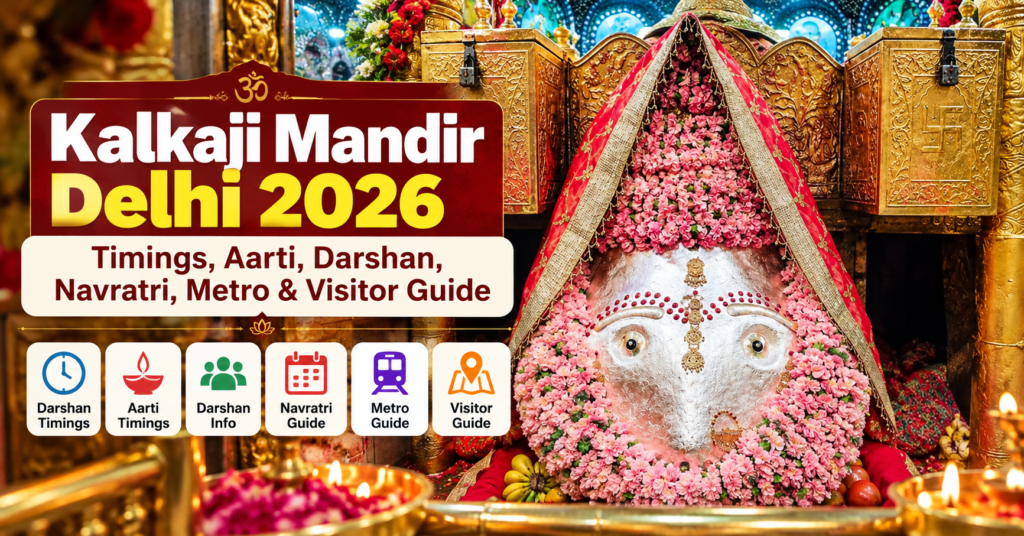
Kalkaji Mandir, located in South Delhi near Nehru Place, is one of Delhi’s most prominent Hindu temples dedicated to Maa Kalka Ji, a form of Goddess Durga. Traditionally revered as a Manokamna Siddha Peetha, the temple attracts devotees seeking the Goddess’s blessings for protection, family wellbeing and the fulfilment of wishes. Devotees visit throughout the year, with particularly large gatherings during Chaitra and Sharad Navratri.
The temple is easily accessible through Kalkaji Mandir Metro Station and is located close to popular South Delhi landmarks such as Lotus Temple and Nehru Place.
If you are planning to visit Kalkaji Mandir in 2026, this guide covers the temple’s darshan timings, morning and evening aarti, Navratri arrangements, VIP darshan information, nearest Metro station and practical travel details. It also explains what to expect during busy worship periods so you can plan your visit accordingly.
https://kalkajimandirguide.com
☷On this pageJump to a section of this temple guide
Kalkaji Mandir Timings 2026: Opening and Closing Time
Kalkaji Mandir opens at around 4:00 AM and closes at approximately 11:30 PM on regular days. The temple remains accessible for most of the day, allowing devotees to visit for Maa Kalka Ji darshan in the morning, afternoon or evening.
Unlike many temples that have a lengthy afternoon closure, Kalkaji Mandir generally follows an extended daily darshan schedule. However, brief interruptions may occur during aarti, bhog, shringar and temple cleaning.
| Temple Activity | Approximate Timing |
|---|---|
| Kalkaji Mandir Opening Time | 4:00 AM |
| Morning Darshan | From 4:00 AM onwards |
| Mangala Aarti | 4:30 AM |
| Midday Aarti | 12:00 PM |
| Evening Aarti | 7:00 PM |
| Shayan Aarti | 10:30 PM |
| Kalkaji Mandir Closing Time | 11:30 PM |
These are commonly followed timings rather than a guaranteed minute-by-minute schedule. Darshan may be paused temporarily during temple rituals, even when the premises remain open.
The daily routine may also change during Navratri, major religious occasions and special worship programmes.
Kalkaji Mandir Aarti Timings: Morning and Evening
Kalkaji Mandir has four commonly followed aarti periods throughout the day. Devotees can attend the early morning worship, midday aarti, evening aarti or the final worship before closing.
Mangala Aarti – 4:30 AM
Mangala Aarti takes place at approximately 4:30 AM, shortly after the temple opens. It marks the beginning of the day’s principal worship activities.
This is a suitable time for devotees who prefer early morning prayers and comparatively smaller crowds. Arriving slightly before the aarti can also help visitors settle in before worship begins.
Madhyahn Aarti – 12:00 PM
Madhyahn Aarti is generally performed around 12:00 PM. This midday worship period may involve a temporary restriction on regular movement near the sanctum.
Devotees arriving around noon should allow extra time in case darshan is briefly interrupted.
Sandhya Aarti – 7:00 PM
Kalkaji Mandir evening aarti is generally held around 7:00 PM. Also known as Sandhya Aarti, it is a popular worship period that attracts devotees after their daytime activities.
The temple can become considerably busier around evening aarti, particularly on weekends and important Devi worship days. If attending the aarti is your priority, plan to arrive before 7:00 PM rather than reaching at the exact scheduled time.
Shayan Aarti – 10:30 PM
Shayan Aarti takes place at approximately 10:30 PM and is associated with the temple’s closing worship.
Although Kalkaji Mandir generally remains open until around 11:30 PM, devotees arriving late should not assume that regular darshan will continue without interruption after Shayan Aarti.
Note: Aarti timings are approximate and may be adjusted during Navratri, festivals and special religious ceremonies.
Best Time to Visit Kalkaji Mandir for Peaceful Darshan
The best time to visit Kalkaji Mandir for peaceful darshan is between 4:30 AM and 7:00 AM, especially on ordinary weekdays. Early morning visits generally offer a calmer atmosphere before the larger daytime crowds begin arriving.
| Visiting Period | Crowd Expectations | Suitable For |
|---|---|---|
| 4:30 AM – 7:00 AM | Generally lighter | Peaceful darshan and morning aarti |
| Late Morning – Afternoon | Varies by day | Regular darshan and flexible visits |
| Around 7:00 PM | Often busier | Sandhya Aarti and evening worship |
| Late Evening | May ease after the evening rush | Devotees visiting after work |
For peaceful darshan: Choose an early weekday morning. The cooler weather and comparatively quieter approach roads can make the visit more comfortable.
For evening aarti: Visit before 7:00 PM and be prepared for a larger gathering near the main worship area.
For weekend visits: Allow additional time, as Saturday, Sunday and important religious occasions can attract more devotees than ordinary weekdays.
During Chaitra Navratri and Sharad Navratri, crowd conditions can be very different from the regular schedule. Even an early morning arrival may involve longer queues, so the usual peaceful-darshan window should not be treated as guaranteed during these festivals.
Is Entry to Kalkaji Mandir Free?
Yes, entry to Kalkaji Mandir is completely free for regular darshan. Devotees do not need to purchase an entry ticket to visit the temple and seek the blessings of Maa Kalka Ji.
There is no compulsory charge for ordinary darshan, whether you visit on a weekday or during a busy religious period.
However, visitors may choose to purchase puja offerings or make voluntary donations.
| Item or Service | Price |
|---|---|
| Regular Temple Entry | Free |
| Maa Kalka Ji Darshan | Free |
| Flowers and Prasad | Depends on purchase |
| Chunri, Coconut and Puja Offerings | Depends on purchase |
| Temple Donations | Voluntary |
| VIP or Priority Darshan | No permanently verified fixed rate |
Buying prasad, flowers or other puja items is optional. These expenses are separate from temple entry and should not be mistaken for compulsory darshan charges.
Kalkaji Mandir VIP Darshan Ticket Price 2026
There is no reliably confirmed, fixed year-round VIP darshan ticket price for Kalkaji Mandir. Although some online travel guides mention priority entry charges of approximately ₹150–₹300, these amounts should not be treated as official or guaranteed rates.
Special entry arrangements may differ during crowded occasions such as Chaitra Navratri and Sharad Navratri. However, visitors should not assume that a paid VIP pass is always available or that purchasing one guarantees immediate darshan.
If a priority darshan facility is offered during your visit, confirm its availability, applicable charges and payment procedure directly with the authorised temple counter before paying.
Can You Book Kalkaji Mandir VIP Darshan Online?
There is no clearly established permanent online VIP darshan booking facility for Kalkaji Mandir. Visitors should therefore avoid relying on unofficial websites, agents or social media accounts advertising paid priority entry.
Be particularly cautious of offers promising guaranteed VIP darshan, instant entry, advance festival passes or fixed-price Navratri packages without clear temple authorisation.
For devotees planning a visit in 2026, free regular darshan is the most reliable option. If you want to avoid long queues, visiting early on an ordinary weekday is generally a better approach than relying on an unverified VIP pass.
Why Is Kalkaji Mandir Called Manokamna Siddha Peetha?
Kalkaji Mandir is revered as a Manokamna Siddha Peetha, a sacred place where devotees worship Maa Kalka Ji with the belief that sincere prayers and wishes may be fulfilled through the Goddess’s blessings.
The word Manokamna means a heartfelt wish or desire, while Siddha Peetha refers to a spiritually significant place associated with divine power and the fulfilment of prayers.
Devotees visit Kalkaji Mandir to seek blessings for different aspects of life, including:
- Family wellbeing and protection: Prayers for the safety, happiness and prosperity of loved ones.
- Marriage and relationships: Seeking blessings for a happy married life and the removal of personal obstacles.
- Career and education: Praying for success in studies, employment and professional life.
- Health and recovery: Seeking divine strength during illness or difficult circumstances.
- Personal wishes: Offering prayers for the resolution of problems and fulfilment of heartfelt desires.
Many devotees also return to offer prayers and express gratitude after experiencing what they believe to be Maa Kalka Ji’s blessings.
The significance of Manokamna Siddha Peetha comes from longstanding Hindu devotional traditions. The fulfilment of wishes is a matter of religious faith rather than a guaranteed outcome.
Maa Kalka Ji: Religious Significance and Temple Legends
Maa Kalka Ji is worshipped as a powerful and protective form of Goddess Durga, representing divine strength and the victory of good over evil.
According to local religious traditions, the Goddess is associated with the destruction of demonic forces and the protection of devotees from harm. These beliefs form an important part of the temple’s spiritual identity and explain why worshippers seek her blessings during difficult periods of life.
Kalkaji Mandir is also associated with ancient Hindu sacred traditions, including legends connected with the Mahabharata period. Such accounts reflect the temple’s religious heritage, although they do not establish the historical age of its present building.
Worship of Maa Kalka Ji becomes particularly significant during Chaitra Navratri and Sharad Navratri, when devotees gather in large numbers to offer prayers and participate in Devi worship.
History of Kalkaji Mandir, Delhi
The history of Kalkaji Mandir combines ancient religious traditions with documented construction and expansion during later historical periods.
Although devotees regard the sacred site as extremely old, the temple structure visible today developed through multiple phases rather than being preserved unchanged from ancient times.
Two important periods associated with the temple’s architectural development are:
- 1764 – Maratha contribution: An important phase of construction or development is traditionally associated with Maratha patronage during the eighteenth century.
- 1816 – Later expansion: Further development of the temple is associated with Mirza Raja Kidar Nath, who served in the Mughal court.
These historical associations help distinguish the temple’s ancient religious significance from the comparatively later development of its present structure.
Therefore, while Kalkaji Mandir is considered an ancient sacred site in Hindu tradition, the existing temple complex reflects construction and expansion carried out over several centuries.
Kalkaji Mandir Architecture and Temple Structure
Kalkaji Mandir is recognised for its distinctive central sanctum surrounded by a circular or polygonal arrangement, with a covered verandah used for movement around the main worship area.
One of its notable architectural features is the 36-arched verandah, which creates a passage around the sanctum and forms part of the temple’s traditional layout.
The temple complex incorporates several architectural elements:
- Central sanctum: The principal sacred area dedicated to Maa Kalka Ji.
- 36-arched verandah: A covered passage surrounding the inner worship area.
- White marble and traditional masonry: Materials reflecting different phases of construction.
- Multiple approach passages: Routes connecting devotees with the main temple area.
Unlike larger temple complexes such as Akshardham or Chhatarpur Mandir, Kalkaji Mandir is relatively compact in architectural scale.
Its importance lies primarily in its longstanding worship traditions, devotion to Maa Kalka Ji and recognition as a Manokamna Siddha Peetha, making it one of South Delhi’s most significant religious destinations.
Kalkaji Mandir During Navratri 2026
Navratri is the busiest and most significant festival period at Kalkaji Mandir in Delhi. Thousands of devotees gather to worship Maa Kalka Ji during Chaitra Navratri and Sharad Navratri, making the temple considerably more crowded than on ordinary days.
During both festivals, the temple experiences increased devotional activity, including special prayers, bhajans, jagran and extended worship periods. The surrounding roads and approach lanes can also become crowded as devotees arrive throughout the day and late into the night.
Visitors planning Kalkaji Mandir darshan during Navratri should prepare for:
- Long darshan queues, particularly during evening hours.
- Barricaded pathways and organised entry routes for crowd management.
- Additional police deployment and security checks.
- Bhajans, jagran and other devotional programmes.
- Increased footfall during Ashtami and Navami.
- Traffic diversions and restrictions on vehicles near the temple.
Is Kalkaji Mandir Open 24 Hours During Navratri?
Kalkaji Mandir may remain accessible overnight during major Navratri celebrations, with extended worship arrangements for devotees arriving outside normal darshan hours.
However, round-the-clock access should not be assumed for every festival day. Opening hours, queue arrangements and entry restrictions can vary according to crowd conditions and local security measures.
If you plan to visit Kalkaji Mandir at midnight or early in the morning during Navratri, confirm the applicable festival arrangements before travelling. The regular opening and closing times may not apply.
Best Time to Visit Kalkaji Mandir During Navratri
The best visiting time depends on whether you want to experience the festival celebrations or primarily wish to complete darshan.
| Visiting Preference | Recommended Time | What to Expect |
|---|---|---|
| Comparatively peaceful darshan | Very early morning | Potentially smaller crowds than evening, but queues are still possible |
| Evening aarti and celebrations | Around Sandhya Aarti | Devotional atmosphere with heavier crowds |
| Ashtami and Navami worship | Festival worship periods | Particularly high footfall and longer queues |
| Family visit with children or elderly members | Early morning, where practical | More manageable than peak periods, depending on crowds |
For the Navratri festival atmosphere, evening aarti and the major worship days of Ashtami and Navami are popular choices. Expect long queues and additional crowd-management arrangements.
For quicker darshan, an early morning visit is generally preferable to the evening rush. However, even early morning queues can be lengthy during Navratri.
Do not rely on unofficial VIP passes or promises of immediate entry, particularly during Ashtami and Navami.
Which Days Are Most Crowded at Kalkaji Mandir?
Apart from Navratri, Tuesdays, Fridays and weekends can attract more devotees to Kalkaji Mandir, particularly around morning and evening aarti.
Tuesday and Friday are important worship days for many devotees of Goddess Durga, while weekends bring additional visitors who cannot attend during working days.
If your schedule is flexible, Wednesday or Thursday morning is a practical choice for comparatively peaceful darshan.
A regular weekday morning is generally more suitable for visitors who want to avoid large gatherings than a Sunday evening or major festival day.
Kalkaji Mandir Dress Code and Visitor Guidelines
Kalkaji Mandir does not require elaborate traditional clothing for ordinary darshan. Visitors should wear modest, comfortable clothes appropriate for a Hindu temple.
There is no need to purchase special clothing before visiting. Simple everyday attire that covers the body respectfully is suitable.
Dress Code for Men and Women
| Visitors | Suitable Clothing |
|---|---|
| Men | Kurta-pyjama, shirt with full-length trousers or dhoti-kurta |
| Women | Saree, salwar-kameez, kurta with full-length bottoms or other modest clothing |
Avoid very short or revealing outfits, particularly when entering the main worship area.
During summer, lightweight clothing is preferable because Delhi can be hot, and devotees may need to stand in queues for extended periods.
Footwear, Bags and Personal Belongings
Footwear must be removed before entering the main worship area of Kalkaji Mandir. Follow the temple’s designated footwear arrangements and avoid leaving expensive shoes or personal belongings unattended.
During crowded periods, especially Navratri, carry only essential items.
- Keep your phone, wallet and valuables securely with you.
- Avoid large bags that may create difficulties at crowded entrances.
- Keep children and elderly family members close.
- Agree on a meeting point if visiting with a group.
- Follow the designated queues and security instructions.
These precautions become particularly important during Navratri, when approach lanes and darshan queues can be extremely crowded.
Is Photography Allowed Inside Kalkaji Mandir?
Photography should not be assumed to be permitted inside the Kalkaji Mandir sanctum. Restrictions may apply to the inner worship area even when visitors are allowed to carry phones elsewhere in the temple complex.
Follow displayed photography instructions and directions from temple personnel. Avoid taking photographs or recording videos during rituals in areas where photography is prohibited.
How to Reach Kalkaji Mandir by Metro, Train and Road
Kalkaji Mandir is located near Nehru Place in South Delhi and is easily accessible by Delhi Metro. The nearest Metro station is Kalkaji Mandir Metro Station, served by both the Violet Line and Magenta Line.
Metro is generally the most convenient option for visitors travelling from different parts of Delhi, especially during Navratri when nearby roads can become heavily congested.
Nearest Metro Station to Kalkaji Mandir
Kalkaji Mandir Metro Station
Violet Line and Magenta Line
This is the preferred Metro station for most temple visitors. From the station, continue on foot toward the temple or take a short e-rickshaw or auto ride if needed.
Okhla NSIC Metro Station
Magenta Line
Okhla NSIC Metro Station is another option for accessing the Kalkaji area. Its convenience depends on your starting point and the temple entrance you intend to use.
For most visitors, getting off at Kalkaji Mandir Metro Station is the simpler choice because it provides more direct access to the temple.
How to Reach Kalkaji Mandir from Nehru Place
Kalkaji Mandir is close to Nehru Place, making it convenient for visitors staying or working in nearby South Delhi neighbourhoods such as Greater Kailash, Chittaranjan Park (CR Park) and Govindpuri.
You can reach the temple by Metro, auto-rickshaw or e-rickshaw, depending on your exact location.
For visitors already in Nehru Place, a short local journey is generally sufficient.
How to Reach Kalkaji Mandir from New Delhi Railway Station
Delhi Metro is a convenient way to travel from New Delhi Railway Station to Kalkaji Mandir, particularly during busy traffic hours.
One option is to take the Yellow Line from New Delhi towards Kashmere Gate, change to the Violet Line towards Raja Nahar Singh, and get off at Kalkaji Mandir Metro Station.
Travellers with heavy luggage or elderly family members may prefer a direct taxi or app-based cab, depending on road conditions.
How to Reach Kalkaji Mandir from Hazrat Nizamuddin Railway Station
Visitors arriving at Hazrat Nizamuddin Railway Station can continue towards Kalkaji Mandir by auto-rickshaw, taxi or app-based cab.
As both locations are within the broader South Delhi area, travelling by road can be convenient, although the journey depends on traffic conditions.
Metro travel is another option if you prefer public transport, but it may involve an additional connection from the railway station.
How to Reach Kalkaji Mandir from Delhi Airport
Kalkaji Mandir can be reached from Indira Gandhi International Airport, Delhi, by Metro, taxi or app-based cab.
The most practical transport option depends on your arrival terminal, luggage and time of travel.
Visitors carrying several bags may find a direct cab more convenient. Those travelling light can consider Delhi Metro to avoid unpredictable road congestion.
Allow flexibility in your travel plans, particularly during office hours, weekends and major festivals.
Parking Near Kalkaji Mandir
Parking near Kalkaji Mandir can be difficult during Navratri, weekends and major religious occasions. The temple’s surrounding approach roads and lanes may experience heavy pedestrian movement, traffic congestion and temporary restrictions.
On regular weekdays, nearby authorised parking facilities may be more manageable, although availability is not guaranteed.
If you plan to bring a private vehicle:
- Use designated parking areas rather than stopping in narrow approach lanes.
- Avoid expecting a parking space directly beside the temple entrance.
- Check for temporary traffic diversions during Navratri.
- Be prepared to park farther away and walk towards the temple.
- Avoid blocking pedestrian routes or emergency access.
During Chaitra and Sharad Navratri, Delhi Metro is generally the better option because it reduces the need to navigate crowded roads or find parking close to the temple.
How Much Time Is Needed for Kalkaji Mandir Darshan?
Keep approximately 45–90 minutes for Kalkaji Mandir darshan on a normal weekday. This should allow enough time to reach the temple entrance, remove your footwear, join the darshan queue, offer prayers to Maa Kalka Ji and spend a few minutes inside the complex.
However, the actual waiting time depends on the day, crowd conditions and ongoing temple rituals. Early weekday mornings are generally less crowded, while weekends and evening aarti periods may require additional time.
| Visiting Period | Time to Allow |
|---|---|
| Regular Weekday | Approximately 45–90 minutes |
| Weekend or Evening Aarti | Allow additional time for queues |
| Chaitra or Sharad Navratri | Several hours may be needed during peak periods |
| Ashtami and Navami | Waiting time can be lengthy and unpredictable |
During Navratri at Kalkaji Mandir, avoid planning darshan around a tight schedule. Security checks, barricaded queues and large gatherings can considerably increase the time needed.
If you are visiting with elderly family members or children, keep extra time available and avoid the busiest evening periods where practical.
Kalkaji Mandir and Lotus Temple: Visit Both in One Day
Kalkaji Mandir and Lotus Temple are located close to each other in South Delhi, making them convenient places to visit together. Both are popular religious landmarks, although their worship practices, architecture and visiting arrangements are different.
Kalkaji Mandir is an active Hindu temple dedicated to Maa Kalka Ji and opens early in the morning for darshan. Lotus Temple is a Bahá’í House of Worship known for its distinctive lotus-shaped architecture and peaceful prayer environment.
Unlike Kalkaji Mandir, Lotus Temple follows separate public visiting hours and designated closure days.
Best Way to Plan Kalkaji Mandir and Lotus Temple Together
A convenient itinerary is to visit Kalkaji Mandir early in the morning, preferably during the quieter darshan period, and then proceed to Lotus Temple after its public opening time.
Step 1: Visit Kalkaji Mandir early. Arrive during the morning darshan period, offer prayers and complete your temple visit before the larger daytime crowds arrive.
Step 2: Take a breakfast break. After darshan, you can have breakfast in the surrounding Kalkaji or Nehru Place area.
Step 3: Visit Lotus Temple. Continue to Lotus Temple once it opens to visitors. Check its visiting hours and weekly closure before travelling, as they differ from Kalkaji Mandir timings.
This combination works particularly well on ordinary weekdays. During Navratri, however, long darshan queues at Kalkaji Mandir may make it difficult to visit both places within a limited time.
Other Places to Visit Near Kalkaji Mandir
Besides Lotus Temple, several attractions in South Delhi can be included in a longer sightseeing itinerary.
| Nearby Place | Why Visit |
|---|---|
| Lotus Temple | Bahá’í House of Worship known for its lotus-shaped architecture |
| ISKCON Temple Delhi | Prominent Krishna temple in East of Kailash |
| Nehru Place | Commercial area known for shopping and electronics markets |
| Greater Kailash | South Delhi neighbourhood popular for shopping and dining |
| Humayun’s Tomb | Historic Mughal monument suitable for a longer Delhi sightseeing trip |
For visitors primarily interested in religious places, Kalkaji Mandir, Lotus Temple and ISKCON Temple Delhi make a practical South Delhi itinerary.
Humayun’s Tomb requires a separate journey and is better suited to visitors who have additional time.
If you are visiting during Chaitra Navratri or Sharad Navratri, keep your itinerary flexible. Festival queues at Kalkaji Mandir may take significantly longer than expected.
Common Mistakes to Avoid When Visiting Kalkaji Mandir
1. Paying for unverified VIP darshan passes: There is no clearly established permanent official online VIP booking system for Kalkaji Mandir. Avoid making payments to third-party websites or individuals promising guaranteed priority entry without confirmation from authorised temple personnel.
2. Assuming ₹150–₹300 is the fixed VIP darshan price: Some travel guides mention this range, particularly in connection with festivals. However, it should not be treated as a confirmed year-round ticket rate. Regular darshan at Kalkaji Mandir is free.
3. Expecting a guaranteed darshan waiting time: Queue duration depends on the number of devotees, aarti periods, weekends and special occasions. Even an early arrival cannot guarantee darshan within a particular number of minutes.
4. Planning a short visit during Navratri: Ashtami, Navami and major evening worship periods can attract very large crowds. Keep additional time for security arrangements, entry queues and movement around the temple.
5. Driving directly to the temple during festivals: Nearby roads may become congested or subject to restrictions. Travelling by Delhi Metro and getting off at Kalkaji Mandir Metro Station is generally more convenient during peak periods.
6. Confusing ancient temple traditions with construction history: Kalkaji Mandir has longstanding religious associations, including its recognition as a Manokamna Siddha Peetha. However, the present temple structure developed through later historical construction and expansion. The temple’s sacred traditions and architectural history should be understood separately.
Frequently Asked Questions About Kalkaji Mandir
What are Kalkaji Mandir opening and closing timings in 2026?
Kalkaji Mandir generally opens around 4:00 AM and closes at approximately 11:30 PM. Brief darshan interruptions may occur during aarti, bhog and other temple rituals. Festival arrangements can differ.
What time is morning aarti at Kalkaji Mandir?
Mangala Aarti at Kalkaji Mandir is commonly held at approximately 4:30 AM, shortly after the temple opens.
What time is Kalkaji Mandir evening aarti?
Sandhya Aarti generally takes place around 7:00 PM. Devotees attending evening worship should arrive before the scheduled time, particularly on weekends and religious occasions.
What time is Shayan Aarti at Kalkaji Mandir?
Shayan Aarti is commonly associated with 10:30 PM and takes place during the temple’s closing worship period.
Is Kalkaji Mandir entry free?
Yes. Regular entry and Maa Kalka Ji darshan at Kalkaji Mandir are free. Devotees may separately purchase flowers, prasad, coconut or chunri, but these offerings are optional.
What is the VIP darshan ticket price at Kalkaji Mandir in 2026?
There is no reliably confirmed permanent VIP darshan ticket price. Some online guides mention ₹150–₹300 for priority arrangements during busy periods, but visitors should verify any such facility and its charges directly at the temple.
Can Kalkaji Mandir VIP darshan be booked online?
There is no clearly established permanent official online VIP darshan booking system. Visitors should avoid purchasing priority passes through unverified websites or agents.
Which day is best to visit Kalkaji Mandir?
Wednesday or Thursday morning is a practical choice for comparatively peaceful darshan. Tuesdays, Fridays, weekends and major religious festivals may attract larger crowds.
Is Kalkaji Mandir open 24 hours during Navratri?
Extended or overnight worship arrangements are associated with major Navratri celebrations at Kalkaji Mandir. However, round-the-clock access should not be assumed for every festival day because entry and security arrangements may change.
Which days are most crowded at Kalkaji Mandir?
Chaitra Navratri, Sharad Navratri, Ashtami and Navami are among the busiest worship periods. Tuesdays, Fridays and weekends can also attract more devotees than ordinary weekdays.
Which is the nearest Metro station to Kalkaji Mandir?
Kalkaji Mandir Metro Station is the preferred nearby station. It is served by the Violet Line and Magenta Line of Delhi Metro.
Can I reach Kalkaji Mandir from Okhla NSIC Metro Station?
Yes. Okhla NSIC Metro Station on the Magenta Line is another option for reaching the Kalkaji area. However, Kalkaji Mandir Metro Station generally provides more convenient access to the temple.
Is Kalkaji Mandir near Lotus Temple?
Yes. Kalkaji Mandir and Lotus Temple are close to each other in South Delhi. Visitors can conveniently include both in a single itinerary, provided they account for their different visiting hours.
Is parking available near Kalkaji Mandir?
Parking options are available in the surrounding area, but finding a space can be difficult during weekends and festivals. Delhi Metro is generally preferable during Navratri.
Which Goddess is worshipped at Kalkaji Mandir?
Kalkaji Mandir is dedicated to Maa Kalka Ji, worshipped as a powerful and protective form of Goddess Durga.
Why is Kalkaji Mandir called Manokamna Siddha Peetha?
Kalkaji Mandir is traditionally known as a Manokamna Siddha Peetha because devotees believe that sincere prayers to Maa Kalka Ji can lead to the fulfilment of heartfelt wishes.
Is Kalkaji Mandir a Shakti Peetha?
Kalkaji Mandir is associated with Shakti worship and is traditionally revered as a Manokamna Siddha Peetha. Its classification within broader Shakti Peetha traditions varies across religious accounts and should not be presented as an undisputed historical designation.
Plan Your Kalkaji Mandir Visit in 2026
Kalkaji Mandir is open for darshan from approximately 4:00 AM to 11:30 PM on regular days, but choosing the right visiting time can make a considerable difference to your experience.
For peaceful Maa Kalka Ji darshan, an ordinary weekday morning between 4:30 AM and 7:00 AM is generally preferable. If you wish to attend evening aarti, arrive before the approximate 7:00 PM worship period and be prepared for larger gatherings.
During Chaitra and Sharad Navratri, expect longer queues, possible extended worship hours and additional security arrangements. Kalkaji Mandir Metro Station, connected to the Violet and Magenta Lines, is one of the most convenient ways to reach the temple without dealing with nearby parking difficulties.
Most importantly, regular Kalkaji Mandir darshan is free. Any advertised VIP or priority-entry arrangement should be confirmed directly with authorised temple personnel before making payment.
https://www.instagram.com/p/DeV8iDwzF_S/?utm_source=ig_web_button_share_sheet