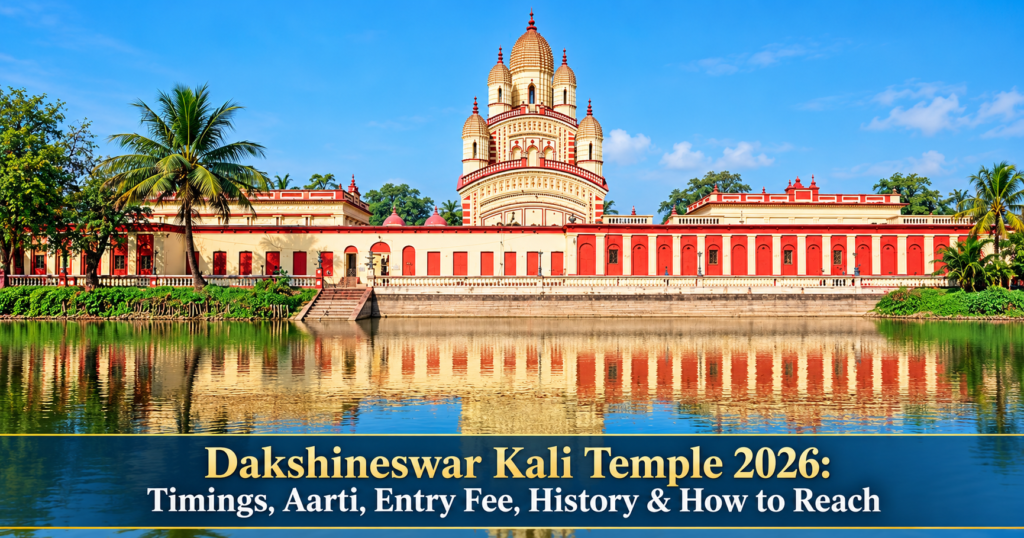
Dakshineswar Kali Temple in Kolkata is one of West Bengal’s most significant Kali temples and a major pilgrimage site closely associated with Sri Ramakrishna Paramahansa and Sarada Devi. Located on the eastern bank of the Hooghly River, the temple is dedicated to Maa Bhavatarini, a form of Goddess Kali worshipped as the divine mother who helps devotees overcome the difficulties of worldly life.
Unlike a quick city-temple visit, Dakshineswar Kali Temple is a large historic complex with several important places to see beyond the main shrine. Visitors can explore the twelve Shiva temples, Radha-Krishna temple, Nat Mandir, Sri Ramakrishna’s room, Panchavati, Nahabat, and the temple ghats, so it is worth keeping enough time for both darshan and the surrounding complex.
For 2026, one practical detail matters more than anything else: Dakshineswar Kali Temple does not remain open continuously throughout the day. Regular darshan is generally available in two sessions:
6:00 AM–12:30 PM and 3:30 PM–7:30 PM
There is no regular temple entry fee, but visitors arriving during the afternoon closure may have to wait until the temple reopens.
This guide explains Dakshineswar Kali Temple timings, entry fee, aarti planning, best time for darshan, Maa Bhavatarini, Sri Ramakrishna’s connection, the twelve Shiva temples, important places inside the complex, and the easiest ways to reach Dakshineswar in 2026.
☷On this pageJump to a section of this temple guide
Dakshineswar Kali Temple Timings 2026
Dakshineswar Kali Temple follows two separate darshan sessions each day, with a long afternoon closure in between. This is one of the most important things to check before planning your visit.
| Dakshineswar Temple Schedule | Timing |
|---|---|
| Morning Darshan | 6:00 AM–12:30 PM |
| Afternoon Closure | 12:30 PM–3:30 PM |
| Evening Darshan | 3:30 PM–7:30 PM |
| Entry Fee | Free |
| Open Days | Daily |
The key planning point is simple:
Avoid arriving between 12:30 PM and 3:30 PM if your main purpose is Maa Bhavatarini darshan.
That three-hour afternoon break can disrupt a tightly planned Kolkata itinerary, especially if you are combining Dakshineswar with Belur Math, central Kolkata, or other sightseeing.
For a more comfortable visit, try to reach:
- Before 11:00 AM if you want darshan plus enough time to explore the wider temple complex.
- After 3:30 PM if you prefer the evening atmosphere and want to stay closer to the evening worship period.
Dakshineswar Kali Temple Entry Fee
Entry to Dakshineswar Kali Temple is free.
There is no compulsory general darshan ticket for entering the temple complex and taking darshan of Maa Bhavatarini.
Visitors may choose to spend separately on:
- Flowers
- Prasad
- Puja offerings
- Donations
- Transport
- Parking
- Other personal travel expenses
These are optional costs and should not be confused with a temple-entry fee.
Is There VIP Darshan at Dakshineswar Kali Temple?
There is no clearly established fixed Dakshineswar Kali Temple VIP darshan ticket price or standard online priority-booking system in the information available for this guide.
So visitors should not assume that a paid ₹100, ₹200, or ₹500 fast-track ticket exists simply because similar systems operate at other major temples.
For a regular visit, plan around the free darshan queue and official temple timings unless the temple introduces a special arrangement for a festival or high-crowd day.
Best Time to Visit Dakshineswar Kali Temple for Darshan
The best time to visit Dakshineswar Kali Temple depends on whether your priority is shorter queues, easier movement, or a stronger devotional atmosphere.
Early Morning: Best for a Peaceful Visit
A particularly convenient window is:
6:00 AM–8:00 AM
Early morning is usually better for visitors who want:
- A calmer darshan experience
- More comfortable movement inside the complex
- Extra time to explore the temple grounds
- A less rushed visit before the morning session ends
It also gives you time to see important places such as:
- Twelve Shiva temples
- Sri Ramakrishna’s room
- Panchavati
- Nahabat
- Radha-Krishna temple
- Hooghly riverfront and ghats
Evening: Best for Devotional Atmosphere
Dakshineswar reopens around 3:30 PM, and the temple gradually becomes more atmospheric as evening worship approaches.
If you want to experience the temple during the evening period, arrive well before closing rather than reaching close to 7:30 PM.
This gives you time for both darshan and movement through the wider complex without feeling rushed.
Tuesday and Saturday Crowds
Tuesday and Saturday are important days for Kali worship and may attract more devotees.
Choose these days if religious significance and temple atmosphere matter more to you.
If your priority is shorter queues and easier exploration, an ordinary weekday morning is generally the better choice.
Dakshineswar Kali Temple Aarti: Best Way to Plan Your Visit
Aarti at Dakshineswar Kali Temple is one of the most devotional parts of the visit, especially during the evening session.
Because a reliable minute-by-minute 2026 aarti timetable is not clearly established in the material available for this guide, it is better to plan around the temple’s broader evening worship period rather than depend on an exact fixed time.
For most visitors, a practical evening plan is:
Reach between 4:30 PM and 6:00 PM → complete Maa Bhavatarini darshan → remain inside the complex for the evening worship period.
Arriving earlier gives you enough time for:
- Main temple darshan
- Movement through the courtyard
- Visiting nearby shrines
- Finding a suitable place before evening worship
- Managing heavier crowd flow on Tuesdays, Saturdays, and festival days
If Sandhya Aarti at Dakshineswar is your main reason for visiting, avoid reaching close to the 7:30 PM closing time.
Maa Bhavatarini: The Presiding Deity of Dakshineswar
The main deity of Dakshineswar Kali Temple is Maa Bhavatarini, a form of Goddess Kali.
The name Bhavatarini is traditionally understood as “She who carries devotees across Bhava Sagara,” the symbolic ocean of worldly suffering and existence.
Inside the main sanctum, Maa Bhavatarini is depicted standing upon the reclining form of Lord Shiva. The shrine is also known for the image being placed upon a thousand-petalled silver lotus, one of the temple’s most distinctive visual elements.
This identity is central to Dakshineswar. Devotees do not visit simply for a generic Kali darshan; they specifically worship Maa Bhavatarini of Dakshineswar.
History of Dakshineswar Kali Temple
Rani Rashmoni and the Foundation of the Temple
The present Dakshineswar Kali Temple was founded by Rani Rashmoni, one of 19th-century Bengal’s best-known philanthropists and devotees.
According to temple tradition, Rani Rashmoni had planned a pilgrimage to Varanasi but received a divine instruction in a dream to establish a temple on the banks of the Ganga instead.
The devotional story forms part of the temple’s religious tradition, while the historical foundation of the present complex is firmly associated with Rani Rashmoni.
The temple was inaugurated in 1855, with the installation of the deities associated with 31 May 1855, on Snana Yatra.
This distinction is useful for visitors:
Dakshineswar’s present temple complex is a 19th-century foundation, while the religious traditions surrounding Kali worship are much older.
Why Dakshineswar Is Closely Associated With Sri Ramakrishna
Dakshineswar became one of the most important spiritual centres of modern Bengal because of its association with Sri Ramakrishna Paramahansa.
His elder brother, Ramkumar Chattopadhyay, initially served as a priest at the temple. After Ramkumar’s death, Sri Ramakrishna became increasingly involved in the worship of Maa Kali and eventually became inseparable from the spiritual identity of Dakshineswar.
His intense spiritual practices attracted seekers, disciples, and intellectuals, and the temple later became closely connected with the wider Ramakrishna-Vivekananda tradition.
For this reason, a complete Dakshineswar visit is not only about the main Kali shrine. Several locations inside the complex preserve direct associations with Sri Ramakrishna and Sarada Devi.
Dakshineswar Temple Architecture and Main Shrines
The Nine-Spired Maa Bhavatarini Temple
The main temple is built in the traditional Bengal Nava-Ratna, or nine-spired, architectural style.
Its nine towers make the shrine instantly recognizable and form one of the most iconic temple silhouettes in Kolkata.
The structure stands at the centre of a much larger sacred complex, which is why visitors should keep more time than they would for a single-shrine city temple.
The Twelve Shiva Temples
One of the most distinctive features of Dakshineswar is the row of twelve Shiva temples near the riverfront.
These smaller shrines follow the traditional Bengal Aat-Chala style, and each contains a Shiva Lingam.
For pilgrims, the twelve Shiva temples are an important part of the religious circuit inside Dakshineswar—not simply an architectural feature to pass on the way out.
Radha Kanta Temple
The complex also includes the Radha Kanta Temple, dedicated to Radha and Krishna.
Its presence shows that Dakshineswar was conceived as a broader sacred complex bringing together several Hindu devotional traditions:
- Shakti worship
- Shaiva worship
- Vaishnava worship
This combination is one reason the site feels much larger in religious scope than a single Kali shrine.
Nat Mandir
The large Nat Mandir stands directly in front of the main Maa Bhavatarini temple.
Historically, it has been associated with:
- Devotional music
- Religious gatherings
- Spiritual discourse
- Ceremonial worship
Its position between the main courtyard and principal shrine makes it one of the most important architectural spaces in the temple complex.
Places Connected With Sri Ramakrishna and Sarada Devi
Sri Ramakrishna’s Room
The room where Sri Ramakrishna lived for many years is one of the most historically significant places inside Dakshineswar.
He is described as having lived there for approximately 14 years after moving from Kuthi Bari, and objects associated with his life have traditionally been preserved in the room.
For visitors interested in Sri Ramakrishna, Swami Vivekananda, or the Ramakrishna movement, this room deserves almost as much attention as the main Kali shrine.
Panchavati
Panchavati is another essential stop for visitors interested in Sri Ramakrishna’s spiritual life.
The site is traditionally associated with five sacred trees:
- Banyan
- Peepal
- Neem
- Amla
- Bel
Panchavati became closely associated with Sri Ramakrishna’s meditation and sadhana.
Visitors who complete only the main darshan and immediately leave often miss one of the most meaningful spiritual locations in the entire complex.
Nahabat and Sarada Devi
The Nahabat originally served a musical function within the temple complex.
Its greater significance today comes from its connection with Sri Sarada Devi, who lived in its lower portion during her time at Dakshineswar.
For visitors following the history of Sri Ramakrishna and Sarada Maa, the most meaningful sequence is:
Sri Ramakrishna’s Room → Panchavati → Nahabat
Together, these places provide a much deeper understanding of Dakshineswar’s role in modern Indian spiritual history.
Dakshineswar Ganga Ghats and Riverfront
Dakshineswar’s location beside the Hooghly River is an important part of the temple experience.
The ghats and riverside areas are historically connected with Sri Ramakrishna, Sarada Devi, and the wider devotional life of the temple.
If you visit during the early morning or late afternoon, keep some time for the riverfront instead of leaving immediately after darshan.
The riverside setting also gives visitors a better sense of the scale of the entire Dakshineswar complex.
How Much Time Should You Keep for Dakshineswar Kali Temple?
A complete Dakshineswar visit requires more time than simply entering the main shrine and taking darshan.
For a visit covering the major areas, keep approximately:
1.5–2 hours or more
A good sequence is:
Maa Bhavatarini Darshan → Twelve Shiva Temples → Radha Kanta Temple → Sri Ramakrishna’s Room → Panchavati → Nahabat → Ganga Ghats
If you are visiting during Tuesday, Saturday, Kali Puja, festival periods, or evening aarti, keep additional time for queues and crowd movement.
For pilgrims interested in Sri Ramakrishna and Sarada Devi, rushing through the complex in 30 minutes would mean missing much of what makes Dakshineswar historically and spiritually important.
How Much Time Do You Need at Dakshineswar Kali Temple?
The time needed at Dakshineswar Kali Temple depends on whether you want only Maa Bhavatarini darshan or a proper visit through the full temple complex.
For only the main Kali darshan, 45–60 minutes may be enough on a normal, manageable day.
For a more complete visit, keep at least 1.5–2 hours.
If you want to explore the temple slowly and include:
- Twelve Shiva temples
- Radha-Krishna Temple
- Sri Ramakrishna’s room
- Panchavati
- Nahabat
- Ganga ghats
then 2–3 hours is a much more comfortable estimate.
Crowds on Tuesday, Saturday, Kali Puja, weekends, and major festivals can increase the total visit time substantially.
Dakshineswar Kali Temple Dress Code
There is no clearly stated strict compulsory Dakshineswar Temple dress code in the material used for this guide.
For a major active Hindu temple, the safest approach is to wear modest and comfortable clothing.
Suitable choices include:
For men: kurta-pyjama, dhoti-kurta, or a shirt with full-length trousers.
For women: saree, salwar-kameez, kurta with full-length bottoms, or other modest clothing.
Comfort is important because visiting the full complex involves much more walking than simply joining the Maa Bhavatarini darshan queue.
Photography, Bags and Belongings
Do not assume photography is permitted everywhere inside Dakshineswar Kali Temple.
Open courtyards, historic areas, and ritual spaces may follow different rules, while photography can be restricted near the main sanctum and active worship areas.
Follow the instructions displayed inside the temple complex.
For a smoother visit:
- Carry minimal belongings
- Avoid large bags on crowded days
- Keep valuables secure
- Follow on-site photography rules
- Avoid bringing unnecessary luggage into the complex
This becomes especially useful during Tuesday, Saturday, Kali Puja, and festival crowds.
How to Reach Dakshineswar Kali Temple
Dakshineswar Kali Temple is located north of central Kolkata on the eastern bank of the Hooghly River, and its urban location makes it relatively easy to reach by rail and road.
By Local Train
Dakshineswar Railway Station is one of the practical options for reaching the temple.
Visitors using suburban rail services can get close to the temple and complete the remaining distance on foot or by short local transport, depending on the route used.
From Central Kolkata
Visitors can reach Dakshineswar by:
- Taxi
- App-based cab
- Local transport
- Rail connections
Traffic conditions can change travel time significantly, so avoid planning around one fixed road estimate.
From Howrah
From Howrah, visitors can continue by road or use Kolkata’s wider public transport network.
Dakshineswar is roughly 19 km from Howrah according to the supplied travel information, but actual road distance and journey time depend on the chosen route and traffic.
From Kolkata Airport
Dakshineswar is comparatively convenient for visitors arriving from the northern side of Kolkata.
Under favourable traffic conditions, road travel may take around 30–40 minutes, but congestion can increase this considerably.
If you are travelling onward to catch a flight, keep a wider buffer rather than relying only on map time.
Dakshineswar Kali Temple and Belur Math in One Trip
One of the best combinations for a religious visit in Kolkata is:
Dakshineswar Kali Temple + Belur Math
The connection is much deeper than simple geography.
Both places are closely linked with the spiritual legacy of:
- Sri Ramakrishna
- Sarada Devi
- Swami Vivekananda
- The Ramakrishna movement
If you have half a day available, visiting both places gives far more context than treating Dakshineswar as only another Kolkata sightseeing stop.
Avoid building an overly tight itinerary, because temple timings, traffic, transport connections, and crowd levels can all affect the schedule.
When Is Dakshineswar Kali Temple Most Crowded?
Dakshineswar gets significantly busier on important Kali worship days, weekends, and major religious occasions.
Expect heavier crowds on:
- Tuesdays
- Saturdays
- Kali Puja
- Major Devi festivals
- Public holidays
- Weekends
- Important Sri Ramakrishna-related observances
Festival visits can offer a much stronger devotional atmosphere, but they are not ideal for visitors whose main priority is shorter queues and easier movement through the temple complex.
For a calmer visit, an ordinary weekday morning between roughly 6:00 AM and 8:00 AM remains one of the better choices.
Common Mistakes to Avoid at Dakshineswar Kali Temple
A smoother visit to Dakshineswar Kali Temple depends less on complicated planning and more on avoiding a few common mistakes.
Arriving during the afternoon closure.
The temple remains closed for darshan for roughly 12:30 PM–3:30 PM, so reaching during this window can leave you waiting for several hours.
Leaving immediately after Maa Bhavatarini darshan.
The main Kali shrine is only one part of Dakshineswar. The twelve Shiva temples, Sri Ramakrishna’s room, Panchavati, Nahabat, Radha Kanta Temple, and riverfront ghats are equally important to the complete experience.
Keeping only 30 minutes for the visit.
That may be enough for a rushed darshan on a manageable day, but not for exploring the temple complex properly. Keep 1.5–2 hours, and longer if you want a slower pilgrimage.
Expecting a paid VIP darshan ticket.
Regular entry is free, and there is no clearly established permanent VIP darshan booking system in the material used for this guide.
Choosing Tuesday or Saturday for lower crowds.
These are important days for Kali worship and can attract more devotees, not fewer.
Dakshineswar Kali Temple FAQs 2026
What are Dakshineswar Kali Temple timings?
The regular darshan schedule is:
6:00 AM–12:30 PM
and
3:30 PM–7:30 PM
Is Dakshineswar Kali Temple closed in the afternoon?
Yes. The temple has an afternoon break from approximately 12:30 PM to 3:30 PM.
What is the Dakshineswar Kali Temple entry fee?
Entry is free. There is no compulsory general darshan ticket.
Is Dakshineswar Kali Temple open every day?
Yes. The regular schedule is listed for all seven days of the week.
Which goddess is worshipped at Dakshineswar?
The main deity is Maa Bhavatarini, a form of Goddess Kali.
Who built Dakshineswar Kali Temple?
The present temple complex was founded by Rani Rashmoni and inaugurated in 1855.
Why is Dakshineswar important in the life of Sri Ramakrishna?
Sri Ramakrishna Paramahansa lived and practised intense spiritual disciplines at Dakshineswar for many years, making the temple central to his life and teachings.
Are there Shiva temples inside Dakshineswar?
Yes. The complex has twelve Shiva temples arranged in a row near the riverfront.
Is there a Radha-Krishna temple at Dakshineswar?
Yes. The complex includes the Radha Kanta Temple, dedicated to Radha and Krishna.
What is the best time to visit Dakshineswar Kali Temple?
For a calmer visit, an ordinary weekday morning between about 6:00 AM and 8:00 AM is one of the better choices.
Is Tuesday a good day to visit Dakshineswar?
Yes for devotional significance, but it may also be busier because Tuesday is an important day for Kali worship.
Is Saturday crowded at Dakshineswar?
It can be. Saturday is another important day for Kali devotees and may attract heavier footfall.
Is there VIP darshan at Dakshineswar Kali Temple?
There is no clearly established permanent official VIP darshan ticket in the material used for this guide. Regular darshan is free.
How much time should I spend at Dakshineswar?
Keep around 1.5–2 hours for a meaningful visit. If you want to explore the entire complex, including Ramakrishna-related places and the riverfront, 2–3 hours is more comfortable.
Which railway station is nearest to Dakshineswar Kali Temple?
Dakshineswar Railway Station is the most convenient local rail option for the temple area.
Is Dakshineswar near Kolkata Airport?
Yes. Dakshineswar is on the northern side of Kolkata and is comparatively convenient from the airport, although actual travel time depends on traffic.
Can Dakshineswar and Belur Math be visited on the same day?
Yes. Dakshineswar Kali Temple and Belur Math are commonly combined because they are geographically close and deeply connected through Sri Ramakrishna, Sarada Devi, Swami Vivekananda, and the Ramakrishna tradition.
Make Time for the Full Dakshineswar Experience
A first visit to Dakshineswar should not be planned as only a quick Maa Kali darshan.
Maa Bhavatarini is the spiritual centre of the temple, but the wider identity of Dakshineswar comes from the twelve Shiva temples, Radha Kanta Temple, Bengal-style architecture, Hooghly riverfront, Sri Ramakrishna’s room, Panchavati, and Nahabat.
For the best first visit, arrive during the morning darshan session, complete Maa Bhavatarini darshan first, and then explore the wider complex before the 12:30 PM afternoon closure.
That approach gives you a much better understanding of why Dakshineswar Kali Temple is not just one of Kolkata’s famous temples, but one of the most important religious and spiritual sites in modern Bengal.