
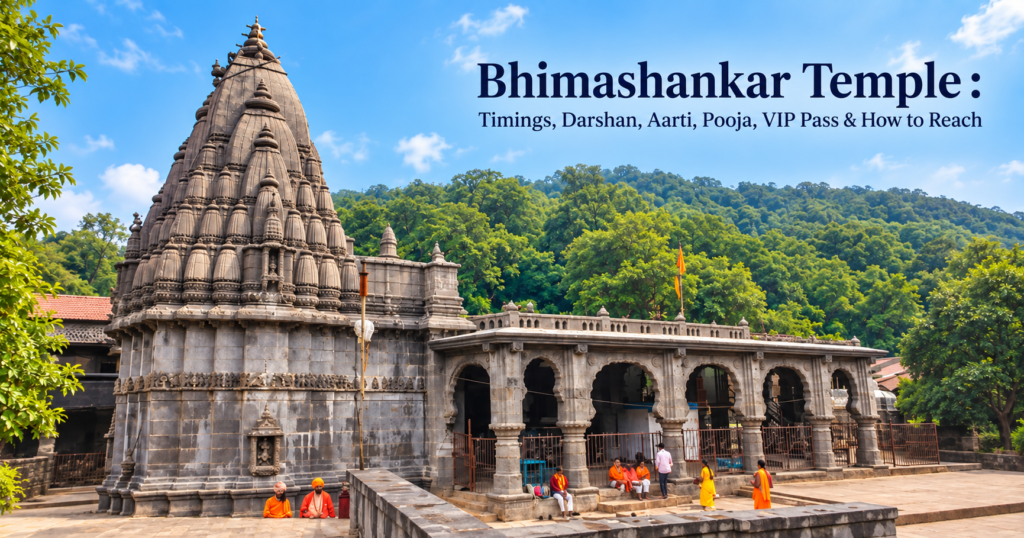
Bhimashankar Temple is one of the twelve sacred Jyotirlingas of Lord Shiva and one of Maharashtra’s most important pilgrimage destinations. Located in the Sahyadri hills of Pune district, the temple is surrounded by the forested landscape of the Bhimashankar Wildlife Sanctuary and is closely associated with the origin of the Bhima River.
The temple is known not only for its Jyotirlinga significance, but also for its old stone architecture, hill setting, and strong pilgrimage atmosphere, especially during Shravan and Mahashivratri.
A visit to Bhimashankar requires a little more planning than a typical city temple because devotees need to consider the hilly road journey, walking near the temple, weather conditions, and crowd levels.
This guide covers Bhimashankar Temple timings 2026, opening and closing time, darshan and aarti schedule, Abhishek, special darshan options, Shravan and Mahashivratri crowds, dress code, travel from Pune and Mumbai, and the best time to visit Bhimashankar.
Bhimashankar Temple 2026: Quick Information
Bhimashankar Jyotirlinga is both a major Shiva pilgrimage centre and a hill destination in the Sahyadris, so visitors should plan not only for darshan but also for the road journey, weather, walking near the temple, and seasonal crowd levels.
| Bhimashankar Temple Detail | 2026 Information |
|---|---|
| Temple | Shri Bhimashankar Jyotirlinga Temple |
| Location | Sahyadri Hills, Pune District, Maharashtra |
| Presiding Deity | Lord Shiva |
| Religious Importance | One of the 12 Jyotirlingas |
| Temple Opening | Early morning, around 4:30 AM |
| Kakad Aarti | Around 4:30 AM |
| Main Abhishek Period | Morning |
| Madhyan Aarti | Afternoon |
| Evening Aarti | Around 7:30 PM |
| Temple Closing | Around 9:30 PM |
| General Darshan | Free |
| Major Festivals | Mahashivratri and Shravan |
| Best Weather | October–February |
| Nearest Major Airport | Pune International Airport |
| Pune to Bhimashankar | Around 125 km |
| Mumbai to Bhimashankar | Around 220–223 km |
| Surroundings | Bhimashankar Wildlife Sanctuary / Sahyadri forest region |
Maharashtra Tourism currently describes Bhimashankar as one of the twelve Jyotirlingas, located amid the Sahyadri hills, and recommends October to February for cooler and more comfortable travel conditions. It also places the temple at roughly 125 km from Pune and 223 km from Mumbai.
For a first visit, an early-morning arrival is usually the most practical choice because it gives more time for darshan, avoids part of the daytime road traffic and heat, and leaves enough flexibility to explore the surrounding Bhimashankar area afterward.
Questions about special/VIP darshan, exact waiting time, and any paid queue facility are better checked separately, because those arrangements can change and should not be treated as a permanent fixed-price feature of the temple.
Bhimashankar Temple Timings 2026
Bhimashankar Jyotirlinga Temple follows an early-morning-to-night worship schedule, with darshan continuing around important poojas, Abhishek periods and aartis.
A commonly followed regular schedule is:
| Bhimashankar Temple Schedule | Approximate Time |
|---|---|
| Temple Opens / Kakad Aarti | Around 4:30 AM |
| Nijaroop Darshan | Around 5:00 AM |
| Morning Abhishek & Pooja | From around 5:30 AM |
| Morning Darshan | Early morning onward |
| Naivedya Pooja | Around 12:00 PM |
| Afternoon Abhishek | Around 12:30 PM |
| Madhyan Aarti | Around 3:00 PM |
| Shringar Darshan | From around 4:00 PM |
| Evening Aarti | Around 7:30 PM |
| Temple Closing | Around 9:30 PM |
The ritual sequence can change on Mondays, Shravan Somvar, Mahashivratri and other high-footfall religious dates, so devotees travelling specifically for an Aarti or Abhishek should confirm the current temple arrangement before relying on an exact minute.
Bhimashankar Temple Opening Time
The regular temple day begins very early, with Kakad Aarti around 4:30 AM followed by Nijaroop Darshan and morning Abhishek.
For pilgrims staying near Bhimashankar, this early period is particularly useful because it combines Jyotirlinga darshan with cooler Sahyadri weather before daytime visitor traffic increases.
Bhimashankar Temple Closing Time
The regular worship schedule continues into the evening, with Evening Aarti around 7:30 PM and the temple generally closing around 9:30 PM.
Devotees travelling back to Pune or another distant city on the same day should avoid planning their journey around the final closing time. The Bhimashankar approach involves long hill-road sections, making an earlier return more comfortable, especially during monsoon or poor visibility.
Best Morning Time for Bhimashankar Darshan
For most pilgrims, early morning after the temple opens through roughly 8:00 AM is one of the most practical periods.
It gives visitors the advantage of:
- Cooler weather in the Sahyadri hills
- Access to the morning worship period
- More time for the temple visit before daytime crowds build
- Greater daylight for the return road journey
However, Shravan Mondays and Mahashivratri are exceptions. Even very early arrival can involve substantial queues during these periods.
Evening Darshan
Evening darshan resumes around the later ritual sequence, including Shringar and Evening Aarti.
This period is more practical for pilgrims staying overnight in or near Bhimashankar than for visitors making a same-day Pune trip.
Because Bhimashankar lies within a forested hill region rather than a city centre, darshan timing and return-road timing should be planned together.
Bhimashankar Aarti and Pooja Timings
Bhimashankar Jyotirlinga Temple follows a daily sequence of Shiva worship that includes Kakad Aarti, Nijaroop Darshan, Abhishek, Naivedya, Madhyan Aarti, Shringar and evening worship.
| Bhimashankar Aarti / Pooja | Approximate Timing |
|---|---|
| Kakad Aarti | Around 4:30 AM |
| Nijaroop Darshan | Around 5:00 AM |
| Morning Abhishek | From around 5:30 AM |
| Naivedya Pooja | Around 12:00 PM |
| Afternoon Abhishek | Around 12:30 PM |
| Madhyan Aarti | Around 3:00 PM |
| Shringar Darshan | From around 4:00 PM |
| Evening Aarti | Around 7:30 PM |
These timings are best used as planning references rather than guaranteed minute-by-minute starts, particularly on Shravan Mondays, Mahashivratri and other high-crowd religious dates.
Maharashtra Tourism confirms that Bhimashankar remains an active Jyotirlinga pilgrimage centre with important daily worship and especially heavy devotional activity during Mahashivratri and Shravan.
Kakad Aarti and Nijaroop Darshan
The temple day begins with Kakad Aarti around 4:30 AM, followed by Nijaroop Darshan around 5:00 AM.
This early period is especially relevant to devotees staying near Bhimashankar who want to experience the temple before the larger daytime pilgrimage flow begins.
Bhimashankar Abhishek Timings
The main morning Abhishek worship begins from around 5:30 AM, with another Abhishek period around midday.
Devotees wanting to book or participate in a specific priest-led Abhishek should check the current temple counter arrangement and applicable pooja rules. General darshan does not automatically mean a personal Abhishek is included.
Naivedya and Madhyan Aarti
Around midday, worship includes Naivedya Pooja, followed later by Madhyan Aarti.
Darshan movement may slow or be temporarily regulated around important ritual periods, so visitors should keep some flexibility rather than planning an extremely tight departure.
Evening Aarti and Shringar Darshan
The later worship sequence includes Shringar Darshan followed by evening Aarti around 7:30 PM.
Evening worship is particularly practical for pilgrims staying overnight in Bhimashankar. Same-day visitors returning to Pune should also account for the long Sahyadri hill-road journey after dark.
Is Bhimashankar Darshan Free?
Yes. General darshan of Bhimashankar Jyotirlinga is free, and pilgrims do not need to purchase a compulsory paid ticket simply to have darshan of Lord Shiva.
Free darshan is particularly practical on:
- Ordinary non-festival weekdays
- Early-morning visits
- Days when the pilgrim has a flexible schedule
During Shravan, especially Shravan Mondays, and Mahashivratri, free-darshan queues can become much heavier because Bhimashankar is one of Maharashtra’s major Shiva pilgrimage centres.
Any special or paid queue arrangement should be checked separately for the actual visit date rather than assuming that an old VIP-pass price or waiting-time claim remains permanently valid.
Bhimashankar VIP Darshan Pass 2026
General darshan at Bhimashankar Jyotirlinga is free. A permanent year-round VIP or fast-darshan ticket with a fixed ₹50 or ₹100 price should not be assumed unless the temple administration is actively offering that facility on the date of your visit.
Older travel pages sometimes mention low-cost VIP passes or claim darshan can always be completed within 15–30 minutes. These figures are not reliable enough to use as a fixed Bhimashankar Temple 2026 darshan rule.
Is Special Darshan Available at Bhimashankar?
Special or priority-entry arrangements can depend on the temple administration, crowd level, festival period and local queue system in operation.
If such a facility is available when you visit, confirm:
- The official ticket price
- Where the pass is issued
- Which queue or entry route it uses
- Whether any ID or other requirement applies
Purchase the pass only through an authorised temple counter or official booking facility.
Is There an Online Bhimashankar VIP Darshan Booking?
I would not describe Bhimashankar as having a guaranteed permanent online VIP-booking system unless a current official temple service clearly confirms it.
If an online special-darshan facility is introduced or active, use only the link provided by the temple administration or another verified government/Devasthan source.
Avoid third-party websites promising guaranteed instant Jyotirlinga darshan or selling an unofficial “VIP ticket.”
How to Check Special Darshan After Reaching Bhimashankar
If you arrive on a crowded day and want a faster queue option:
- Go to the official temple enquiry or authorised ticket area.
- Ask whether special darshan is operating that day.
- Confirm the current charge and conditions.
- Purchase only from the authorised counter.
- Keep the issued receipt or pass.
- Follow the designated queue instructions.
This is particularly relevant on weekends, Shravan Mondays, Mahashivratri and public holidays, when the normal darshan queue can become much heavier.
Does Special Darshan Guarantee a 15–30 Minute Wait?
No fixed waiting time should be promised.
Even if a separate priority queue is available, actual darshan time can still depend on:
- Crowd levels
- Security checks
- Temple rituals
- Queue merging
- Festival arrangements
- Temporary crowd-control measures
So special darshan should be understood as a priority or separate queue arrangement when offered, not a guaranteed instant-darshan service.
Bhimashankar Darshan Waiting Time
Bhimashankar darshan waiting time can vary significantly depending on the weekday, festival season, weather and the number of pilgrims reaching the Sahyadri temple complex.
| Visit Period | Expected Crowd |
|---|---|
| Ordinary weekday, early morning | Low to Moderate |
| Ordinary weekday, later morning | Moderate |
| Weekend | High |
| Monday | High |
| Shravan Monday | Extremely High |
| Mahashivratri | Extremely High |
| Public holiday / long weekend | High |
Rather than relying on claims such as “40-minute darshan” or “exactly two hours,” pilgrims should keep a flexible buffer because queue conditions can change quickly.
How Much Time Should You Keep on a Regular Weekday?
On a normal weekday outside Shravan and major festivals, keeping around 1–2 hours as a planning allowance for darshan is reasonable.
Actual queue time may be shorter or longer depending on when you arrive and whether a pooja, Abhishek or crowd-control pause affects movement.
For the easiest experience, early morning is usually preferable to arriving later in the day.
Weekend and Monday Crowd
Saturday and Sunday attract both pilgrims and visitors coming to the Bhimashankar hills and wildlife-sanctuary region, so crowd levels can increase noticeably by late morning.
Monday is also important for Lord Shiva worship, which can bring additional devotees even outside Shravan.
If your only priority is a quieter Jyotirlinga darshan, a non-festival weekday morning is usually a better choice than Monday or the weekend.
Bhimashankar During Shravan
Shravan is one of the busiest pilgrimage periods at Bhimashankar, and Mondays are particularly important for Shiva devotees. Maharashtra Tourism notes that thousands of pilgrims visit during this auspicious month.
A Shravan visit needs planning for both crowd and weather, because the holy month usually overlaps with the monsoon in the Sahyadris.
Expect:
- Heavy darshan queues
- Longer vehicle approach times
- Busy parking areas
- Wet and slippery walking surfaces
- Rain and reduced visibility on the hill road
- More time needed for the entire temple visit
For a Shravan Monday, keep several hours flexible rather than scheduling another distant temple immediately afterward.
Is Shravan a Good Time to Visit Bhimashankar?
Choose Shravan if you specifically want the religious atmosphere of Shiva worship during the holy month.
Choose a non-Shravan weekday if your priority is:
- Easier darshan
- Less road traffic
- More predictable travel
- A quieter temple experience
Because Bhimashankar is located within the forested Sahyadri region, monsoon conditions are part of the visit itself rather than just a minor weather consideration. Maharashtra Tourism highlights the dense forest, waterfalls and monsoon landscape surrounding the temple.
Mahashivratri at Bhimashankar Temple
Mahashivratri is the most important annual festival at Bhimashankar Temple. Maharashtra Tourism identifies it as the shrine’s biggest festival, with large numbers of devotees gathering for night-long worship, prayers and Shiva rituals.
Visitors should expect a very different experience from an ordinary weekday visit.
During Mahashivratri, there can be:
- Very long darshan queues
- Night-time devotional activity
- Special poojas and Abhishek
- Heavy traffic on the Bhimashankar approach road
- Crowded parking and transport
- Temporary police and traffic-management measures
- Greater demand for nearby accommodation
A Mahashivratri visit should be planned for the festival experience, not for quick Jyotirlinga darshan.
How Early Should You Reach During Mahashivratri?
There is no single arrival time that guarantees a short queue during the festival.
If Mahashivratri is the main purpose of your trip, it is better to reach Bhimashankar with a large time buffer or stay nearby rather than depend on a tightly timed same-day Pune return.
For current festival arrangements, traffic advisories and any special darshan instructions, pilgrims should check the official Maharashtra Tourism Bhimashankar page along with local administration updates closer to the visit date.
The key planning difference is:
Regular weekday → plan in hours
Shravan Monday / Mahashivratri → plan the entire visit around crowd, road and weather conditions
Bhimashankar Temple Dress Code
There is no need for elaborate ceremonial clothing for ordinary Bhimashankar Jyotirlinga darshan. Comfortable, modest clothing suitable for a Shiva temple is the practical choice.
At Bhimashankar, footwear deserves more attention than a long dress-code checklist. The temple lies in the Sahyadri hill and forest region, and during the monsoon the approach paths and steps can become wet or slippery.
Wear footwear with good grip for the approach journey and remove it at the designated point before entering the sacred temple area.
Mobile Phones, Photography and Bags
Photography can be restricted inside or close to the temple’s sacred areas. Maharashtra Tourism specifically advises visitors to check the applicable photography restrictions before taking pictures inside Bhimashankar Temple.
Carry only essential belongings, particularly during Shravan, Mahashivratri and crowded weekends, when queue movement and security checks are easier with minimal luggage.
Can Devotees Touch the Bhimashankar Jyotirlinga?
Access close to the Bhimashankar Jyotirlinga can depend on the temple’s current ritual and crowd-management arrangement.
Devotees should not assume that every general-darshan visitor will automatically be allowed to touch the Jyotirlinga or personally perform Abhishek.
During high-footfall periods such as Shravan Mondays and Mahashivratri, sanctum access can be more tightly regulated.
If performing Abhishek is important to your visit, confirm the current authorised pooja procedure at the temple rather than relying on older descriptions of direct access.
Why Is Bhimashankar Jyotirlinga Famous?
Bhimashankar is distinctive because its religious importance is closely connected with the surrounding Sahyadri landscape.
The pilgrimage site is known for:
- Being one of the 12 Jyotirlingas of Lord Shiva
- Its traditional association with a Swayambhu Shiva form
- Its connection with the source region of the Bhima River
- Historic Nagara-style temple architecture
- The surrounding Bhimashankar Wildlife Sanctuary
- Major Shiva pilgrimage during Shravan and Mahashivratri
Maharashtra Tourism describes the shrine as a Jyotirlinga temple with Nagara-style architecture, surrounded by the forests and biodiversity of Bhimashankar Wildlife Sanctuary.
Bhimashankar Temple History
Bhimashankar Temple reflects more than one period of construction and restoration rather than a single building phase.
The Pune district administration describes the shrine as an important example of temple architecture and notes that Nana Phadnavis constructed the Sabhamandap and Shikhara during the 18th century.
This later Maratha-period work forms part of the temple visitors see today alongside its older architectural character.
Nana Phadnavis and Bhimashankar Temple
Nana Phadnavis, one of the important statesmen of the Maratha period, is closely associated with later development at Bhimashankar.
His contribution to the Sabhamandap and Shikhara gives the temple an important connection with 18th-century Maratha history in addition to its much older religious significance.
Legend of Bhimashankar Jyotirlinga
Several religious traditions explain the sacred origin of Bhimashankar.
One well-known account connects the Jyotirlinga with the demon Bhima, traditionally associated with Kumbhakarna. According to the legend, Bhima gained great power and oppressed devotees before Lord Shiva appeared and defeated him.
Another tradition connects Bhimashankar with Tripurasura. Maharashtra Tourism records the belief that Lord Shiva rested in this region after defeating Tripurasura.
These stories belong to Hindu religious tradition and should be understood as sacred narratives rather than documented historical events.
Bhimashankar and the Origin of the Bhima River
Bhimashankar is also closely associated with the source region of the Bhima River, one of the important rivers flowing from the Western Ghats.
Religious tradition links the river’s origin with Lord Shiva following his battle with Tripurasura. Maharashtra Tourism records the traditional belief that the Bhima River emerged from Shiva’s perspiration after the battle.
The river later becomes part of the wider Krishna River system, giving Bhimashankar a distinctive combination of Jyotirlinga pilgrimage and sacred river geography.
Bhimashankar Wildlife Sanctuary
Another feature that makes Bhimashankar unusual among India’s Jyotirlinga destinations is its location within the Bhimashankar Wildlife Sanctuary landscape of the Western Ghats.
The protected forest is known for dense Sahyadri vegetation, birdlife and the Indian giant squirrel, locally known as Shekru, which is Maharashtra’s state animal. Maharashtra Tourism specifically highlights the giant squirrel as one of the sanctuary’s best-known species.
This means a Bhimashankar trip passes through an ecologically sensitive area, not simply a road leading to a temple.
Visitors should therefore:
- Avoid littering or leaving plastic waste
- Never feed or disturb wild animals
- Keep noise low in forest stretches
- Follow sanctuary and local traffic instructions
- Avoid unnecessary roadside stopping in sensitive areas
For current destination and sanctuary information, visitors can use the official Maharashtra Tourism Bhimashankar page.
The combination of Jyotirlinga worship, the Bhima River source tradition, historic temple architecture and Western Ghats biodiversity is what gives Bhimashankar a pilgrimage identity that is difficult to separate from its natural setting.
Best Time to Visit Bhimashankar Temple
For most pilgrims, October to February is the best time to visit Bhimashankar Temple. Maharashtra Tourism recommends this period because the weather is cooler and more comfortable for darshan, road travel, walking and exploring the surrounding Sahyadri landscape.
| Visit Goal | Best Period |
|---|---|
| Comfortable Weather | October–February |
| Peaceful Darshan | Non-festival weekday morning |
| Mahashivratri Experience | Mahashivratri festival period |
| Shravan Worship | Shravan, especially Mondays |
| Green Sahyadri Scenery | Monsoon |
| Easier Road and Walking Conditions | Post-monsoon / winter |
| Family or Senior-Citizen Visit | Weekday in cooler months |
October to February
This is the easiest season for a first Bhimashankar Jyotirlinga visit because the monsoon has largely passed and the cooler weather makes the hill journey and temple approach more comfortable.
It is particularly suitable for families, senior citizens and visitors combining darshan with nearby religious or nature points.
March to May
Summer is warmer, so early-morning darshan is preferable if travelling during this period.
The forested hill setting can feel more comfortable than the surrounding plains, but visitors should still avoid building a long walking itinerary around the hottest part of the day.
June to September
The monsoon transforms Bhimashankar into a lush Western Ghats destination with mist, streams and waterfalls. Maharashtra Tourism specifically highlights the scenery during this season but also warns that trails can become slippery.
A monsoon visit can involve:
- Wet or slippery steps
- Fog and reduced visibility
- Slower driving on ghat roads
- Muddy or slippery trekking routes
- Sudden heavy rainfall
This is an excellent period for scenery, but not necessarily the easiest season for elderly pilgrims or visitors who want the simplest road-and-darshan experience.
How Long Is Needed for Bhimashankar Temple?
For the temple visit alone on a normal weekday, keeping roughly 1.5–2.5 hours as a planning allowance is sensible.
That time can include:
- Parking and final approach
- Walking or steps toward the shrine
- Darshan queue
- Jyotirlinga visit
- Returning to the vehicle area
This is not a fixed waiting-time promise. Shravan, Mondays, weekends and Mahashivratri can make the visit substantially longer.
If you also want to explore Gupt Bhimashankar or the surrounding sanctuary area, keep at least half a day.
How to Reach Bhimashankar Temple
Road travel is generally the most practical way to reach Bhimashankar Jyotirlinga, because the final journey passes through the winding roads of the Sahyadri hills.
Maharashtra Tourism places Bhimashankar approximately 125 km from Pune and 223 km from Mumbai.
Pune to Bhimashankar Temple
The Pune to Bhimashankar distance is about 125 km.
A commonly used road approach passes through the Pune–Manchar side before continuing toward the hills. Depending on traffic, weather and the starting point in Pune, travellers should generally allow several hours for the journey.
By Bus from Pune
State transport buses operate between Pune and Bhimashankar. Maharashtra Tourism specifically identifies state-run buses from Pune as one of the regular access options.
Because bus timings can change, check the current MSRTC schedule for your travel date rather than relying on a timetable copied into an old article.
By Cab or Private Car
A taxi or private vehicle is often the most convenient option for:
- Families
- Senior citizens
- Groups
- Early-morning darshan
- Same-day Pune return
During the monsoon, allow extra road time and use greater caution on the winding hill sections.
Mumbai to Bhimashankar Temple
Mumbai to Bhimashankar is about 223 km according to Maharashtra Tourism.
A same-day Mumbai–Bhimashankar–Mumbai trip is possible, but it creates a long day once road travel and darshan waiting time are combined.
For families or visitors travelling during a busy religious period, staying overnight near Bhimashankar or breaking the journey is more comfortable.
By Train
There is no railway station at Bhimashankar itself.
Maharashtra Tourism identifies Karjat Railway Station, around 65 km away, as the closest station.
However, the closest station is not always the most convenient option for a long-distance pilgrim. Pune Junction can be more practical because of its wider train connectivity and easier access to buses, taxis and private vehicles heading toward Bhimashankar.
So the practical distinction is:
Karjat → geographically closer
Pune → often easier for long-distance connectivity and onward road transport
By Air
Pune International Airport is the nearest major airport, approximately 125 km from Bhimashankar according to Maharashtra Tourism.
From Pune, continue to Bhimashankar by taxi, private vehicle or an appropriate bus connection.
Bhimashankar Trek from Khandas
Bhimashankar can also be reached by trekking from Khandas village, but this should be treated as a separate adventure itinerary rather than the normal pilgrim route.
Maharashtra Tourism identifies the Khandas approach and describes two well-known trekking options: the more demanding Shidi Ghat route and the comparatively gradual Ganesh Ghat route.
During monsoon, both require additional caution because rocks, streams and forest trails can become slippery.
Families, elderly devotees and visitors interested only in Jyotirlinga darshan should normally use the road approach instead of planning the trek.
Parking and Final Temple Approach
Reaching the Bhimashankar pilgrimage area by vehicle does not necessarily mean the temple entrance is directly beside the parking point.
Visitors should allow additional time for the final walking approach, steps and crowd movement, particularly on weekends, Shravan Mondays and festival dates.
This is especially important when travelling with elderly relatives: calculate the trip based on parking-to-darshan time, not just Pune-to-Bhimashankar driving time.
Places to Visit Near Bhimashankar Temple
The best nearby additions are places genuinely connected with Bhimashankar’s Shiva pilgrimage and Sahyadri forest setting.
Gupt Bhimashankar
Gupt Bhimashankar is a well-known religious and natural site within the surrounding forest.
Maharashtra Tourism describes it as a Shiva-linga-like natural formation beneath a waterfall, reached through a forest path involving streams and uneven terrain.
It is better suited to visitors who have extra time and are comfortable walking through natural terrain.
Bhimashankar Wildlife Sanctuary
The surrounding Bhimashankar Wildlife Sanctuary is integral to the destination rather than an unrelated attraction.
Visitors interested in nature can explore permitted areas while following forest regulations and avoiding disturbance to wildlife.
For current destination information, use the official Maharashtra Tourism Bhimashankar page.
Nagphani and Nearby Trekking Points
The Bhimashankar region has several viewpoints and trekking routes, including Nagphani-area trails.
These should be attempted only when current weather, visibility and trail conditions are suitable, especially during monsoon.
For most pilgrimage-focused visitors, Bhimashankar Temple + Gupt Bhimashankar + limited sanctuary exploration is a more realistic half-day plan than trying to cover every trekking point around the hills.
FAQs
What are Bhimashankar Temple timings in 2026?
The temple begins its early rituals around 4:30 AM and generally continues through the day until approximately 9:30 PM, with pooja and aarti periods affecting darshan.
What time does Bhimashankar Temple open?
The temple generally opens around 4:30 AM.
What time does Bhimashankar Temple close?
The temple usually closes around 9:30 PM.
What time is Kakad Aarti at Bhimashankar?
Kakad Aarti is generally performed around 4:30 AM.
What time is evening aarti?
The evening aarti is generally associated with around 7:30 PM.
Is Bhimashankar darshan free?
Yes. General Jyotirlinga darshan is free.
Is VIP Darshan available at Bhimashankar?
Special or faster-darshan arrangements can vary. Do not assume that older ₹50–₹100 VIP-pass information represents a permanent 2026 facility.
Can Bhimashankar VIP Darshan be booked online?
Use only an authorized temple booking facility if a special darshan service is active. Avoid unofficial third-party “guaranteed VIP” bookings.
How long does Bhimashankar darshan take?
On an ordinary weekday, keeping 1–2 hours or more for darshan is sensible. Shravan, Mondays, weekends and Mahashivratri can require substantially longer.
Which day is most crowded at Bhimashankar?
Monday is generally busier because of Lord Shiva worship. Shravan Mondays are especially crowded.
What is the best time for Bhimashankar darshan?
An early weekday morning between October and February is one of the easiest options.
Is Bhimashankar crowded during Shravan?
Yes. Shravan, particularly Shravan Mondays, brings some of the heaviest annual crowds.
Can devotees touch the Bhimashankar Jyotirlinga?
Sanctum access and direct ritual participation can depend on current temple rules and crowd conditions. Do not assume touching is always permitted.
Is there a dress code at Bhimashankar Temple?
There is no complicated mandatory dress code for ordinary darshan, but visitors should wear modest clothing appropriate for a Jyotirlinga temple.
Is photography allowed inside Bhimashankar Temple?
Photography may be restricted in sacred interior areas, especially around the sanctum. Follow the instructions displayed by temple authorities.
How far is Bhimashankar from Pune?
Bhimashankar is approximately 120–125 km from Pune.
How far is Bhimashankar from Mumbai?
The road distance is roughly 220 km, depending on the route.
Which railway station is best for Bhimashankar?
For most long-distance pilgrims, Pune Junction is the most practical major railway station because of its connectivity and onward road transport.
Which airport is nearest to Bhimashankar?
Pune International Airport is the main practical airport, approximately 125 km away.
Can Bhimashankar be visited as a day trip from Pune?
Yes. A day trip is practical if you leave Pune early in the morning.
Is Bhimashankar safe during monsoon?
The temple remains a popular monsoon destination, but roads, steps and trekking trails can become slippery and foggy. Road travellers should drive carefully and trekkers should consider current weather conditions.
Final Thoughts
A Bhimashankar Temple visit in 2026 is best planned around an early start rather than around claims of guaranteed fast-track darshan. General darshan is free, daily worship begins around 4:30 AM, and important rituals include Kakad Aarti, morning Abhishek, Madhyan Aarti and evening Aarti.
Visitors should be particularly careful with old information about a permanent ₹50–₹100 VIP ticket. Special-darshan arrangements may exist at certain times, but the current official facility should always take priority over old price claims.
For the easiest visit, choose an ordinary weekday morning between October and February. If travelling during Shravan, a Monday or Mahashivratri, expect a completely different level of crowd and allow several extra hours.
Bhimashankar is also unusual among the twelve Jyotirlingas because the pilgrimage is closely tied to the Sahyadri forest, Bhima River and Bhimashankar Wildlife Sanctuary. A simple plan—early arrival, Jyotirlinga darshan and one or two nearby stops—is usually far better than filling the day with unnecessary destinations.