
Ambaji Temple in Gujarat is one of India’s most important Shakti pilgrimage centres. Located in Ambaji town of Banaskantha district near the Gujarat–Rajasthan border, the temple is dedicated to Maa Amba and is traditionally counted among the sacred Shakti Peethas.
One of the most distinctive features of Ambaji Mata Temple is that the main sanctum does not contain a conventional idol of the Goddess. Worship is centred on the sacred Shree Yantra, which represents the divine form of Maa Amba.
For devotees planning Ambaji Temple darshan in 2026, the regular day is divided into morning, afternoon and evening darshan sessions. Morning darshan normally begins around 7:30 AM, while the final evening session continues until approximately 9:00 PM. The main daily worship periods include Morning Aarti, Rajbhog Aarti and Sandhya Aarti.
A complete Ambaji pilgrimage often also includes Gabbar Hill, located around 4 km from the main temple. Devotees can climb approximately 999 steps or use the Gabbar Ropeway, making the hilltop shrine easier to reach for senior citizens, families and visitors who may find the traditional climb difficult.
This guide covers Ambaji Temple timings 2026, Ambaji Temple timings today, opening and closing time, aarti schedule, entry fee, VIP or special darshan, Gabbar Hill timings, ropeway ticket price, online and offline ropeway booking, dress code, festivals, accommodation and how to reach Ambaji from Abu Road, Mount Abu and Ahmedabad.
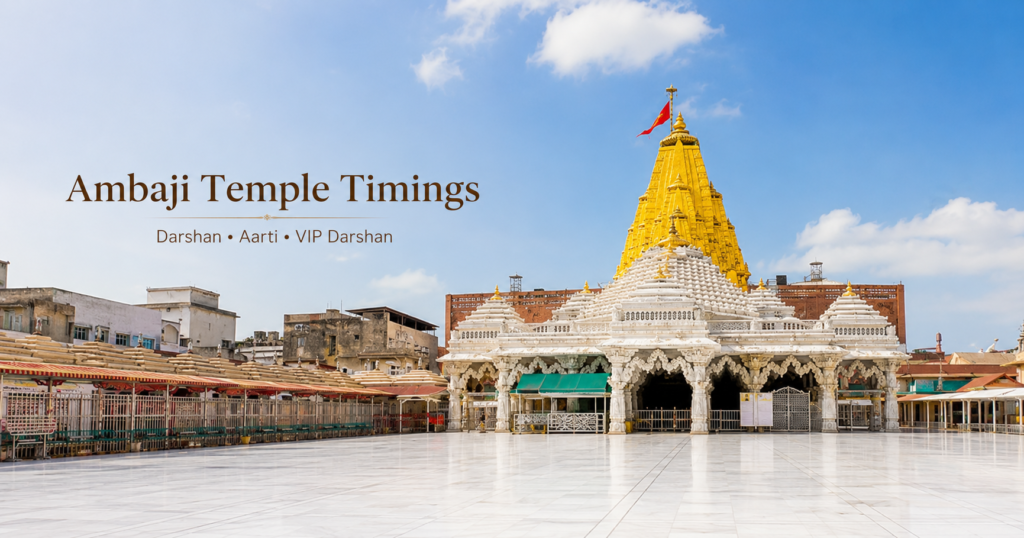
Ambaji Temple 2026: Quick Information
Before planning the full pilgrimage, it helps to understand that Ambaji Mata Temple and Gabbar Hill are separate stops. The main temple has its own darshan and aarti schedule, while Gabbar has separate hill and ropeway timings.
| Ambaji Temple Detail | 2026 Information |
|---|---|
| Temple | Shri Arasuri Ambaji Mata Mandir |
| Location | Ambaji, Banaskantha, Gujarat |
| Main Deity | Maa Amba |
| Religious Importance | Shakti Peetha |
| Main Form of Worship | Sacred Shree Yantra |
| Morning Darshan | 7:30 AM–11:30 AM |
| Afternoon Darshan | 12:30 PM–4:15 PM |
| Evening Darshan | 6:30 PM–9:00 PM |
| General Darshan Fee | Free |
| Morning Aarti | 7:30 AM–8:00 AM |
| Rajbhog Aarti | Around 12:00 PM |
| Sandhya Aarti | 6:30 PM–7:00 PM |
| VIP/Special Darshan | Depends on current arrangements |
| Gabbar Hill Distance | Around 4 km |
| Gabbar Steps | Approximately 999 |
| Gabbar Ropeway | Available |
| Regular Ropeway Ticket | Around ₹125 |
| Child Ropeway Ticket | Around ₹70 |
| Nearest Railway Station | Abu Road |
| Abu Road to Ambaji | Around 22–25 km |
| Main Festivals | Bhadarvi Poonam, Navratri, Purnima |
| Official Website | https://ambajitemple.in/ |
For first-time visitors, one of the easiest schedules is early Ambaji Mata darshan followed by Gabbar Hill before the afternoon heat.
Ambaji Temple Timings 2026
The regular Ambaji Temple darshan timings are divided into three sessions. Public darshan pauses between these periods for temple rituals, Bhog and preparation.
| Ambaji Darshan Session | Regular Timing |
|---|---|
| Morning Darshan | 7:30 AM–11:30 AM |
| Midday Interval | 11:30 AM–12:30 PM |
| Afternoon Darshan | 12:30 PM–4:15 PM |
| Evening Interval | 4:15 PM–6:30 PM |
| Evening Darshan | 6:30 PM–9:00 PM |
For most pilgrims, 7:30 AM to 9:30 AM is the most convenient period. Morning weather is usually better for walking, and visitors still have enough time afterward to continue toward Gabbar Hill.
Ambaji Temple Timings Today
On a normal non-festival day, Ambaji Temple timings today can be planned around these three windows:
Morning: 7:30 AM–11:30 AM
Afternoon: 12:30 PM–4:15 PM
Evening: 6:30 PM–9:00 PM
Visitors should remember that Ambaji does not operate as one continuous public darshan session throughout the day.
During Bhadarvi Poonam, Navratri and important Purnima dates, extended darshan or different crowd-management arrangements may operate.
Ambaji Temple Opening Time
The normal Ambaji Temple opening time for morning public darshan is approximately 7:30 AM.
Devotees interested in Morning Aarti should reach the temple area a little before this time so they can complete footwear deposit and security procedures.
Ambaji Temple Closing Time
The normal Ambaji Temple closing time is around 9:00 PM after the final evening darshan period.
The two important daytime intervals are:
- 11:30 AM–12:30 PM
- 4:15 PM–6:30 PM
If you are travelling from Abu Road, Mount Abu or Ahmedabad, avoiding arrival just before these intervals can save significant waiting time.
Best Time for Ambaji Temple Darshan
For a quieter regular visit, an ordinary non-Purnima weekday between 7:30 AM and 9:00 AM is one of the better choices.
This period is particularly practical for:
- Senior citizens
- Families with children
- Visitors continuing to Gabbar Hill
- Same-day travellers returning to Abu Road
- Pilgrims wanting to attend Morning Aarti
Evening darshan has a different atmosphere because of Sandhya Aarti, but it can also attract more visitors.
Ambaji Temple Aarti Timings 2026
Daily worship at Ambaji revolves around three important aarti periods. Visitors specifically searching for Ambaji Mata aarti timings can plan around the following schedule.
| Ambaji Aarti | Usual Timing |
|---|---|
| Morning Aarti | 7:30 AM–8:00 AM |
| Rajbhog Aarti | Around 12:00 PM |
| Sandhya Aarti | 6:30 PM–7:00 PM |
The morning and evening aartis are especially convenient because they coincide with the beginning of public darshan sessions.
Morning Aarti at Ambaji Temple
Ambaji Morning Aarti begins around 7:30 AM.
Visitors planning specifically for this aarti should reach before the morning opening. After Morning Aarti and darshan, they can comfortably continue to Gabbar Hill.
Rajbhog Aarti
Rajbhog Aarti takes place around 12:00 noon.
This occurs close to the end of the morning darshan period. Travellers reaching Ambaji around midday may find the 12:30 PM afternoon reopening more practical than arriving just as morning access is ending.
Sandhya Aarti
The Ambaji Sandhya Aarti normally begins around 6:30 PM and continues until approximately 7:00 PM.
This is one of the busiest and most attractive times for devotees staying overnight in Ambaji. Visitors who complete Gabbar Hill earlier in the day can return to the main temple for evening worship.
Ambaji Temple Entry Fee and Darshan Booking
General Ambaji Mata darshan is free. Ordinary visitors do not need to purchase an admission ticket simply to enter the regular darshan queue.
Paid facilities are separate and may include:
- Gabbar Ropeway
- Selected religious services
- Accommodation
- Donation-related services
- Other individually booked facilities
Is Online Booking Required for Ambaji Temple Darshan?
Normal free Ambaji darshan does not require every visitor to purchase an online entry ticket.
Devotees can reach the temple during an active darshan session and join the regular public entry arrangement.
The official temple website is:
It can be used for temple information, live darshan and available digital services.
Ambaji Live Darshan
Ambaji Live Darshan is useful for devotees unable to travel to Gujarat.
It becomes particularly popular during:
- Navratri
- Bhadarvi Poonam
- Purnima
- Special Maa Amba celebrations
Live darshan should not be confused with physical entry booking.
Ambaji VIP Darshan 2026
Searches for Ambaji VIP Darshan, Ambaji special darshan and priority darshan are common, particularly among families, senior citizens and pilgrims travelling during crowded periods.
Ambaji does not operate like temples that sell one permanent fixed-price public VIP ticket online throughout the year. Special or priority access can depend on the day’s temple administration and crowd arrangement.
General darshan remains free.
How to Get Ambaji VIP or Special Darshan Offline
Visitors looking specifically for Ambaji VIP Darshan offline can enquire about special arrangements after reaching the temple.
Step 1: Reach the Temple Early
Morning is the best time to enquire because the temple area is generally easier to navigate before major crowds build.
Step 2: Ask at the Official Enquiry Area
Ask whether special darshan, priority entry or assisted darshan is operating that day.
Availability can differ on:
- Ordinary weekdays
- Weekends
- Purnima
- Navratri
- Bhadarvi Poonam
- Other high-crowd days
Step 3: Confirm the Current Process
If a special facility is operating, confirm whether a pass, fee, registration or separate entry route applies.
Step 4: Complete the Required Formality
Provide the requested devotee information and keep a government photo ID available if required.
Step 5: Follow the Designated Darshan Route
Use only the entry route assigned for that facility and retain any receipt or pass until darshan is completed.
For many visitors, however, an ordinary weekday morning darshan may already be comfortable enough that a special entry is unnecessary.
Ambaji Temple Crowd and Waiting Time
Crowd levels change sharply depending on the religious calendar.
| Ambaji Visit Period | Expected Crowd |
|---|---|
| Ordinary Weekday Morning | Low to Moderate |
| Ordinary Weekday Evening | Moderate |
| Weekend | Moderate to High |
| Purnima | High |
| Navratri | Very High |
| Bhadarvi Poonam | Extremely High |
The important takeaway is that an ordinary Tuesday or Wednesday morning should not be compared with Bhadarvi Poonam, when pilgrim movement can dominate the entire town.
For the shortest practical queue, choose a non-Purnima weekday morning.
Ambaji Temple Dress Code and Visitor Rules
There is no complicated compulsory traditional dress requirement for normal Ambaji Mata darshan.
Visitors should wear modest clothing suitable for an active Hindu temple.
Dress Code for Men
Suitable choices include:
- Kurta-pajama
- Dhoti-kurta
- Full-length trousers
- Shirt
- Other modest clothing
Dress Code for Women
Suitable choices include:
- Saree
- Salwar-kameez
- Kurta with full-length bottoms
- Other modest traditional clothing
Visitors planning to climb Gabbar Hill’s 999 steps should also choose clothing that is comfortable for walking.
Mobile Phones, Bags and Photography
Temple security rules apply around the main sacred areas.
Photography should not be attempted where it is restricted, particularly around sensitive worship areas.
For easier darshan, avoid carrying:
- Large suitcases
- Heavy backpacks
- Multiple shopping bags
- Unnecessary electronic equipment
This becomes especially useful during Purnima and festival periods.
Footwear
Footwear must be removed before entering the designated sacred area.
If Gabbar Hill is also part of the itinerary, choose footwear that is both easy to remove and comfortable for walking or stair climbing.
Why Is Ambaji Temple Famous?
Ambaji is not simply another Goddess temple. Its importance is connected with several specific traditions:
- Shakti Peetha significance
- Worship of the Shree Yantra
- Association with Maa Amba
- Gabbar Hill
- Bhadarvi Poonam pilgrimage
- Navratri celebrations
- Strong Purnima tradition
The absence of a conventional deity idol inside the central shrine makes the Shree Yantra form of worship one of the temple’s defining features.
Ambaji Temple History and Religious Significance
According to Hindu tradition, after Goddess Sati’s death, Lord Shiva carried her body while overcome with grief. Lord Vishnu used the Sudarshan Chakra, and parts of Sati’s body are believed to have fallen at different sacred places that later became known as Shakti Peethas.
Ambaji tradition associates this sacred region with the heart of Goddess Sati.
For devotees, this gives Ambaji an important place within Shakti worship.
The temple is administered by the Shri Arasuri Ambaji Mata Devasthan Trust.
Suvarna Shikhar
The temple’s Suvarna Shikhar, or golden upper spire, is one of the most recognizable architectural features of Ambaji.
The gold-covered Shikhar rises prominently over the main temple and has become an important visual symbol of the pilgrimage site.
Gabbar Hill Ambaji
Gabbar Hill lies roughly 4 km from the main Ambaji Temple and is closely connected with Maa Amba tradition.
Pilgrims visit Gabbar for:
- Akhand Jyot
- Sacred footprints associated with Maa Amba
- Hilltop shrines
- Traditional Shakti worship
- Views across the surrounding Aravalli landscape
For many devotees, Ambaji Temple + Gabbar Hill together form the more complete pilgrimage.
Ambaji Temple or Gabbar Hill: Which Should You Visit First?
For a morning visit, the most practical order is:
Morning Aarti → Ambaji Temple Darshan → Breakfast → Gabbar Hill
This works because the temple begins morning darshan around 7:30 AM and the ropeway operates during daytime hours.
If you reach Ambaji during the 4:15 PM–6:30 PM temple interval, visiting Gabbar first and returning for Sandhya Aarti may make more sense.
Gabbar Hill Timings
Gabbar Hill is generally accessible from morning into the evening, with a practical visitor window of approximately:
7:00 AM–9:00 PM
The ropeway closes earlier than general hill access.
How Many Steps Are There at Gabbar Hill?
The traditional climb has approximately 999 steps.
For most visitors, the ascent takes roughly 45 minutes to 1 hour, depending on fitness, heat, crowd and rest breaks.
Early morning is the best period for visitors choosing to climb.
Ambaji Gabbar Ropeway 2026
The Gabbar Ropeway, also known as Udan Khatola, offers a convenient alternative to climbing the 999 steps.
It is particularly useful for:
- Senior citizens
- Families with young children
- Visitors with limited time
- People who find steep stair climbing difficult
The actual cable-car journey takes only a few minutes.
Gabbar Ropeway Timings
The normal ropeway operating window is approximately:
7:00 AM–6:00 PM
Bookings are generally organised through time slots.
Purnima and major festival days can have extended or modified operations.
Gabbar Ropeway Ticket Price 2026
Gabbar Hill darshan itself is free. The following amount is charged for using the ropeway service.
| Gabbar Ropeway Ticket | Approximate Price |
|---|---|
| Regular Ticket | ₹125 |
| Child Ticket | ₹70 |
| Gabbar Hill Entry by Steps | Free |
Visitors climbing the traditional stairs do not need to purchase a ropeway ticket.
How to Book Gabbar Ropeway Online
Online booking is particularly useful during weekends, Purnima and festivals.
Step 1: Open the Ropeway Website
Visit:
Step 2: Select Ambaji Gabbar
Choose Ambaji Gabbar Ropeway from the available destinations.
Step 3: Select the Date
Choose the day of your Gabbar visit.
If visiting Ambaji Temple first, leave enough time between darshan and the ropeway slot.
Step 4: Choose a Time Slot
Select an available hourly slot.
Morning slots are particularly convenient during warmer months.
Step 5: Enter Passenger Details
Add the required traveller information and choose the correct adult or child category.
Step 6: Pay the Fare
Complete the online payment.
Step 7: Save the Ticket
Keep the electronic confirmation accessible for ropeway entry.
Gabbar Ropeway Offline Booking
Offline tickets can also be purchased from the Gabbar ropeway counter, subject to availability.
Counter booking is usually easier on ordinary weekdays.
During Purnima, Navratri, Bhadarvi Poonam and weekends, earlier arrival is preferable because demand can rise substantially.
Ambaji Temple Facilities for Senior Citizens and Families
The combination of an early temple visit and ropeway makes Ambaji relatively manageable for senior pilgrims.
Senior Citizens
A practical plan is:
- Visit Ambaji Temple early
- Avoid Purnima if shorter queues are important
- Use Gabbar Ropeway
- Carry minimal luggage
- Avoid hot afternoon walking
Families With Children
Families can use a similar itinerary:
Morning darshan → breakfast → Gabbar Ropeway → rest → evening aarti if desired
Climbing 999 steps with very young children during the hottest part of the day is far more tiring than using the ropeway.
Major Festivals at Ambaji Temple
Ambaji’s normal crowd pattern changes dramatically during its major Goddess festivals.
Bhadarvi Poonam
Bhadarvi Poonam is one of Ambaji’s largest annual pilgrimage events.
Visitors should expect:
- Very heavy darshan queues
- Large numbers of walking pilgrims
- Traffic controls
- Special transport
- Medical arrangements
- Security barricading
- High accommodation demand
The festival is ideal for devotees wanting the full pilgrimage atmosphere, but not for visitors prioritising a short queue.
Navratri
Navratri has special importance at Ambaji because Maa Amba is the central deity.
During the nine nights, Ambaji becomes strongly associated with:
- Maa Amba worship
- Garba
- Devotional music
- Special decoration
- Evening crowds
- Religious programmes
Purnima Darshan
Every Purnima attracts additional devotees to Ambaji.
Travellers combining the main temple and Gabbar on Purnima should allow extra time for both darshan and ropeway queues.
Best Time to Visit Ambaji Temple
The ideal visit depends on whether the priority is lower crowds or festival atmosphere.
| Visitor Goal | Recommended Time |
|---|---|
| Shorter Darshan Queue | Non-Purnima weekday morning |
| Morning Aarti | Reach before 7:30 AM |
| Sandhya Aarti | Reach before 6:30 PM |
| Ambaji + Gabbar | Start early morning |
| Ropeway | Morning |
| Senior Citizens | Weekday morning + ropeway |
| Festival Experience | Navratri / Bhadarvi Poonam |
| Comfortable General Visit | Cooler months |
For most first-time visitors, Ambaji around 7:30 AM followed by Gabbar before noon remains the strongest schedule.
How Much Time Is Needed for Ambaji Temple?
For only normal Ambaji Temple darshan, approximately 30–60 minutes may be sufficient during manageable crowds.
For a full pilgrimage including:
- Main temple darshan
- Aarti
- Gabbar Hill
- Ropeway or stair climb
- Local movement
keep approximately 3–5 hours.
Festival dates can require considerably more time.
Accommodation in Ambaji
Ambaji has a substantial pilgrim accommodation network.
Visitors can choose from:
- Dharamshalas
- Trust accommodation
- Guest houses
- Budget hotels
- Family hotels
Staying in Ambaji is particularly useful if Morning Aarti is part of the plan.
Accommodation demand rises sharply around Bhadarvi Poonam and Navratri.
How to Reach Ambaji Temple
Ambaji is well connected by road with Gujarat and neighbouring Rajasthan. Abu Road is the most convenient railway gateway, while Ahmedabad and Udaipur provide practical airport options.
By Train: Abu Road to Ambaji Temple
Abu Road Railway Station is the nearest major railhead, approximately 22–25 km from Ambaji.
From Abu Road, travellers can use:
- Bus
- Taxi
- Shared vehicle
- Private car
Abu Road has rail connections with cities such as Ahmedabad, Jaipur and Delhi.
By Road: Mount Abu to Ambaji
Ambaji is approximately 45 km from Mount Abu.
Visitors staying in Mount Abu can comfortably plan Ambaji as a half-day or full-day pilgrimage.
Taxi, private vehicle and bus connections through Abu Road are commonly used.
By Road: Ahmedabad to Ambaji Temple
Ambaji is approximately 175–190 km from Ahmedabad, depending on the route and starting point.
Travellers can use:
- GSRTC bus
- Private bus
- Taxi
- Private car
An overnight stay in Ambaji is useful for Ahmedabad visitors who want to attend Morning Aarti.
By Air: Nearest Airport to Ambaji Temple
Sardar Vallabhbhai Patel International Airport in Ahmedabad is one of the main airport gateways, roughly 175–180 km away.
Maharana Pratap Airport near Udaipur is another practical option at roughly 180–185 km depending on the route.
The remaining journey is completed by road.
Places to Visit Near Ambaji Temple
Visitors with additional time can combine Ambaji with several nearby religious and travel destinations.
Gabbar Hill
The most important religious extension of the Ambaji pilgrimage.
Kailash Tekari
A nearby religious and scenic location around Ambaji.
Koteshwar Mahadev Temple
A Shiva temple suitable for a longer local pilgrimage itinerary.
Mount Abu
The famous Rajasthan hill station is approximately 45 km from Ambaji.
Dilwara Jain Temples
These celebrated marble Jain temples near Mount Abu can be combined with Ambaji on a longer trip.
Suggested Ambaji One-Day Itinerary
A good one-day itinerary should work around both Ambaji Temple darshan sessions and Gabbar Ropeway hours.
7:15 AM – Reach Ambaji Temple
Complete footwear and security formalities.
7:30 AM – Morning Aarti and Darshan
Attend Morning Aarti and complete Maa Amba darshan.
9:00 AM – Breakfast
Take a short break before heading to Gabbar.
10:00 AM – Gabbar Hill
Use the ropeway or begin the 999-step climb.
11:00 AM–12:00 PM – Gabbar Darshan
Complete the hilltop pilgrimage and return.
Afternoon – Lunch and Rest
Use the hotter afternoon period for food or nearby sightseeing.
6:15 PM – Return to Ambaji Temple
Reach before the evening session begins.
6:30 PM – Sandhya Aarti
Complete evening darshan and conclude the pilgrimage day.
This itinerary works best on an ordinary weekday. During Navratri or Bhadarvi Poonam, a flexible schedule is much more realistic.
FAQs
What are Ambaji Temple timings in 2026?
Regular darshan is generally available 7:30 AM–11:30 AM, 12:30 PM–4:15 PM and 6:30 PM–9:00 PM.
What are Ambaji Temple timings today?
On a normal day, Ambaji follows morning, afternoon and evening darshan sessions with breaks in between.
What time does Ambaji Temple open?
Morning public darshan normally begins around 7:30 AM.
What is Ambaji Temple closing time?
The final evening darshan normally ends around 9:00 PM.
What are Ambaji Temple aarti timings?
Morning Aarti is around 7:30 AM, Rajbhog Aarti around 12:00 noon, and Sandhya Aarti around 6:30 PM.
Is Ambaji Temple darshan free?
Yes. General Ambaji Mata darshan is free.
Is online booking required for Ambaji Temple?
No. Regular public darshan does not normally require a paid online entry ticket.
Is VIP Darshan available at Ambaji?
Special or priority arrangements can depend on the day’s temple and crowd-management setup.
How can I get Ambaji VIP Darshan offline?
Enquire at the official temple help or enquiry area after reaching Ambaji about any priority or special-darshan arrangement operating that day.
What is the least crowded time for Ambaji Temple?
An ordinary non-Purnima weekday morning between approximately 7:30 AM and 9:00 AM is generally one of the better periods.
Should I visit Ambaji Temple or Gabbar first?
For an early-morning itinerary, Ambaji Temple first and Gabbar Hill afterward is the more practical sequence.
How far is Gabbar Hill from Ambaji Temple?
Gabbar Hill is approximately 4 km from the main temple.
How many steps are there at Gabbar Hill?
There are approximately 999 steps.
What is the Gabbar Ropeway ticket price?
The commonly followed fare is approximately ₹125 for a regular ticket and ₹70 for a child ticket.
What are Gabbar Ropeway timings?
The normal operating window is approximately 7:00 AM–6:00 PM.
Can Gabbar Ropeway tickets be booked online?
Yes. Online booking is available through the official Udan Khatola service.
Is Gabbar Hill darshan free?
Yes. General Gabbar Hill darshan is free. A ticket is required only for ropeway transportation.
Is Gabbar Ropeway suitable for senior citizens?
Yes. The ropeway is particularly helpful for senior citizens who may find the 999-step climb difficult.
Which railway station is nearest to Ambaji Temple?
Abu Road Railway Station is the nearest major railway station, approximately 22–25 km away.
How far is Mount Abu from Ambaji?
Mount Abu is approximately 45 km from Ambaji.
Which airport is nearest to Ambaji Temple?
Ahmedabad and Udaipur are the main practical airport gateways, with Ahmedabad roughly 175–180 km away.
When is Ambaji Temple most crowded?
Bhadarvi Poonam, Navratri and major Purnima dates attract the largest crowds.
How much time is required for Ambaji and Gabbar?
Keep approximately 3–5 hours for both places on an ordinary day.
Final Thoughts
An Ambaji Temple visit in 2026 is easiest to plan around the three regular darshan sessions: 7:30 AM–11:30 AM, 12:30 PM–4:15 PM and 6:30 PM–9:00 PM. Visitors interested in temple worship can additionally plan around Morning Aarti, Rajbhog Aarti and Sandhya Aarti.
General Ambaji Mata darshan is free, while special or priority arrangements depend on the day’s temple setup. For most visitors, choosing a non-Purnima weekday morning is the easiest way to reduce crowd-related waiting.
A complete Ambaji pilgrimage should also include Gabbar Hill. The sacred hill lies around 4 km from the main temple and can be reached either by climbing approximately 999 steps or taking the Gabbar Ropeway. The ropeway is particularly useful for senior citizens, families and visitors who want to save time.
For a first visit, the most practical sequence is Morning Aarti → Ambaji Temple darshan → Gabbar Hill before noon. Travellers staying overnight can return for Sandhya Aarti in the evening.
Bhadarvi Poonam, Navratri and Purnima provide the strongest festival atmosphere but also bring the biggest crowds. Visitors looking for a quieter pilgrimage should choose an ordinary weekday instead.
With Abu Road around 22–25 km away, Mount Abu roughly 45 km away and good road connectivity from Ahmedabad, Ambaji is also easy to combine with a wider Gujarat–Rajasthan pilgrimage itinerary.