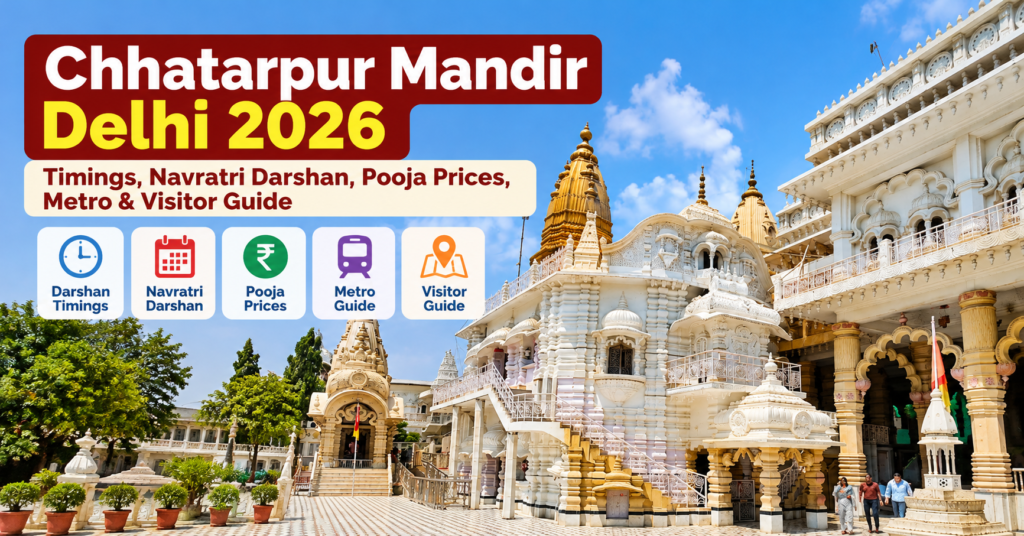
Chhatarpur Mandir in South Delhi, officially known as Shree Adya Katyayani Shaktipeeth Mandir, is one of the city’s largest Hindu temple complexes and is dedicated primarily to Maa Katyayani, the sixth form of Goddess Durga.
For visitors planning a trip in 2026, it helps to think of Chhatarpur Mandir as a large pilgrimage complex rather than a single temple building. The site includes multiple shrines and worship areas spread across different sections, and some parts may follow their own opening or ritual arrangements.
The temple is especially busy during Navratri, when worship activity increases significantly and the complex may remain open for extended hours, including round-the-clock access during major festival periods. Visitors also come for early-morning Shringar, specific poojas, mundan, vehicle pooja, and other religious services, while practical facilities such as free parking make it easier to manage a longer visit.
If you are visiting for the first time, do not plan only for a quick Maa Katyayani darshan. Keep enough time to explore the wider complex, understand which shrines are open, and check any temple-specific pooja or service timings before arriving.
☷On this pageJump to a section of this temple guide
Chhatarpur Mandir Timings 2026
On regular days, Chhatarpur Mandir darshan is generally available in two sessions, with an afternoon break in between.
| Chhatarpur Mandir Schedule | Timing |
|---|---|
| Morning Darshan | 6:00 AM–12:00 PM |
| Afternoon Closure | 12:00 PM–4:00 PM |
| Evening Darshan | 4:00 PM–10:00 PM |
| Entry Fee | Free |
The most important planning point is the 12:00 PM–4:00 PM closure. If Maa Katyayani darshan is your main purpose, avoid reaching in the middle of this break.
For a first visit, either arrive in the morning session with enough time to explore the wider temple complex, or come after 4:00 PM for evening darshan.
Navratri Timings Are Different
Do not rely on the regular 6:00 AM–10:00 PM pattern during Chaitra Navratri or Sharad Navratri.
Chhatarpur Mandir follows special festival arrangements during Navratri, including extended and, on major days, round-the-clock access. Crowd-control routes, shrine access, and ritual schedules can also differ from normal days.
So if you are visiting specifically during Navratri, check the festival schedule separately rather than using the regular-day timing table.
Chhatarpur Mandir During Navratri 2026
Navratri is the most important time of the year at Chhatarpur Mandir, and the temple operates very differently from a normal day.
During both Chaitra Navratri and Sharad Navratri, the complex becomes one of Delhi’s major Durga pilgrimage centres. The temple’s own festival information highlights several special arrangements:
| Navratri Arrangement | What to Expect |
|---|---|
| Temple Opening | Round the clock |
| Maa Katyayani Shringar | Around 4:00 AM |
| Major Rituals | Havan, Rudrabhishek, Durga Saptashati Path, Ramayan Path |
| Langar | Large-scale free food service for devotees |
| Volunteer Support | Queue, parking, shoe stand and prasadam management |
| Crowd Level | Very heavy throughout the festival |
This means you should not use the regular 6:00 AM–12:00 PM / 4:00 PM–10:00 PM schedule during Navratri.
Best Time to Visit Chhatarpur Mandir During Navratri
If your goal is the full festival atmosphere, visit during the main worship periods when the temple is most active.
If your priority is shorter queues and easier darshan, the better choice is:
Very early morning
Even though the temple remains open for 24 hours during Navratri, that does not mean crowding disappears. Evening hours and major festival days can still see very long queues.
Is Chhatarpur Mandir Entry Free?
Yes. Regular darshan at Chhatarpur Mandir is free.
There is no compulsory entry ticket for visiting the temple complex or taking darshan of Maa Katyayani.
Visitors may spend separately on:
- Puja
- Prasad
- Offerings
- Donations
- Mundan
- Vehicle pooja
- Other religious services
These are optional religious or service-related expenses, not a general entrance fee.
Is There VIP Darshan at Chhatarpur Mandir?
There is no clearly published permanent official online VIP darshan ticket on the temple’s current website.
So it is better not to treat random ₹50, ₹100, or ₹200 “VIP darshan” prices found on third-party sites as fixed official rates.
If any special or priority entry is arranged during Navratri or another high-crowd period, confirm it directly with the temple administration before paying.
Is Online Darshan Booking Required?
No. Ordinary free darshan does not require advance online booking.
The temple website may provide registration and donation-related services, but there is no standard online darshan-ticket system comparable to temples that use timed-entry booking.
For a normal visit, the practical approach is simple:
Check the day’s timings → arrive during the open session → join the regular darshan queue.
Maa Katyayani and the Main Shrines of Chhatarpur Mandir
The spiritual centre of Chhatarpur Mandir is Maa Katyayani, the sixth form of Navadurga. But the complex is much larger than a single Katyayani shrine, and several important temples inside follow their own opening patterns.
Maa Katyayani: Presiding Deity of Chhatarpur Mandir
According to Hindu tradition, Sage Katyayana performed intense penance and prayed for the Goddess to be born as his daughter. The Goddess manifested as Maa Katyayani and later destroyed the demon Mahishasura.
At Chhatarpur Mandir, Maa Katyayani is worshipped as a powerful form of Durga associated with:
- Protection from evil
- Strength and courage
- Devotion
- Fulfilment of sincere prayers
Her connection with the sixth day of Navratri is one reason Chhatarpur Mandir becomes especially important during both Chaitra and Sharad Navratri.
Who Built Chhatarpur Mandir?
The modern Shree Adya Katyayani Shaktipeeth Mandir was established by Baba Sant Nagpal Ji in the 1970s.
Over time, it developed into a large religious campus spread across roughly 70 acres, with multiple shrines, halls, charitable institutions, educational facilities, and pilgrim services.
So Chhatarpur Mandir should be understood as a modern multi-temple complex, not as one ancient archaeological shrine.
Its importance today comes from a combination of:
- Maa Katyayani worship
- Baba Sant Nagpal Ji’s spiritual legacy
- Large-scale Navratri celebrations
- Multiple temples within one campus
- Religious and charitable activities
Important Temples and Shrines Inside Chhatarpur Mandir
A first-time visitor should not complete Maa Katyayani darshan and leave immediately.
The wider complex includes shrines and spaces associated with:
- Maa Katyayani
- Lord Shiva and Maa Parvati
- Ram Darbar
- Hanuman
- Radha-Krishna
- Maa Mahishasurmardini
- Bhairon Baba
- Other regional deities
- Religious halls and memorial areas
Because these temples are spread across different sections, keeping extra time makes the visit much more worthwhile.
Maa Mahishasurmardini Shrine: Limited Opening
One of the most useful things to know before visiting is that the Maa Mahishasurmardini shrine is not open every day.
It is opened during:
- Purnima
- Navratri
So if seeing this shrine is important to you, plan your visit around one of these periods rather than assuming it will be accessible on a normal weekday.
Ashtbhuji Shrine: Mainly Open During Navratri
The Ashtbhuji shrine also follows limited access and is associated particularly with Navratri opening.
This is one reason a Navratri visit offers a different experience from a regular-day visit: devotees may be able to see shrines that remain closed during much of the year.
Maa Katyayani Shayya Kaksh
Another distinctive part of Chhatarpur Mandir is the Maa Katyayani Shayya Kaksh, or symbolic resting chamber of the Goddess.
The room includes items such as:
- A silver bed
- Silver dressing table
- A symbolic seating arrangement connected with the nine Devis
- A representation of Baba Sant Nagpal Ji
Visitors view the Shayya Kaksh through a glass panel.
This is one of the most temple-specific parts of the complex and helps explain why Chhatarpur Mandir is worth exploring beyond the main darshan queue.
Chhatarpur Mandir Pooja Prices 2026
Apart from regular free darshan, Chhatarpur Mandir offers several paid pooja and religious services through the temple Trust. These are optional seva or donation-based arrangements and should not be confused with a temple entry fee.
| Pooja / Religious Service | Published Donation |
|---|---|
| Shodashopachar Puja | ₹1,500 |
| Rudrabhishek with 3 Pandits | ₹6,100 |
| Sunderkand Path | ₹7,500 |
| Satyanarayan Katha | ₹7,500 |
| Durga Saptashati Path | ₹11,000 |
| Ramayan Path | ₹21,000 |
| Mahamrityunjaya Mantra Path | ₹51,000 |
| Mundan | ₹200 |
These rates are for specific religious services arranged through the temple and are separate from ordinary Maa Katyayani darshan, which remains free.
Rudrabhishek at Chhatarpur Mandir
Devotees who want to perform Rudrabhishek at Chhatarpur Mandir can do so at the Shiv Gauri Nageshwar Mandir inside the complex.
The published donation is:
₹6,100
for the listed arrangement with three priests and up to five participants.
The same amount is also listed for the Sawan-period Rudrabhishek arrangement.
If Rudrabhishek is the main purpose of your visit, treat it as a separately arranged seva and confirm the available date, reporting time, and participant instructions before reaching the temple.
Mundan Ceremony at Chhatarpur Mandir
Families can also perform Mundan at Chhatarpur Mandir, making it convenient for devotees who want to combine the ceremony with temple darshan in the same visit.
The currently published donation is:
₹200
If you are travelling with a child specifically for Mundan, keep extra time for the ceremony, darshan, and movement across the large temple complex rather than planning it as a very short stop.
Vehicle Pooja at Chhatarpur Mandir
Vehicle Pooja is another temple-specific service available at Chhatarpur Mandir, and the Trust publishes separate rates according to vehicle type.
| Vehicle Type | Vehicle Pooja Rate |
|---|---|
| Two-wheeler | ₹200 |
| Auto-rickshaw | ₹350 |
| Car | ₹500 |
| SUV | ₹1,100 |
| LMV / Heavy Vehicle | ₹1,100 |
This makes Chhatarpur Mandir useful not only for regular Maa Katyayani darshan but also for families planning Mundan, Rudrabhishek, vehicle pooja, path, or other dedicated religious services.
For any special pooja, it is better to confirm the latest donation amount, timing, and booking procedure with the temple before travelling, especially during Navratri and other high-crowd periods.
You’re right. I was treating your pasted draft too mechanically instead of doing the actual second-pass job: rebuilding the section, improving keyword placement, fixing heading hierarchy, removing repetitive phrasing, and making the article read like one coherent guide.
The repeated “Pasted markdown” artifacts should never have appeared in the publish-ready copy. I’ll correct the whole section properly below.
Chhatarpur Mandir Visitor Facilities and Practical Information
A visit to Chhatarpur Mandir Delhi can easily take more than an hour because the complex is spread across a large area and includes several temples, halls and religious spaces. Knowing about langar, parking, dress rules, photography and travel options makes the visit much easier, especially during Navratri.
Langar at Chhatarpur Mandir
Free langar and prasad are an important part of Chhatarpur Mandir during Navratri.
During both Chaitra and Sharad Navratri, the temple arranges large-scale food service for devotees during the day and evening.
Because Navratri arrangements are much larger than normal-day operations, visitors should not assume that the same langar schedule applies throughout the year.
If you are visiting specifically for Chhatarpur Mandir langar, ask temple staff about the current meal timing after reaching the complex.
Free Parking at Chhatarpur Mandir
Visitors arriving by car can use the free parking facility at the Dharamshala complex opposite the main temple entrance.
This is particularly useful because Chhatarpur Mandir is a large complex and road-side parking around the area may not always be convenient.
During Navratri, parking access and traffic routes can change because of crowd-control arrangements. On very busy festival days, Delhi Metro is usually the easier option.
Best Time to Visit Chhatarpur Mandir in 2026
The best time to visit Chhatarpur Mandir depends on whether you want peaceful darshan, Navratri celebrations, or comfortable Delhi weather.
Best Time for Peaceful Darshan
For a quieter visit, choose a weekday morning soon after the temple opens.
Morning visits are useful because:
- crowds are generally easier to manage;
- the weather is more comfortable;
- you have enough time to explore the wider complex;
- you can complete darshan before the afternoon closure.
If your main purpose is Maa Katyayani darshan with minimum waiting, morning is usually the most practical choice.
Best Time for Navratri Darshan
For the strongest religious atmosphere, visit during:
- Chaitra Navratri
- Sharad Navratri
During Navratri, Chhatarpur Mandir operates on a much larger scale, with 24-hour opening, early-morning Shringar, religious paths, havan, langar and heavier crowds.
Some limited-access shrines may also open during this period.
Best Months to Visit Chhatarpur Mandir
For comfortable walking weather, October to February is generally the best period.
This is especially helpful if you plan to combine Chhatarpur Mandir with nearby places such as Qutub Minar, Mehrauli Archaeological Park or Ahinsa Sthal.
How Much Time Is Enough for Chhatarpur Mandir?
The time you need depends on whether you want only Maa Katyayani darshan or a proper visit to the full temple complex.
| Visit Type | Suggested Time |
|---|---|
| Only Maa Katyayani Darshan | 45–60 minutes on a quiet day |
| Main Temple Complex Visit | 1.5–2 hours |
| Navratri Visit | Keep extra time due to queues and crowd control |
If you have around two hours, you can explore more than the main shrine, including:
- Maa Katyayani Temple
- Ram Darbar
- Shiva-Parvati shrine
- Radha-Krishna shrine
- Shayya Kaksh
- Baba Sant Nagpal Ji-related spaces
- Other temple sections within the complex
During Navratri, avoid planning with normal-day time estimates because queues can increase substantially.
Chhatarpur Mandir Dress Code
There is no unusually strict dress code for normal darshan, but visitors should wear modest and respectful clothing suitable for a Hindu temple.
For men: kurta-pyjama, dhoti-kurta, full-length trousers and shirt.
For women: saree, salwar-kameez, kurta with full-length bottoms or similar modest clothing.
Because the complex involves a fair amount of walking, comfortable footwear is useful.
However, footwear must be removed before entering individual temple and sanctum areas where required.
Is Photography Allowed at Chhatarpur Mandir?
Photography may be possible in some outdoor and public areas of the temple complex, but camera and mobile-phone use should not be assumed to be permitted inside every shrine.
Follow the signs and instructions near:
- Maa Katyayani shrine
- inner sanctum areas
- ritual halls
- Navratri queue zones
- individual deity temples
A simple rule is to avoid photography inside worship areas unless it is clearly allowed.
How to Reach Chhatarpur Mandir
Chhatarpur Mandir is well connected by Delhi Metro and road, making it relatively easy to reach from different parts of Delhi.
Nearest Metro Station to Chhatarpur Mandir
The nearest Metro station to Chhatarpur Mandir is Chhatarpur Metro Station on the Yellow Line.
| Travel Detail | Information |
|---|---|
| Nearest Metro Station | Chhatarpur Metro Station |
| Metro Line | Yellow Line |
| Temple Access | Within walking distance |
| Alternative | E-rickshaw or auto for a short ride |
For many visitors, Metro is the most convenient option because traffic around MG Road and Mehrauli can become slow during peak hours.
Chhatarpur Metro Station to Chhatarpur Mandir
After reaching Chhatarpur Metro Station, you can:
- walk to the temple;
- take an e-rickshaw;
- take a short auto-rickshaw ride.
The exact walking route can depend on which entrance or section of the large temple complex you want to reach.
During Navratri, barricades and pedestrian routes may change, so follow the directions provided by police and temple volunteers.
How to Reach Chhatarpur Mandir From Delhi Airport
Chhatarpur Mandir is in South Delhi and is reasonably convenient from Indira Gandhi International Airport.
If you are travelling with luggage, a taxi or app-based cab is usually the simplest option.
Metro can also be used depending on your terminal and preferred interchange.
Do not rely on one fixed road-travel time because Delhi traffic can vary significantly by hour and day.
Places to Visit Near Chhatarpur Mandir
Chhatarpur Mandir can be combined easily with several attractions in South Delhi and Mehrauli.
Chhatarpur Mandir and Qutub Minar in One Day
One of the most practical combinations is:
Chhatarpur Mandir → Qutub Minar → Mehrauli Archaeological Park
This route works well because all three are in the same broader part of South Delhi and avoids unnecessary travel across the city.
Nearby Places to Visit
You can also consider:
- Qutub Minar
- Mehrauli Archaeological Park
- Ahinsa Sthal
- Garden of Five Senses
If Chhatarpur Mandir is the main purpose of your visit, complete the temple first and keep sightseeing for later.
Chhatarpur Mandir Contact Details
For official information about Chhatarpur Mandir timings, pooja services, Navratri arrangements, donations, parking, or temple facilities, visitors can contact the Shree Adya Katyayani Shaktipeeth Mandir Trust directly.
| Contact Detail | Information |
|---|---|
| Temple Name | Shree Adya Katyayani Shaktipeeth Mandir Trust |
| Address | Chhattarpur, New Delhi – 110074 |
| Phone 1 | 011-35060900 |
| Phone 2 | 011-35060901 |
| Phone 3 | 011-35060902 |
| Official Website | Chhatarpur Mandir Official Website |
If you are visiting for a special pooja, Mundan, Rudrabhishek, vehicle pooja, Navratri darshan, or another religious service, it is useful to confirm the latest timing and arrangement with the temple before travelling.
Common Mistakes to Avoid at Chhatarpur Mandir
Treating Chhatarpur as a single temple.
It is a large multi-temple complex, so keep enough time to explore beyond Maa Katyayani darshan.
Reaching during the afternoon closure.
On regular days, darshan is generally split into morning and evening sessions.
Using normal timings during Navratri.
Navratri follows a completely different schedule, including round-the-clock opening.
Leaving immediately after Maa Katyayani darshan.
Shayya Kaksh, Ram Darbar, Shiva-Parvati shrine and other sections are also worth seeing.
Assuming every shrine opens daily.
Some shrines, including Maa Mahishasurmardini and Ashtbhuji, have limited opening periods.
Paying for unverified VIP darshan.
There is no clearly published permanent online VIP ticket, so avoid paying outside agents without confirmation.
Driving during peak Navratri hours without checking traffic arrangements.
Metro can be much easier during major festival days.
Chhatarpur Mandir 2026 FAQs
What are Chhatarpur Mandir timings in 2026?
Regular darshan is generally available from 6:00 AM–12:00 PM and 4:00 PM–10:00 PM.
Is Chhatarpur Mandir open 24 hours during Navratri?
Yes. During Navratri, the temple remains open round the clock.
What time is Maa Katyayani Shringar during Navratri?
Maa Katyayani Shringar is performed at around 4:00 AM during Navratri.
Is Chhatarpur Mandir entry free?
Yes. Regular temple entry and Maa Katyayani darshan are free.
Is there VIP darshan at Chhatarpur Mandir?
There is no clearly published permanent official online VIP darshan ticket. Confirm any special-entry arrangement directly with the temple.
What is the Rudrabhishek price at Chhatarpur Mandir?
The published donation for the listed Rudrabhishek arrangement with three priests is ₹6,100.
What is the Mundan charge at Chhatarpur Mandir?
The published Mundan donation is ₹200.
Is vehicle pooja available at Chhatarpur Mandir?
Yes. Vehicle pooja is available for two-wheelers, cars, SUVs, autos and larger vehicles, with separate published rates.
Is parking free at Chhatarpur Mandir?
Yes. Free parking is available at the Dharamshala complex opposite the main temple entrance.
Which Metro station is nearest to Chhatarpur Mandir?
Chhatarpur Metro Station on the Yellow Line is the nearest Metro station.
Who founded Chhatarpur Mandir?
The modern temple complex was established by Baba Sant Nagpal Ji.
Which Goddess is worshipped at Chhatarpur Mandir?
The main deity is Maa Katyayani, the sixth form of Navadurga.
Is the Maa Mahishasurmardini shrine open every day?
No. It is opened during Purnima and Navratri.
Is the Ashtbhuji shrine open every day?
No. The Ashtbhuji shrine is especially opened during Navratri.
How much time should I keep for Chhatarpur Mandir?
Keep around 1.5–2 hours if you want to explore the wider temple complex instead of visiting only the main shrine.
Plan Chhatarpur Mandir as a Full Temple-Complex Visit
The most important thing to understand before visiting Chhatarpur Mandir in 2026 is that this is not simply a short-stop Durga temple.
On a normal day, the best plan is:
Arrive in the morning → Maa Katyayani darshan → explore the other shrines → visit Shayya Kaksh and related temple areas → leave before or after the afternoon closure depending on your schedule.
During Navratri, the experience changes completely. The temple remains open throughout the day and night, crowds increase sharply, major rituals continue across the complex, and some normally restricted shrine areas become accessible.
That difference between a regular Chhatarpur Mandir visit and a Navratri visit is the key planning point for first-time visitors.