Jhandewala Devi Mandir in central Delhi is one of the capital’s best-known temples dedicated to the Mother Goddess. Located near Karol Bagh and easily accessible by Delhi Metro, the temple attracts devotees throughout the year for Maa Jhandewali darshan, daily aarti, sacred Jhanda offerings and the distinctive lower shrine associated with the original form of the Goddess.
Despite its busy urban location, Jhandewala Mandir remains an important devotional centre where thousands of visitors come for morning and evening worship. On regular days, the temple generally operates from 6:00 AM to 10:00 PM, with a short evening cleaning interval, while Navratri follows a special extended schedule beginning earlier in the morning.
The temple has also expanded its digital facilities. Devotees can use the official website for temple information and registration, while live darshan is available through the temple’s official YouTube and Facebook channels.
This Jhandewala Temple 2026 guide covers temple timings, daily aarti schedule, free darshan, current ticket and VIP-darshan information, live darshan, devotee registration, Navratri timings, nearest metro station, dress guidance, temple history and the best time to visit.
☷On this pageJump to a section of this temple guide
Jhandewala Temple 2026: Quick Information
Jhandewala Devi Mandir, also widely searched as Jhandewala Temple, Jhandewalan Mandir and Maa Jhandewali Temple, is located at Jhandewala Estate on Deshbandhu Gupta Road in central Delhi.
The temple follows a long daily worship schedule, but visitors should pay particular attention to the evening cleaning closure from 6:15 PM to 7:00 PM and to the separate schedule followed during Navratri.
| Jhandewala Temple Detail | 2026 Information |
|---|---|
| Official Name | Jhandewali Devi Mandir |
| Popular Names | Jhandewala Temple / Jhandewalan Mandir |
| Main Deity | Maa Jhandewali / Goddess Durga |
| Location | Jhandewala Estate, New Delhi |
| Regular Opening | Early morning; check current official schedule |
| Regular Closing | 10:00 PM |
| Evening Cleaning Closure | 6:15 PM–7:00 PM |
| Mangla Aarti | 6:00 AM on the regular published schedule |
| Morning Shringar Aarti | 9:00 AM |
| Bhog Aarti | 12:00 PM |
| Evening Shringar Aarti | 7:30 PM |
| Shayan Aarti / Closing | 10:00 PM |
| General Darshan | Free |
| Mandatory Online Darshan Ticket | No standard requirement displayed |
| Regular Public VIP Ticket | No standard paid VIP tariff displayed on the official website |
| Live Darshan | Available through official YouTube / Facebook |
| Major Festival | Navratri |
| Navratri Opening | Around 4:00 AM |
| Nearest Metro | Jhandewalan Metro Station |
| Official Website | https://jhandewalamandir.org/ |
| Contact | 7440079900 / 7440071100 |
| PIN Code | 110055 |
For an ordinary visit, the main planning decision is not which ticket to purchase—it is what time to reach the temple and whether your visit overlaps with an aarti or the evening cleaning break.
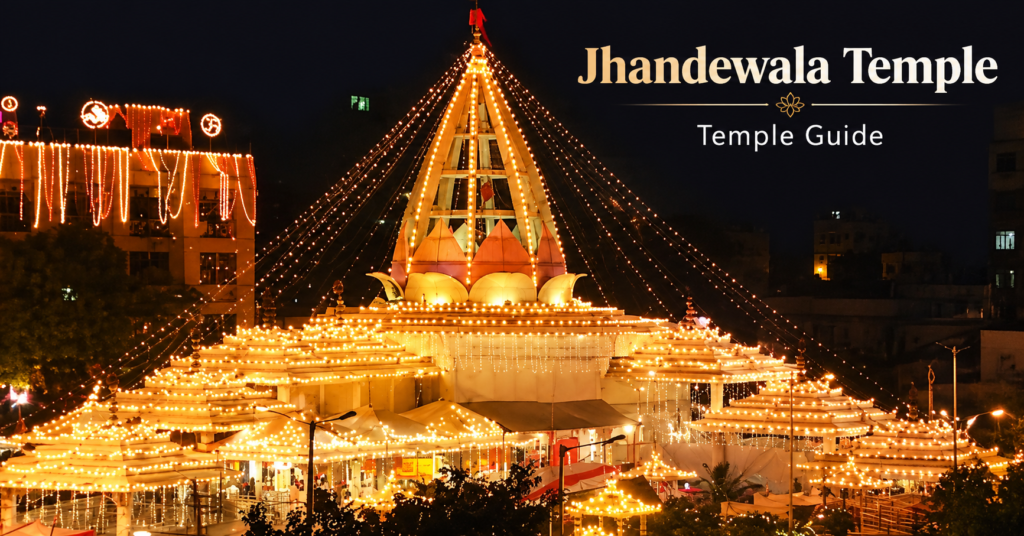
Jhandewala Temple Timings 2026
Jhandewala Mandir remains open for most of the day and continues until approximately 10:00 PM, but the temple temporarily closes for cleaning in the evening.
The official temple website currently shows some variation between its pages regarding the exact regular opening time, so visitors planning a very early-morning visit should check the latest temple schedule before travelling.
The core regular schedule currently published by the temple includes:
| Temple Activity | Regular Published Timing |
|---|---|
| Morning Temple Activities | Early morning |
| Mangla Aarti | 6:00 AM |
| Morning Shringar Aarti | 9:00 AM |
| Bhog Aarti | 12:00 PM |
| Afternoon Darshan | Available during the regular open period |
| Cleaning Closure | 6:15 PM–7:00 PM |
| Evening Darshan Resumes | 7:00 PM |
| Evening Shringar Aarti | 7:30 PM |
| Shayan Aarti | 10:00 PM |
| Temple Closes | Around 10:00 PM |
The most important timing for an ordinary visitor to remember is:
6:15 PM–7:00 PM — temple closed for cleaning
Arriving during this interval can mean waiting outside until regular darshan resumes.
Jhandewala Temple Opening Time
The temple begins activity early in the morning.
Because the official website currently displays different opening times on different pages, visitors specifically planning to arrive before 6:00 AM should verify the latest schedule on:
The regular published aarti timetable places Mangla Aarti at 6:00 AM.
For most visitors who are not attending a special early programme, arriving around or after the morning aarti period is a practical choice.
Jhandewala Temple Closing Time
The regular closing time is approximately 10:00 PM.
The final part of the daily worship includes Shayan Aarti, after which the temple closes for the night.
Do not plan to reach the entrance only a few minutes before closing. Allow enough time for:
- Security
- Queue movement
- Main darshan
- Visiting the lower shrine
- Any offering you wish to make
Is Jhandewala Temple Closed in the Evening?
Yes.
The temple normally closes for cleaning from approximately:
6:15 PM to 7:00 PM
This is easy to miss because the temple otherwise operates for a long period during the day.
If your main purpose is to attend the 7:30 PM evening Shringar Aarti, reaching after reopening but comfortably before the aarti begins is the more practical plan.
Jhandewala Temple Navratri Timings
Navratri follows a special schedule rather than the normal daily routine.
The official temple website currently states that during Navratri the temple opens from around 4:00 AM, with special worship, bhajans and extended programmes taking place throughout the festival period.
Because individual Navratri days can have additional programmes and crowd-control arrangements, visitors should check the current festival schedule on the official temple website before travelling.
Jhandewala Temple Aarti Timings 2026
Daily aarti is one of the main reasons devotees choose a particular time to visit Jhandewala Devi Mandir.
The temple’s current official homepage publishes the following regular aarti schedule:
| Jhandewala Temple Aarti | Regular Published Timing |
|---|---|
| Mangla Aarti | 6:00 AM |
| Morning Shringar Aarti | 9:00 AM |
| Bhog Aarti | 12:00 PM |
| Evening Shringar Aarti | 7:30 PM |
| Shayan Aarti | 10:00 PM |
The temple follows a separate programme during Navratri and other special occasions, so devotees visiting specifically for an aarti should check the latest schedule on the official temple website before travelling.
Official website:
Mangla Aarti
The Mangla Aarti is associated with the beginning of the temple’s morning worship.
On the regular schedule currently displayed on the temple homepage, it takes place at approximately 6:00 AM.
This is one of the most practical periods for devotees who want to combine early darshan with morning worship before the larger daytime crowd develops.
Morning Shringar Aarti
The morning Shringar Aarti is currently listed at approximately 9:00 AM.
By this time, the temple generally has more activity than immediately after opening, making it a good choice for devotees who specifically want to experience one of the principal daily aartis without visiting extremely early.
Bhog Aarti
The Bhog Aarti takes place around 12:00 PM on the regular published schedule.
It forms part of the temple’s midday worship.
Visitors reaching close to noon should allow some flexibility because ritual activity can temporarily affect movement near the main darshan area.
Evening Shringar Aarti
The regular evening Shringar Aarti is listed around 7:30 PM.
This timing is particularly important because Jhandewala Mandir normally closes for cleaning from approximately:
6:15 PM–7:00 PM
Visitors attending the evening aarti should therefore plan to reach after the temple reopens and sufficiently before the 7:30 PM worship period.
Shayan Aarti
Shayan Aarti marks the final worship period of the regular temple day and is listed at approximately 10:00 PM.
Because it falls close to closing time, devotees should not treat 10:00 PM as a convenient last-entry time for normal darshan. Arrive earlier if you want enough time for the queue, main shrine and lower temple area.
Is Is Jhandewala Temple Darshan Free?
Yes. General darshan at Jhandewala Devi Mandir is free.
Devotees visiting Maa Jhandewali for ordinary darshan do not need to purchase a compulsory entry ticket before entering the temple.
This is useful for first-time visitors because older information online can sometimes create confusion about e-passes, advance registration or special entry arrangements. Under the current regular setup, normal physical darshan does not require a standard paid ticket.
The temple also provides digital facilities such as devotee registration and live darshan, but these services are separate from ordinary temple entry.
Any special arrangements introduced during Navratri or another major festival may follow different rules. Visitors travelling during those periods should check the latest notice on the official temple website:
For normal physical darshan, there is no standard paid entry requirement displayed by the temple.
The temple does provide online facilities such as devotee registration and live darshan, but registration should not be confused with purchasing a normal darshan ticket.
If the temple introduces a special entry arrangement for Navratri or another major programme, follow the current notice published on:
Jhandewala Temple VIP Darshan and Ticket Price 2026
For ordinary visitors, general darshan at Jhandewala Devi Mandir is free.
The temple’s current official website does not display a standard public paid VIP Darshan ticket tariff similar to the fixed ₹150, ₹300 or ₹500 fast-darshan systems used at some other major temples.
The practical 2026 position is:
| Darshan Detail | Current Information |
|---|---|
| General Darshan | Free |
| Mandatory Entry Ticket | Not required for normal darshan |
| Standard Public VIP Ticket | No fixed regular tariff currently displayed |
| Advance Paid Darshan Booking | Not shown as a normal requirement |
| Festival Arrangements | May differ according to temple notices |
Visitors should therefore avoid relying on unofficial websites that quote a fixed Jhandewala Temple VIP ticket price without current confirmation from the temple.
Special queue, security or entry arrangements may be introduced during Navratri or another major religious programme, but temporary crowd-management measures should not be described as a permanent paid VIP facility.
Do You Need to Book Jhandewala Temple Darshan?
For an ordinary visit, advance darshan booking is not normally required.
Devotees can reach Jhandewala Mandir during the applicable public darshan hours and follow the regular entry and queue arrangements.
Advance planning becomes more important during:
- Chaitra Navratri
- Sharad Navratri
- Durga Ashtami
- Major temple programmes
- Weekends
- Other high-crowd religious occasions
During these periods, check the latest notice issued by the temple before travelling.
Jhandewala Temple Online Booking and E-Pass 2026
Older information online can make this topic confusing because some guides refer to e-pass registration, QR-code entry or advance darshan slots.
The temple’s current official digital setup should be understood differently.
At present, the official website prominently provides:
- Temple timings and aarti information
- Festival and event updates
- Bhakt Registration
- Temple history and information
- Contact details
- Live darshan
- Current temple programmes
The currently available registration facility is not presented as a compulsory timed e-pass for normal physical darshan.
Therefore, ordinary visitors should not assume that they must generate a QR-code ticket or reserve a darshan slot online before entering Jhandewala Temple.
If a special entry system is activated for Navratri or another exceptionally busy occasion, follow the specific instructions published by the temple for that event.
Jhandewala Temple Bhakt Registration
The official Jhandewala Mandir website provides a Bhakt Registration facility for devotees who want to stay connected with the temple.
The registration form currently asks for details such as:
- Full name
- Mobile number
- Email address
- Address
- City or state
According to the temple’s registration page, registered devotees can receive information about special programmes and temple activities.
This facility should therefore be understood as devotee registration, not as a paid darshan ticket.
Official temple website:
Jhandewala Temple Live Darshan
Devotees who cannot visit the temple physically can watch live darshan of Maa Jhandewali through the temple’s official digital channels.
The temple currently provides live darshan through YouTube and Facebook, with access available from the official website.
This is especially useful during Navratri, major programmes, or for devotees living outside Delhi.
Live darshan is an online devotional facility and should not be confused with physical darshan booking or an entry pass.
Jhandewala Temple Navratri Timings 2026
Navratri is the most important festival period at Jhandewala Devi Mandir, and the temple follows a special programme that differs from its normal daily schedule.
According to the current official temple information, during Navratri the temple remains open for public darshan approximately:
4:00 AM–10:00 PM
The festival programme includes early-morning worship, special Shringar Aarti, devotional performances and extended religious activities throughout the day.
| Navratri Activity | Published Festival Timing |
|---|---|
| Temple Opens for Navratri | 4:00 AM |
| Morning Shringar Aarti | Early morning / as per festival schedule |
| Devotional Performances Begin | 9:00 AM |
| Daytime Bhajan Programme Ends | Around 5:30 PM |
| Evening Shringar Aarti | 7:00 PM |
| Regular Public Temple Hours | Generally until 10:00 PM |
| Special Shayan Aarti | 1:00 AM on the published Navratri programme |
The 1:00 AM Shayan Aarti should not be interpreted as normal public darshan continuing continuously until 1:00 AM. The temple separately states its Navratri public hours as approximately 4:00 AM–10:00 PM, while special rituals may continue later according to the festival programme.
Durga Ashtami at Jhandewala Temple
Durga Ashtami is one of the most important days of the Navratri celebration.
The current temple programme specifically mentions the jagran jyot ceremony at around 9:00 AM on Durga Ashtami, along with special devotional activity.
Crowd levels can be substantially higher on Ashtami than on an ordinary Navratri day, so visitors should allow additional time for:
- Security checks
- Queue movement
- Maa Jhandewali darshan
- Entry into the lower shrine
- Metro and road congestion around Jhandewalan
Best Time to Visit During Navratri
If your priority is festival atmosphere and special worship, Navratri is one of the best times to visit Jhandewala Mandir.
If your priority is a comparatively easier darshan, reaching close to the early-morning opening is generally more practical than arriving during the heavier daytime or evening period.
Because festival programmes can change by day, check the latest Navratri notice on:
before planning a visit around a particular aarti or special programme.
Jhandewala Temple Crowd During Navratri
Navratri is the busiest period of the year at Jhandewala Devi Mandir. The temple attracts very large numbers of devotees for Maa Jhandewali darshan, special aartis, bhajans and festival programmes.
Compared with an ordinary day, visitors should expect:
- Much longer darshan queues
- Controlled entry and exit routes
- Barricaded queue sections
- Additional security checks
- More volunteers and temple staff
- Heavy pedestrian movement around the temple
- Traffic congestion around Jhandewalan and Karol Bagh
- Busier metro approaches
- More time needed for entering and leaving the temple complex
Navratri is therefore ideal for devotees who want to experience Jhandewala Mandir at its most devotional and festive, but it is not the easiest period for a quick or peaceful darshan.
Best Time to Visit Jhandewala Temple During Navratri
The temple opens much earlier during Navratri, at around 4:00 AM.
For visitors who want to avoid the strongest daytime crowd, reaching close to the early-morning opening is generally the most practical strategy.
However, even the early hours can be extremely busy on:
- Durga Ashtami
- Navami
- The first day of Navratri
- Weekends falling during Navratri
- Other important festival programme days
Visitors should therefore treat early arrival as a way to improve the experience, not as a guarantee of a short queue.
Durga Ashtami at Jhandewala Temple
Durga Ashtami is one of the most important days of the Navratri celebration at Jhandewala Temple.
The temple’s special Navratri programme includes the jagran jyot ceremony around 9:00 AM on Durga Ashtami, along with regular darshan, aarti and devotional activities.
Because Ashtami attracts significantly more devotees than an ordinary temple day, allow extra time for the complete visit:
metro or road arrival → security → queue → Maa Jhandewali darshan → lower shrine → exit from the temple area
If you are visiting specifically on Ashtami, avoid scheduling another tightly timed Delhi attraction immediately afterward. Crowd movement outside the temple can take additional time even after darshan is complete.
Why Is Jhandewala Temple Famous?
Jhandewala Devi Mandir is one of Delhi’s best-known Shakti temples, and its importance comes from much more than its convenient central-city location.
The temple is particularly famous for:
- Worship of Maa Jhandewali
- Its long-standing Shakti worship tradition
- The sacred lower cave shrine
- The Jhanda or sacred flag tradition
- Major Chaitra and Sharad Navratri celebrations
- Daily aartis and regular devotional worship
- Strong religious importance among Delhi devotees
- Easy access from central Delhi
- Official live darshan for devotees unable to visit personally
The name Jhandewali itself is traditionally associated with the sacred flags or jhandas offered at the shrine, which became closely connected with the identity of the Goddess and temple.
Another distinctive feature is the lower shrine or cave area, which preserves an important connection with the temple’s older religious tradition even as the present complex has expanded around it.
Unlike many major Shakti pilgrimage centres that require an outstation journey, Jhandewala Mandir sits within the heart of Delhi. A devotee can reach the temple by metro, complete darshan and return to another part of the city on the same day, while still visiting a shrine with a deep and continuing local devotional tradition.
Jhandewala Temple History
Jhandewala Devi Mandir has been an important centre of Goddess worship in Delhi for generations.
According to the temple’s religious tradition, the site has long been associated with the worship of Maa Durga in her Jhandewali form. The sacred jhandas, or religious flags, became closely connected with the shrine and eventually gave the Goddess—and the surrounding Jhandewalan area—its distinctive name.
The temple continued to remain a centre of local devotion through different periods of Delhi’s history. After Independence, the complex underwent further expansion and renovation, while its management became more organised under the Jhandewali Devi Mandir Trust Committee.
Today, Jhandewala combines its older Shakti tradition with a much larger urban temple complex, regular daily worship, major Navratri celebrations and modern facilities such as live online darshan.
Maa Jhandewali and Gufa Darshan
One distinctive feature of Jhandewala Temple is that devotees can experience both the main darshan area and the Gufa Darshan area.
Maa Jhandewali
The main shrine is dedicated to Maa Jhandewali, the form of the Mother Goddess most closely associated with the present temple.
This is the principal darshan that most first-time visitors encounter when entering the temple complex.
Gufa Darshan
The temple also has a Gufa Darshan, or cave-shrine area, which forms an important part of the devotional visit.
Because the temple itself treats Main Darshan and Gufa Darshan as separate parts of the worship experience, first-time visitors should avoid leaving immediately after seeing only the main shrine.
If the normal visitor route and crowd conditions permit, follow the complete temple flow so you can experience both areas.
Jhanda Offering at Jhandewala Temple
The Jhanda, or sacred flag offering, is closely connected with the identity of Jhandewala Devi Mandir.
Devotees may offer a Jhanda to Maa Jhandewali as an expression of:
- Devotion
- Gratitude
- Sankalp
- Completion of a religious vow
- Prayer for the Goddess’s blessings
The importance of the offering lies in the devotional act rather than the cost of the flag.
If you specifically want to make a Jhanda offering, use the arrangement authorised by the temple rather than relying on unofficial sellers or assuming that every flag sold around the area forms part of the temple’s formal offering process.
Best Time to Visit Jhandewala Temple
The best time depends on whether your priority is quieter darshan, attending an aarti, or experiencing Navratri.
| Visit Priority | Better Time |
|---|---|
| Easier Regular Darshan | Weekday morning |
| Mangla Aarti | Around 6:00 AM on the regular published schedule |
| Morning Shringar Aarti | Around 9:00 AM |
| Bhog Aarti | Around 12:00 PM |
| Evening Shringar Aarti | Around 7:30 PM |
| Lower Regular Crowd | Monday–Thursday morning |
| Navratri Experience | Chaitra or Sharad Navratri |
| Avoid Heavy Festival Crowd | Ordinary non-festival weekday |
Weekday Morning
For most first-time visitors who simply want Maa Jhandewali darshan, a weekday morning is the easiest option.
It generally offers a better combination of:
- Lower temple crowd
- Easier metro travel
- Less congestion around Jhandewalan
- More comfortable movement through the main and Gufa Darshan areas
Tuesday
Tuesday can attract stronger devotional traffic because it is an important worship day for many devotees of the Goddess.
If visiting on Tuesday primarily for darshan rather than the busier devotional atmosphere, arriving early is preferable.
Saturday and Sunday
Weekends naturally bring more families and visitors than an ordinary working day.
A morning visit is usually the better choice if you want to avoid the heavier daytime flow.
Evening Darshan
Evening worship has a stronger devotional atmosphere, particularly around the Shringar Aarti.
Remember that on the regular published schedule the temple closes for cleaning from approximately:
6:15 PM–7:00 PM
If you are targeting the 7:30 PM evening Shringar Aarti, plan your arrival around that reopening period rather than reaching during the cleaning interval.
How Long Does Jhandewala Temple Darshan Take?
There is no fixed official waiting time.
A practical visit can vary significantly depending on the weekday, aarti period and whether Navratri or another major programme is taking place.
| Visit Period | Practical Time to Keep |
|---|---|
| Quiet Weekday Morning | Around 30–60 minutes |
| Normal Weekday | Around 45–90 minutes |
| Tuesday | Allow additional time |
| Weekend | Around 1–2 hours when busy |
| Navratri | Several hours may be required |
| Durga Ashtami | Expect very heavy crowd |
These are planning estimates rather than guaranteed queue durations.
For an ordinary visit, keeping about one hour gives enough flexibility for security, Maa Jhandewali darshan, the Gufa area and normal movement through the temple.
During Navratri, the same visit can take much longer.
Jhandewala Temple Dress Code
For ordinary darshan, visitors should wear clean, modest clothing appropriate for a Hindu temple.
There is no need to make a normal Jhandewala visit complicated by purchasing a special ceremonial outfit.
Traditional clothing such as saree, salwar-kameez, kurta-pyjama or dhoti is appropriate, but modest everyday clothing is also practical for a regular visit.
The more important considerations at this busy Delhi temple are:
- Remove footwear at the designated area
- Carry only necessary belongings
- Follow security instructions
- Respect the sanctity of the main and Gufa shrine areas
- Dress comfortably enough to stand and move through queues
Mobile Phones, Bags and Photography
Because Jhandewala Mandir can become extremely crowded—particularly during Navratri and Durga Ashtami—travelling with minimal belongings makes the visit easier.
Follow current temple instructions regarding:
- Mobile phones
- Photography
- Videography
- Bags
- Footwear
- Other restricted items
Do not assume that being allowed to carry a mobile phone means photography is permitted near Maa Jhandewali, the Gufa shrine or other sensitive worship areas.
Where signs or temple staff restrict photography, follow those instructions rather than relying on older visitor photos or videos found online.
How to Reach Jhandewala Temple Delhi
One of the biggest advantages of visiting Jhandewala Devi Mandir is its central Delhi location. Unlike temples that require a long road journey, Jhandewala is easy to reach by Delhi Metro, auto-rickshaw, cab or city bus.
For most visitors, the simplest option is the Delhi Metro.
Jhandewala Temple Nearest Metro Station
The nearest metro station is:
Jhandewalan Metro Station
It is located on the Delhi Metro Blue Line.
From the station, Jhandewala Mandir is within the surrounding Jhandewalan area. Depending on the exit used and your walking preference, you can continue toward the temple on foot or take a short auto-rickshaw ride.
For visitors travelling through Delhi, metro is usually preferable because it avoids much of the uncertainty caused by road traffic and parking.
From New Delhi Railway Station
New Delhi Railway Station is only a short distance from Jhandewala.
Visitors arriving by train can continue by:
- Delhi Metro
- Auto-rickshaw
- Taxi
- App-based cab
Metro is generally the more predictable choice during busy traffic hours.
If you have heavy luggage, however, a direct cab or auto may be more comfortable than changing transport with bags.
From Old Delhi Railway Station
Travellers arriving at Old Delhi Railway Station can use the Delhi Metro network toward Jhandewalan or continue by cab or auto-rickshaw.
Because traffic conditions in central Delhi can vary significantly, metro can be useful during morning and evening peak periods.
From Delhi Airport
Visitors arriving at Indira Gandhi International Airport can reach Jhandewala using:
- Airport Express combined with the Delhi Metro network
- Taxi
- App-based cab
The most suitable option depends on your airport terminal, luggage and where you plan to stay in Delhi.
For travellers arriving from another city, it can be easier to check in first and then visit Jhandewala Mandir without luggage.
By Bus
Delhi city buses serve the Jhandewalan, Karol Bagh and Deshbandhu Gupta Road areas.
Bus travel can work well for Delhi residents familiar with local routes, but tourists will generally find metro easier to understand and more predictable.
Jhandewalan Metro Station to Temple
For anyone searching specifically for the nearest metro station to Jhandewala Temple, Jhandewalan Metro Station is the most relevant stop.
Its location on the Blue Line makes the temple accessible from major parts of Delhi through direct travel or interchange connections.
This becomes especially useful during Navratri, when road traffic and parking around the temple can become much more difficult.
A simple visit can be planned as:
Reach Jhandewalan Metro Station → continue to Jhandewala Mandir → complete darshan → return by metro
For most first-time visitors, this is easier than bringing a private vehicle into the temple area.
Parking Near Jhandewala Temple
Parking can be one of the less convenient parts of a Jhandewala visit because the temple is located in a busy central Delhi neighbourhood.
A private vehicle may be manageable on an ordinary weekday, but conditions become much more difficult during:
- Tuesday
- Saturday and Sunday
- Chaitra Navratri
- Sharad Navratri
- Durga Ashtami
- Public holidays
- Major temple programmes
During Navratri or another high-crowd event, Delhi Metro is generally the more practical option unless travelling with someone who specifically requires door-to-door transport.
Jhandewala Temple With Children and Senior Citizens
Jhandewala Mandir is comparatively convenient for families because it is located within Delhi and does not require a long pilgrimage journey.
For senior citizens, a practical plan is:
- Choose a weekday morning
- Avoid major Navratri dates if large crowds are difficult
- Use metro or a direct cab
- Carry minimal belongings
- Allow enough time for both main darshan and Gufa Darshan
- Avoid arriving during the busiest festival periods
For families with young children, an ordinary weekday is also considerably easier than Durga Ashtami or peak Navratri days, when queues and pedestrian movement around the temple can become intense.
If an elderly family member has difficulty walking, a cab may be more comfortable than metro even though Jhandewalan is the nearest station.
Jhandewala Temple Address
Jhandewali Devi Mandir
10196, Jhandewala Estate
Deshbandhu Gupta Road
New Delhi – 110055
Contact:
7440079900
7440071100
Official Website:
https://jhandewalamandir.org/
Using the full temple name and address is particularly useful when booking a cab or auto because it reduces the chance of confusion with other Goddess temples in Delhi.
FAQs
What are Jhandewala Temple timings in 2026?
On normal days, Jhandewala Temple generally remains open from 6:00 AM to 10:00 PM, with an evening cleaning closure from approximately 6:15 PM to 7:00 PM.
What time does Jhandewala Temple open?
The regular opening time is 6:00 AM.
What time does Jhandewala Temple close?
The temple generally closes around 10:00 PM after the final worship.
Is Jhandewala Temple closed in the evening?
Yes. A regular cleaning closure takes place from approximately 6:15 PM to 7:00 PM.
What are Jhandewala Temple aarti timings?
The regular schedule includes Mangla Aarti at 6:00 AM, morning Shringar Aarti at 9:00 AM, Bhog Aarti at 12:00 PM, evening Shringar Aarti at 7:30 PM and Shayan Aarti around 10:00 PM.
Is Jhandewala Temple darshan free?
Yes. General darshan is free.
What is the Jhandewala Temple ticket price?
There is no mandatory ticket price for regular General Darshan.
Is VIP Darshan available at Jhandewala Temple?
The current official temple information does not display a standard public paid VIP Darshan tariff for ordinary daily visitors.
Is online booking compulsory for Jhandewala Temple?
No. Ordinary visitors should not assume that advance online booking is compulsory for regular darshan.
Is the Jhandewala Temple e-pass available in 2026?
Older guides describe an e-pass system, but the current official website does not prominently display a mandatory timed e-pass facility for normal darshan. Follow any special entry arrangements announced for major festival periods.
Can I watch Jhandewala Temple darshan online?
Yes. Live darshan is currently available through the temple’s official YouTube and Facebook presence.
What is the official website of Jhandewala Temple?
The official temple website is:
What are Jhandewala Temple Navratri timings?
During Navratri, the temple generally opens around 4:00 AM, with extended religious programmes and special arrangements throughout the day.
Is Jhandewala Temple crowded during Navratri?
Yes. Navratri is the temple’s biggest festival period and attracts very heavy crowds.
Which days are crowded at Jhandewala Mandir?
Tuesday, weekends, Ashtami and Navratri dates generally receive more devotees than ordinary weekdays.
What is the best time to visit Jhandewala Temple?
For lower crowds, visit early morning on an ordinary weekday.
Which metro station is nearest to Jhandewala Temple?
Jhandewalan Metro Station on the Blue Line is the nearest and most convenient station.
Is Jhandewala Temple near Karol Bagh?
Yes. The temple is located in the Jhandewalan–Karol Bagh area of central Delhi.
Can senior citizens visit Jhandewala Temple easily?
Yes. The urban location and metro connectivity make it relatively convenient, but senior visitors who find crowds difficult should avoid major Navratri dates.
What is special about Jhandewala Temple?
The temple is particularly known for Maa Jhandewali, the lower Gufa shrine, Jhanda offerings, daily aartis and its major Navratri celebrations.
Is there live aarti from Jhandewala Temple?
The temple provides live online darshan through official digital channels, particularly useful for devotees who cannot visit Delhi in person.
Final Thoughts
A Jhandewala Temple visit in 2026 is simpler than many older online guides make it appear. On ordinary days, devotees can visit for free General Darshan without purchasing a compulsory entry ticket or standard VIP pass.
The most useful timing to remember is 6:00 AM–10:00 PM, along with the evening cleaning closure between approximately 6:15 PM and 7:00 PM. If aarti is your priority, the main daily worship periods include 6:00 AM, 9:00 AM, 12:00 PM, 7:30 PM and the closing worship around 10:00 PM.
There is also an important 2026 update for people searching for Jhandewala Temple online darshan. The temple currently provides live darshan through its official online channels, while the older idea that every visitor needs to obtain an online QR e-pass should not be treated as a permanent daily requirement.
For a first visit, choose an ordinary weekday morning, take the Delhi Metro to Jhandewalan Metro Station, complete darshan of Maa Jhandewali and the accessible lower shrine, and keep enough time to understand the Jhanda tradition rather than treating the temple as a quick photo stop.
Navratri is a completely different experience. The temple opens earlier, worship intensifies and the surrounding area fills with devotees. Visit during Navratri if you want that festival atmosphere; choose a normal weekday if your priority is a quieter and easier darshan.