
Dharmasthala Temple, officially associated with Sri Manjunatheshwara Temple, is one of Karnataka’s most important pilgrimage destinations. Located in Dharmasthala, Dakshina Kannada district, the temple is dedicated to Lord Manjunatha, a form of Lord Shiva.
What makes Dharmasthala especially distinctive is its long-standing religious tradition. The institution is administered by the Jain Heggade family, while the temple rituals are performed by Vaishnava priests for a Shaiva deity. This unusual combination reflects the spirit of Sarva Dharma Sama Bhava, or respect for different faiths, which has become closely associated with Dharmasthala.
Devotees visit for Manjunatha Swamy darshan, daily poojas, Sannidhana Special Darshan, free Annadanam and worship connected with Sri Annappa Swami and Goddess Annapoorneshwari. The temple also becomes especially important during major religious occasions such as Laksha Deepotsava and Maha Shivaratri.
For first-time visitors, the most useful questions are practical: What are the Dharmasthala Temple timings? Is darshan free? How does Special Darshan work? What is the ticket price? When is Annadanam served? Is accommodation available near the temple?
This 2026 guide covers Dharmasthala Temple timings, darshan hours, Sannidhana Special Darshan, ticket price, free darshan, Annadanam, festivals, accommodation, travel information and practical tips for planning a visit to Sri Manjunatheshwara Temple.
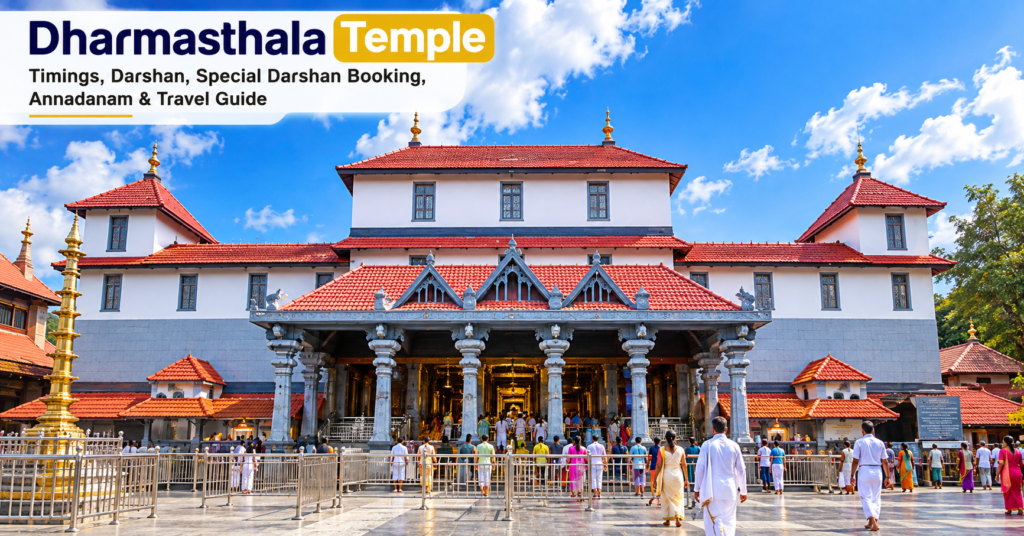
Dharmasthala Temple Timings 2026
The Dharmasthala Temple darshan timings are generally divided into three main sessions during the day, with an afternoon closure between the midday and evening periods.
| Temple Activity | Timing |
|---|---|
| Praat Aarti / Morning Ritual | Around 6:00 AM |
| Morning Darshan | 6:30 AM–11:00 AM |
| Midday Darshan | 12:15 PM–2:30 PM |
| Afternoon Closure | 2:30 PM–5:00 PM |
| Evening Darshan | 5:00 PM–8:30 PM |
| Final Temple Closure | Around 9:00 PM–9:30 PM |
The most important planning point is that Dharmasthala darshan does not run continuously throughout the day.
Visitors arriving between 2:30 PM and 5:00 PM should not expect regular darshan during the afternoon closure.
Shorter interruptions can also happen during Mahapooja and other temple rituals, even within an otherwise open darshan session.
On major festival days, the normal schedule may also be adjusted.
Best Time for Dharmasthala Temple Darshan
For a quieter and more comfortable visit, early morning is usually the best time for Dharmasthala darshan.
A practical window is:
6:30 AM–8:00 AM
This gives visitors a chance to complete darshan before the larger daytime flow of pilgrims builds up.
Evening Darshan
The 5:00 PM–7:00 PM period can also be a good choice for visitors who prefer cooler weather and the evening devotional atmosphere.
When Is Dharmasthala Temple Most Crowded?
Higher crowds can generally be expected during:
- weekends
- public holidays
- Maha Shivaratri
- Laksha Deepotsava
- major festival dates
- peak pilgrimage periods
For families with elderly devotees or children, a regular weekday is usually easier than a major festival day.
Is Dharmasthala Temple Darshan Free?
Yes. General darshan at Dharmasthala Temple is free.
Visitors do not need to buy a paid ticket simply to have darshan of Lord Manjunatha.
The regular free queue is generally referred to as Sarva Darshan.
This distinction is useful because searches for Dharmasthala Special Darshan or Sannidhana Darshan can make first-time visitors assume that entry itself is paid.
In practice:
| Darshan Type | Entry |
|---|---|
| Sarva Darshan | Free |
| Sannidhana / Special Darshan | Paid priority option |
The paid darshan facility should be treated as an optional priority-access service, not as a compulsory entry ticket for Dharmasthala Temple.
Dharmasthala Special Darshan Booking 2026
The paid priority darshan option at Dharmasthala Temple is commonly referred to as Sannidhana Darshan or Special Darshan.
It is designed for devotees who want a more organized priority-access queue, especially on:
- weekends
- public holidays
- festival dates
- other high-crowd periods
The listed Dharmasthala Special Darshan ticket price is approximately:
₹200 per person
This paid option is not compulsory for temple entry. Regular Sarva Darshan remains free, as explained earlier.
Because ticket prices and booking conditions can change, the amount shown on the official booking portal at the time of payment should be treated as final.
How to Book Dharmasthala Sannidhana Darshan Online
Devotees can use the official Dharmasthala Temple online booking portal for eligible Special Darshan reservations.
Official website:
Step 1: Open the Official Dharmasthala Booking Portal
Go to the official website and select the available Darshan Booking / Sannidhana Darshan facility.
Avoid paying through unrelated third-party websites when the same service is available directly through the temple.
Step 2: Register or Sign In
Enter the details requested by the booking system.
These may include:
- name
- mobile number
- email address
Step 3: Select Sannidhana / Special Darshan
Choose the relevant Special Darshan option and check the available date, slot and current ticket amount.
Step 4: Enter Devotee Details
Provide the information requested for each visitor.
Depending on the booking system, this may include:
- devotee name
- age
- number of visitors
- valid identification details
Step 5: Complete Payment
Pay the displayed Special Darshan fee using the payment options currently supported by the portal.
These may include:
- UPI
- debit card
- credit card
- net banking
Step 6: Save the Booking Confirmation
After successful payment, save the digital ticket, booking confirmation or QR code shown by the portal.
Keep it accessible when you reach Dharmasthala and follow the reporting or entry instructions displayed on the confirmation.
Before Booking Special Darshan
Check these details carefully before payment:
date → darshan slot → number of devotees → names → ticket amount → reporting instructions
This is especially important if you are visiting Dharmasthala on a festival or other high-crowd date.
For a quieter weekday visit, the free Sarva Darshan queue may already be sufficient for many devotees, while Sannidhana Darshan is more useful when waiting time is the main concern.
Can Dharmasthala Special Darshan Be Booked Offline?
Dharmasthala Sannidhana / Special Darshan tickets may also be available at temple counters, subject to current availability.
If you plan to depend on an offline ticket instead of advance Dharmasthala Special Darshan online booking, reaching earlier is the safer approach.
This is especially important during:
- weekends
- public holidays
- Laksha Deepotsava
- Maha Shivaratri
- other high-crowd pilgrimage dates
For a normal weekday, same-day availability may be easier, but visitors travelling specifically for paid priority darshan should avoid assuming that an offline ticket will always be available.
If your travel date is fixed, advance online booking is usually the more predictable option, while offline booking is better treated as an alternative rather than a guarantee.
Why Is Dharmasthala Temple Unique?
What makes Dharmasthala Temple unusual is not simply the number of pilgrims it receives, but the way different religious traditions have continued within the same institution.
The central arrangement is distinctive:
| Tradition | Role at Dharmasthala |
|---|---|
| Shaiva | Lord Manjunatheshwara is worshipped as Shiva |
| Jain | The hereditary Heggade family administers the institution |
| Vaishnava | Temple rituals are performed by Vaishnava priests |
This combination is closely associated with the Dharmasthala principle of Sarva Dharma Sama Bhava — respect for different faiths.
Rather than functioning as competing identities, these traditions have become part of the same religious institution and are one of the main reasons Sri Manjunatheshwara Temple Dharmasthala is considered distinctive among major pilgrimage centres in Karnataka.
Dharmasthala Temple History
The traditional history of Dharmasthala begins with Birmanna Pergade, a Jain householder, and his wife.
According to the founding legend, they lived in the region historically known as Kudumapuram and were known for offering hospitality to travellers and guests.
The tradition tells of four divine visitors who came to their home and were treated with great respect.
Later, these visitors are said to have appeared to Pergade in a dream and revealed themselves as guardian deities connected with Dharma.
They became associated with four Daivas:
- Kalarahu
- Kalarkayi
- Kumara
- Kanyakumari
According to Dharmasthala tradition, Pergade then dedicated the site to the service of Dharma.
His descendants continued the responsibility of administering the institution and became the hereditary Heggades of Dharmasthala.
This origin story is best understood as the traditional founding legend of Dharmasthala, rather than as a modern archaeological account.
From Kudumapuram to Dharmasthala
The importance of this tradition lies in the idea that the institution developed around hospitality, Dharma and service, rather than around temple worship alone.
That philosophy later became closely connected with many of the features visitors associate with Dharmasthala today, including:
- Manjunatha worship
- Annadanam
- service to pilgrims
- the Heggade tradition
- respect across religious traditions
This gives the history section more relevance for a present-day visitor than simply presenting the founding legend as an isolated story.
Lord Manjunatha at Dharmasthala
The principal deity at Dharmasthala is Sri Manjunatheshwara, worshipped as a form of Lord Shiva.
The deity is worshipped in Shivalinga form, and Manjunatha Swamy darshan remains the central religious purpose of the pilgrimage for most devotees.
Although the temple has an unusual administrative and ritual structure, its main shrine remains fundamentally centred on Shiva worship.
This distinction is useful for first-time visitors because Dharmasthala’s Jain administration does not mean the main deity is Jain; Sri Manjunatheshwara is Lord Shiva.
Sri Annappa Swami at Dharmasthala
Sri Annappa Swami is another important figure within the Dharmasthala religious tradition.
He is strongly associated in local belief with:
- protection of Dharma
- justice
- righteous conduct
- guardianship of the sacred institution
This connection helps explain why Dharmasthala is understood as more than a single Shiva temple.
The wider pilgrimage tradition includes beliefs and worship associated with Manjunatheshwara, the Daivas and Sri Annappa Swami, all connected through the larger concept of Dharma.
For visitors interested in the religious meaning of the site rather than only completing darshan, understanding Annappa Swami adds important context to the Dharmasthala pilgrimage.
Annapoorneshwari Worship at Dharmasthala
Dharmasthala also includes worship associated with Goddess Annapoorneshwari, the divine form connected with nourishment and food.
This has particular relevance in a pilgrimage centre widely known for Annadanam and feeding devotees.
Visitors planning to see multiple shrines in the Dharmasthala complex should not assume that every shrine follows the exact same schedule as the main Sri Manjunatheshwara Temple.
If you want to include Manjunatha darshan, Annappa Swami-related worship and Annapoorneshwari worship in the same visit, allow additional time rather than planning the entire trip around only the main darshan queue.
Annadanam at Dharmasthala Temple
One of the traditions most closely associated with Dharmasthala Temple is Annadanam, the serving of free meals to pilgrims.
The meal service is not treated simply as a visitor facility. It is part of Dharmasthala’s wider tradition of seva, hospitality and service without discrimination.
Devotees from different religious and social backgrounds can participate in the same community dining system, which is one reason Annadanam has become one of the most recognizable aspects of a Dharmasthala pilgrimage.
Is Annadanam Free at Dharmasthala?
Yes. Meals provided through the Annadanam tradition are free for pilgrims.
Visitors do not need to purchase a meal ticket simply to participate in the regular community dining service.
The practical arrangement can vary depending on crowd levels, particularly during:
- Laksha Deepotsava
- Maha Shivaratri
- weekends
- public holidays
- other high-pilgrimage periods
On busy days, follow the dining-hall queue and serving instructions operating at that time rather than expecting exactly the same movement as on an ordinary weekday.
How to Include Annadanam in Your Temple Visit
For first-time visitors, it is better to treat Annadanam as a separate part of the Dharmasthala experience rather than trying to fit it into a rushed darshan schedule.
A practical visit can be planned as:
Manjunatha Swamy darshan → other temple activities → Annadanam → rest or onward travel
Families with children or elderly devotees should allow extra time for walking, queue movement and dining instead of scheduling immediate onward travel after darshan.
Can Devotees Sponsor Annadanam at Dharmasthala?
Yes, devotees can support food-related seva and Annadanam through the temple’s recognized donation system.
If you want to sponsor or contribute towards Annadanam, check the current:
- donation category
- contribution amount
- payment method
- receipt or acknowledgement process
through official Dharmasthala channels.
Avoid making donations through unrelated individuals or third-party websites when an official option is available.
Major Festivals at Dharmasthala Temple
The experience at Sri Manjunatheshwara Temple changes significantly during major religious occasions.
Festival visits are best for devotees who specifically want the larger devotional atmosphere, while ordinary days are usually better for easier darshan and simpler travel.
Laksha Deepotsava at Dharmasthala
Laksha Deepotsava is one of the most distinctive annual celebrations associated with Dharmasthala.
The festival is traditionally connected with the lighting of a very large number of lamps, commonly described as one lakh lamps, creating a very different atmosphere from a normal temple day.
Visitors travelling specifically for Laksha Deepotsava should expect:
- much heavier pilgrim crowds
- longer darshan queues
- slower traffic approaching Dharmasthala
- greater parking pressure
- higher accommodation demand
- changes to normal visitor movement
Laksha Deepotsava is therefore better treated as a festival pilgrimage, not as an ordinary quick darshan trip.
Maha Shivaratri at Dharmasthala
Because Sri Manjunatheshwara is Lord Shiva, Maha Shivaratri is one of the most important religious occasions at Dharmasthala.
It is also one of the busiest periods for Manjunatha Swamy darshan.
Choose Maha Shivaratri if your priority is:
- Shiva worship
- festival atmosphere
- large-scale devotional participation
- experiencing Dharmasthala on an important Shaiva occasion
Choose a normal weekday instead if your priority is:
- shorter queues
- easier travel
- less crowd pressure
- a more relaxed first visit
Navratri at Dharmasthala
Navratri is another important religious period and can bring increased pilgrim activity to Dharmasthala.
Since the exact festival dates and temple-side arrangements vary by year, visitors planning specifically around Navratri 2026 should check the current programme before travelling.
For an ordinary temple visit, Navratri should be treated as a potentially busier period rather than assuming the regular weekday pattern will continue unchanged.
Best Time to Visit Dharmasthala Temple
For most travellers, October to March is the more comfortable period for visiting Dharmasthala.
Within that range, November to February is particularly suitable for visitors who want milder conditions for:
- road travel
- walking around the temple town
- standing in darshan queues
- visiting several Dharmasthala attractions in one day
What About the Monsoon?
Dharmasthala lies in the Western Ghats region, so its weather pattern differs from drier parts of interior Karnataka.
Heavy monsoon conditions can make:
- road journeys slower
- outdoor movement less convenient
- short regional trips more tiring
Visitors travelling during the rainy season should therefore consider weather conditions alongside temple timings.
Best Choice for a First Visit
For a first-time visitor, the easiest combination is usually:
ordinary weekday + early morning darshan + cooler season
Choose Laksha Deepotsava, Maha Shivaratri or another major festival only if the festival itself is an important part of your pilgrimage.
That distinction matters because a festival visit and a normal Dharmasthala darshan are two very different experiences.
What First-Time Visitors Should Know About Dharmasthala Temple
A few planning mistakes can make a Dharmasthala Temple visit more difficult than necessary.
Free Darshan and Special Darshan Are Not the Same
Regular Sarva Darshan is free.
The paid Sannidhana / Special Darshan is an optional priority facility, not a compulsory temple-entry ticket.
First-time visitors therefore do not need to buy a ₹200 ticket simply to have darshan of Lord Manjunatha.
Avoid Reaching During the Afternoon Closure
Regular darshan is generally unavailable between approximately:
2:30 PM and 5:00 PM
If you reach Dharmasthala during this period, you may have to wait until the evening darshan session begins.
This is especially important for travellers arriving by bus or road from Mangalore, Bengaluru or another distant city.
Rituals Can Temporarily Slow Darshan
Even during a scheduled darshan session, Mahapooja or another temple ritual may temporarily affect queue movement.
Treat the published timings as a planning framework rather than assuming that the queue will move continuously throughout every open hour.
Festival Darshan Requires a Different Plan
Maha Shivaratri and Laksha Deepotsava should be treated as festival pilgrimages rather than ordinary temple visits.
On such dates, allow extra time for:
- road traffic
- parking
- darshan queues
- Annadanam
- local transport
- accommodation check-in
Visitors seeking a simple first darshan will generally find an ordinary weekday easier.
Dharmasthala Temple Dress Code and Visitor Guidelines
There is no need to overcomplicate the Dharmasthala Temple dress code.
Wear simple, modest and respectful clothing that is also comfortable for walking and standing in queues.
Visitors should:
- remove footwear where instructed
- follow the designated darshan queue
- maintain cleanliness
- avoid disturbing ongoing worship
- observe current photography restrictions
- follow temple staff instructions
- respect rules displayed at individual shrines
The instructions displayed at the temple on the day of your visit should take priority over general online advice.
How to Reach Dharmasthala Temple
Dharmasthala is located in Dakshina Kannada district, Karnataka, in the Western Ghats region.
The temple town is primarily reached by road, with Mangalore serving as an important rail and air gateway.
Mangalore to Dharmasthala Temple
Mangalore is one of the most practical starting points for pilgrims travelling from outside the region.
Depending on the exact starting point and road route, Dharmasthala is roughly:
55–75 km from the Mangalore region
Common onward transport options include:
- bus
- taxi
- private car
Visitors planning a specific darshan or Special Darshan slot should keep sufficient road-travel buffer rather than calculating arrival based only on the distance.
Bangalore to Dharmasthala Temple
The road distance from Bengaluru to Dharmasthala is approximately:
300–340 km
depending on the chosen route.
Because this is a comparatively long journey, families may find it more comfortable to separate the road trip and temple visit instead of trying to complete both under a tight same-day schedule.
Before departure, check current:
- road conditions
- bus availability
- departure time
- expected arrival time
If your priority is early-morning Manjunatha darshan, an overnight stay in or near Dharmasthala can make the visit much easier.
Nearest Railway Station to Dharmasthala
The Mangalore region is a major railway gateway for Dharmasthala Temple.
After arriving by train, pilgrims can continue to Dharmasthala by:
- bus
- taxi
- private road transport
The most convenient railway station can still depend on your starting city and available train connection, so choose the route based on the complete journey rather than the rail distance alone.
Nearest Airport to Dharmasthala Temple
Mangalore International Airport is the nearest major air gateway commonly used for Dharmasthala.
The remaining journey is completed by road.
Approximate airport-to-Dharmasthala road distance:
around 80 km
The exact distance and travel time depend on the route and traffic conditions.
If you are arriving by air for a specific aarti or Special Darshan slot, allow time for:
airport exit → baggage collection → road journey → temple-area arrival → queue or reporting procedure
rather than planning from flight arrival time alone.
Local Transport in Dharmasthala
For shorter journeys within the temple town, visitors may find:
- auto-rickshaws
- local taxis
- shared transport
useful for travelling between:
- accommodation areas
- bus stops
- temple-related locations
- nearby pilgrimage facilities
Transport availability may be more limited very early in the morning or late at night.
If you have a fixed bus, train or flight connection after darshan, arrange your local transfer with enough buffer.
Accommodation in Dharmasthala
Dharmasthala has pilgrim-oriented accommodation and other lodging options in and around the temple town.
Staying overnight can be particularly useful if you want to:
- attend early-morning darshan
- avoid a long same-day return journey
- travel with elderly family members
- spend more time exploring Dharmasthala
- visit during a major religious programme
Demand increases sharply during:
- Maha Shivaratri
- Laksha Deepotsava
- weekends
- public holidays
- other major pilgrimage periods
Before travelling, confirm:
- room availability
- tariff
- check-in and check-out time
- identification requirements
- cancellation conditions
- distance from the temple
For major festival dates, advance reservation is much safer than depending on a room after arrival.
Dharmasthala Official Booking Portal
For Sannidhana Darshan, seva and eligible temple booking services, use the recognized Dharmasthala portal:
shridharmasthala.org
Regular Sarva Darshan remains free, so visitors should be cautious of unrelated websites that present paid booking as compulsory temple entry.
Final Words
A visit to Dharmasthala Temple is not defined only by darshan of Sri Manjunatheshwara.
What makes the pilgrimage distinctive is the way worship, service, hospitality and multiple religious traditions exist together within the same institution. The Manjunatha shrine, Heggade lineage, Annadanam tradition, Annappa Swami worship and the idea of Sarva Dharma Sama Bhava all contribute to the identity of Dharmasthala.
For first-time visitors, the best approach is not to try to cover every ritual, shrine and facility in a single rushed visit. Choose the part of the pilgrimage that matters most to you and allow enough time to experience it properly.
Dharmasthala is best understood not as a single temple stop, but as a living pilgrimage institution built around Dharma, worship and service.