
At Shrinathji Temple in Nathdwara, Rajasthan, darshan follows a rhythm unlike most temples. The sanctum does not remain continuously open from morning to night. Instead, devotees see Shrinathji through a series of daily Jhankis, each representing a different moment in the Lord’s day—from waking and dressing to meals, rest, evening worship and finally Shayan.
That makes timing the most important part of planning a Nathdwara visit. Arriving between Jhankis can mean waiting for the next opening, while reaching before Mangala, Rajbhog, Aarti or another major darshan period can give you a much more meaningful temple experience.
The Nathdwara Temple Board also provides official online facilities for darshan booking, Manorath requests, Vastra Seva, Samagri Seva and accommodation. Visitors searching for “VIP Darshan” should therefore understand that Nathdwara’s system is closely tied to special darshan arrangements, Manorath and seva-based access, rather than a simple permanent ₹300 or ₹500 fast-darshan ticket available throughout the day.
This updated Shrinathji Temple Nathdwara 2026 guide covers all eight daily Jhankis, temple timings, online darshan booking, special darshan and Manorath, temple rules, major festivals, accommodation and how to plan your visit without losing hours between darshan sessions.
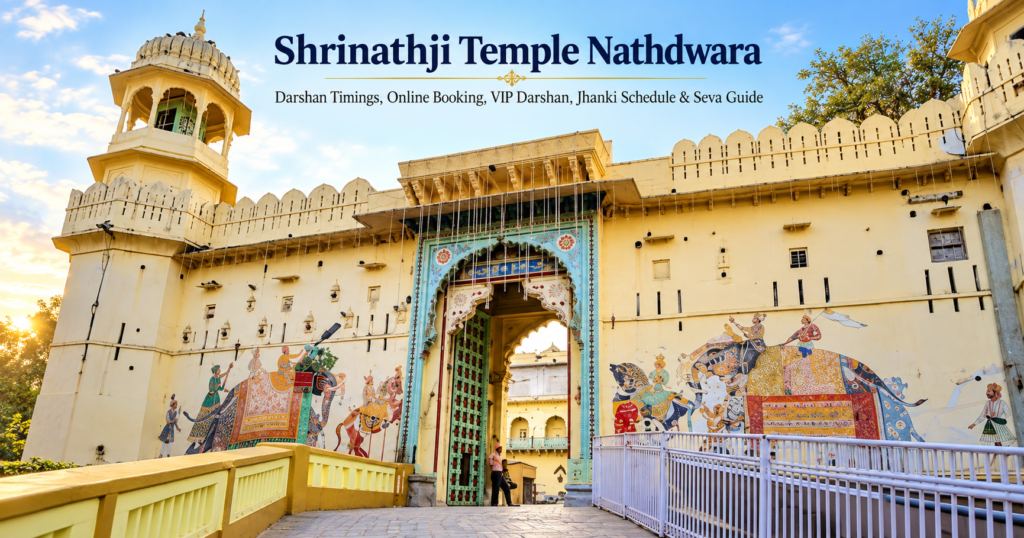
Shrinathji Temple Nathdwara 2026: Quick Information
Shrinathji Temple in Nathdwara is the principal centre of the Pushtimarg tradition associated with Shri Vallabhacharya and is dedicated to Shrinathji, the form of Lord Krishna traditionally connected with lifting Govardhan Hill.
Unlike temples that remain continuously open, Nathdwara follows eight daily Jhanki darshans, so visitors should plan around the actual darshan windows for their date.
| Shrinathji Temple Detail | 2026 Information |
|---|---|
| Temple | Shrinathji Temple |
| Location | Nathdwara, Rajsamand District, Rajasthan |
| Main Deity | Shrinathji – Lord Krishna |
| Tradition | Pushtimarg |
| Daily Darshan System | Eight Jhankis |
| Jhanki Sequence | Mangla, Shringar, Gwal, Rajbhog, Uthapan, Bhog, Aarti, Shayan |
| First Darshan | Mangla |
| Main Midday Darshan | Rajbhog |
| Final Darshan | Shayan |
| General Darshan | Free |
| Online Darshan Booking | Available through official Temple Board portal |
| Manorath | Available through official Temple Board system |
| Vastra / Samagri Seva | Available |
| Accommodation Booking | Available through official Temple Board |
| Special Darshan Access | Depends on current official darshan / Manorath arrangement |
| Major Festivals | Janmashtami, Annakut, Holi, Diwali |
| Nearest Major City | Udaipur |
| PIN Code | 313301 |
| Official Website | https://www.nathdwaratemple.org/ |
The most important thing for a first-time visitor is simple:
Do not plan Nathdwara like an all-day open temple.
Shrinathji darshan happens in separate Jhanki periods, with the doors closing between many of them. Always check the current day’s Jhanki schedule on the official Temple Board website before deciding when to reach Nathdwara.
The official portal also supports Darshan Booking, Manorath requests, Vastra Seva, Samagri Seva and temple accommodation booking, so it should be the main planning source for your visit.
Shrinathji Temple Darshan Timings 2026
Shrinathji Temple follows a distinctive eight-Jhanki darshan system rather than remaining continuously open throughout the day.
The eight daily darshans are:
Mangala → Shringar → Gwal → Rajbhog → Utthapan → Bhog → Aarti → Shayan
Between these Jhankis, the temple doors close while Shrinathji’s seva, shringar, bhog and other rituals are performed.
| Jhanki | Typical Darshan Period | Meaning |
|---|---|---|
| Mangala | Around 5:00–6:30 AM | Shrinathji awakens for the day |
| Shringar | Around 7:00–8:00 AM | Dressing and ornamentation |
| Gwal | Around 9:00–9:45 AM | Krishna prepares to go with the cows |
| Rajbhog | Around 11:00 AM–12:15 PM | Principal midday meal darshan |
| Utthapan | Around 3:30–4:00 PM | Shrinathji awakens after afternoon rest |
| Bhog | Around 4:30–5:15 PM | Afternoon food offering |
| Aarti / Sandhya | Around 5:00–6:00 PM | Evening worship |
| Shayan | Around 6:45–7:45 PM | Final darshan before resting for the night |
These timings are best treated as planning windows rather than fixed year-round times.
The daily schedule can change according to:
- Season
- Festival or Utsav
- Shringar
- Bhog
- Religious calendar
- Special Manorath arrangements
For this reason, the current day’s Jhanki timings published by the Nathdwara Temple Board should always take priority over a general timetable.
Why Does Shrinathji Temple Have Eight Jhankis?
The eight darshans are not simply separate entry slots.
In Pushtimarg, Shrinathji is served with the intimacy and care given to a living divine child. His day therefore follows a complete routine—waking in the morning, dressing, going out, taking meals, resting, returning for evening worship and finally retiring for the night.
Each Jhanki represents one stage of that daily seva.
Mangala is the first glimpse of Shrinathji after waking and is especially popular with early-morning devotees.
During Shringar, the deity appears dressed in carefully selected vastra, jewellery, flowers and seasonal ornamentation.
Gwal reflects Krishna’s pastoral childhood and his going out with the cows.
Rajbhog is one of the principal and most popular Jhankis of the day, associated with the main midday meal. It can become particularly crowded on weekends, holidays, Ekadashi and festival dates.
After the afternoon rest, Utthapan marks Shrinathji’s awakening. It is a useful darshan for visitors reaching Nathdwara later in the day.
Bhog follows with another food offering, before the temple moves into the evening worship period.
The Aarti or Sandhya Jhanki is especially atmospheric and is popular with devotees who want to experience evening worship along with darshan.
Finally, Shayan Darshan represents Shrinathji preparing to rest for the night and marks the end of the regular daily Jhanki sequence.
For first-time visitors, the practical lesson is simple: choose the Jhanki you most want to attend and reach the temple before that darshan begins. Arriving just after the doors close can mean waiting until the next scheduled Jhanki.
Shrinathji Temple Darshan Booking 2026
Shrinathji Temple provides an official online darshan booking facility through the Nathdwara Temple Board website.
Official website:
https://www.nathdwaratemple.org
The same official portal also provides access to:
- Darshan Booking
- Manorath
- Vastra Seva
- Samagri Seva Bhent
- Shriji Seva Bhent
- Cottage Booking
- Religious calendar and Shringar Pranalika
For anyone planning advance darshan or seva, this should be the main booking source.
How to Book Shrinathji Darshan Online
Step 1: Open the Official Temple Website
Visit:
https://www.nathdwaratemple.org
Choose Darshan Booking from the available services.
Step 2: Log In or Register
The official system uses a devotee account for bookings and booking history.
New users can register, while existing users can log in with their account details.
Step 3: Select the Visit Date
Choose the date on which you plan to visit Nathdwara.
Availability can differ according to:
- Religious calendar
- Festival dates
- Jhanki schedule
- Booking capacity
Step 4: Choose the Available Darshan
Select the darshan option shown for your chosen date.
Because Nathdwara follows separate Jhanki darshan periods, availability should be checked for the actual date rather than assumed from a general timetable.
Step 5: Enter the Required Details
Provide the devotee information requested by the official booking system.
Check names, mobile number and other details carefully before proceeding.
Step 6: Review and Complete the Booking
Where payment or Nyochhavar applies, review the selected darshan, date and amount before completing the transaction.
Use only the payment options provided through the official Temple Board website.
Step 7: Save the Confirmation
Keep the booking confirmation or receipt available during your visit.
If the booking includes a specific reporting instruction or darshan period, follow that information rather than relying only on the general Jhanki schedule.
Important Booking Tip
Darshan Booking and Manorath are not the same service.
Darshan Booking is used for available darshan arrangements, while Manorath is connected with specific devotional offerings and may include separate conditions, Prasad options or a darshan pass.
Always select the service that matches the purpose of your visit.
Is Shrinathji Temple General Darshan Free?
Yes. Ordinary darshan at Shrinathji Temple is free.
Devotees do not need to purchase a compulsory paid ticket simply to join the public darshan during an open Jhanki.
Paid arrangements at Nathdwara are connected with specific official bookings, Manorath, seva or special darshan-pass facilities, rather than a mandatory general entry charge.
Shrinathji Temple VIP Darshan 2026
Visitors often search for Shrinathji VIP Darshan, but Nathdwara does not need to be described as having one permanent ₹300, ₹500 or similar all-day VIP ticket.
The official system is more specific and includes:
- Free general darshan
- Online darshan booking
- Manorath services
- Seva-based arrangements
- Darshan passes linked with eligible Manorath bookings
For most visitors, the safest approach is to use the official Nathdwara Temple Board portal and choose whatever darshan or seva arrangement is actually available for the selected date.
Avoid relying on unofficial websites or agents promising a fixed “VIP package” unless the same facility is clearly shown by the Temple Board.
What About the ₹1,100 Group VIP Ticket?
Some older or third-party guides mention a ₹1,100 group ticket for up to five devotees.
Do not treat this as a permanent 2026 public VIP tariff unless that exact option appears in the official booking system for your visit date.
Nathdwara services, Nyochhavar amounts and access arrangements can vary according to the Jhanki, Manorath, Utsav and religious calendar.
Shrinathji Manorath Seva
Manorath is a much more important concept at Nathdwara than a generic commercial-style VIP ticket.
A Manorath is a devotional seva or offering made to Shrinathji with a particular religious intention. The Nathdwara Temple Board allows devotees to submit Manorath Vinanti through its official website.
Depending on the selected Manorath, the official system may include options related to:
- Seva
- Prasad
- Nyochhavar
- Darshan Pass
- Other devotional arrangements
The official Manorath form specifically asks devotees to select whether a Darshan Pass is required.
It also instructs Manorath devotees to complete the relevant entry with the temple department and collect the applicable pass according to the booking conditions.
For current Manorath availability and terms, use:
https://www.nathdwaratemple.org
Shrinathji Temple Online Seva Options
Apart from darshan booking, the official Nathdwara Temple Board system also supports several devotional services connected with Shrinathji’s daily seva tradition.
These include:
- Vastra Seva – offerings connected with the clothing and shringar of Shrinathji
- Samagri Seva Bhent – devotional offerings connected with seva materials
- Shriji Seva Bhent – contributions made through the official temple system
- Manorath – specific devotional seva or offering arrangements
- Cottage Booking – temple accommodation reservation
Availability can depend on the date, religious calendar, Utsav and temple schedule.
These services are better understood as part of Pushtimarg seva tradition, rather than as simple paid upgrades to ordinary darshan.
For current availability, use the official Nathdwara Temple Board website:
https://www.nathdwaratemple.org
Best Jhanki for First-Time Visitors
There is no single “best” Shrinathji darshan because each Jhanki represents a different stage in the Lord’s daily seva.
A simple comparison is:
| Your Priority | Better Jhanki |
|---|---|
| Early-morning experience | Mangala |
| Shringar and decoration | Shringar |
| Krishna’s cowherd form | Gwal |
| Main midday darshan | Rajbhog |
| Afternoon visit | Utthapan |
| Evening worship | Aarti |
| Final darshan of the day | Shayan |
For a first visit, Mangala, Rajbhog and evening Aarti are usually the three most practical Jhankis to consider.
Mangala gives the first darshan of the day and suits devotees who prefer an early-morning atmosphere.
Rajbhog is one of the principal daily Jhankis and is a strong choice if you want a major daytime darshan.
Aarti is ideal for visitors who prefer the evening devotional atmosphere.
The right choice depends more on your travel schedule and devotional preference than on one Jhanki being universally better than another.
How Early Should You Reach Before a Jhanki?
On an ordinary weekday, reaching around 20–30 minutes before the scheduled Jhanki is generally a sensible planning approach.
Allow more time during:
- Saturday and Sunday
- Public holidays
- Janmashtami
- Annakut
- Holi
- Diwali
- Major Pushtimarg Utsavs
For heavily attended sessions such as Rajbhog or major festival darshan, reaching roughly 30–60 minutes early is more practical.
The important point is not to arrive several hours early without reason.
Because the temple closes between Jhankis, the best strategy is to:
check the current day’s darshan timing → choose the Jhanki you want → reach shortly before that opening
This makes a Nathdwara visit far more efficient than treating the temple like an all-day continuous darshan shrine.
Shrinathji Temple Mobile Phone and Photography Rules
Visitors should follow the current instructions displayed by the Nathdwara Temple Board and temple staff regarding mobile phones, cameras, photography and videography.
Because Shrinathji Temple is a highly sacred and crowded worship space, it is best to carry only essential belongings and avoid using cameras or phones in sensitive darshan areas unless clearly permitted.
For a smoother visit, avoid carrying:
- Large bags
- Dedicated photography equipment
- Unnecessary electronic devices
- Extra luggage
Festival days are especially crowded, so travelling light makes queue movement much easier.
Shrinathji Temple Dress Code
There is no need to make the dress-code section complicated.
Wear clean, modest and respectful clothing suitable for a Vaishnava temple.
Traditional Indian clothing such as dhoti, kurta-pyjama, saree or salwar-kameez is appropriate, but ordinary visitors do not need to purchase a special outfit just for darshan.
Comfort also matters because Nathdwara can involve considerable standing and waiting between Jhankis.
Shrinathji Temple Festival Timings
The normal eight-Jhanki schedule can change significantly during major Pushtimarg festivals and Utsavs.
Important occasions include:
- Janmashtami
- Annakut / Govardhan Puja
- Holi
- Diwali
- Other major Pushtimarg Utsavs
Special bhog, shringar, Manorath and religious programmes can alter the opening time and duration of individual Jhankis.
For a festival visit, always check the current day’s darshan schedule on the official Nathdwara Temple Board website:
https://www.nathdwaratemple.org
The Temple Board publishes current darshan information and religious-calendar details through the official portal.
Janmashtami at Shrinathji Temple
Janmashtami is one of the most important Krishna festivals at Nathdwara.
Visitors should expect:
- Special Shringar
- Festival Bhog
- Modified Jhanki timings
- Large darshan queues
- Heavy traffic in Nathdwara
- Strong demand for accommodation
If your visit falls around Janmashtami, plan the Jhanki first and accommodation second, rather than assuming you can arrive at any hour and enter immediately.
Annakut at Nathdwara
Annakut, celebrated around Govardhan Puja, has exceptional significance at Shrinathji Temple because Shrinathji is closely associated with Govardhan Hill.
The festival is known for elaborate food offerings and attracts very large numbers of devotees.
For someone interested in the Pushtimarg seva tradition, Annakut is one of the most distinctive times to visit Nathdwara.
For an easier first darshan, however, an ordinary weekday is far more practical.
Holi at Shrinathji Temple
Holi is another major celebration in Nathdwara’s Pushtimarg calendar.
Special shringar, devotional music and festival customs make the temple experience very different from an ordinary darshan day.
Visitors should therefore follow the festival-specific Jhanki schedule rather than relying on the normal daily timing table.
Why Shrinathji Is Worshipped at Nathdwara
Shrinathji represents Lord Krishna lifting Govardhan Hill, and the deity was originally worshipped in the Govardhan region of Braj.
According to temple tradition, Shrinathji was moved from Govardhan during a period of political uncertainty. During the journey toward Rajasthan, the chariot carrying the deity became fixed at the place that later developed into Nathdwara.
The event came to be understood as Shrinathji choosing this location as his new home.
The name Nathdwara is commonly understood as “Gateway to the Lord.”
Today, the town’s religious identity remains centred on Shrinathji and the Pushtimarg seva tradition.
Pushtimarg and Shrinathji
Shrinathji Temple is the principal centre of Pushtimarg, the devotional tradition founded by Shri Vallabhacharya. The Nathdwara Temple Board itself maintains extensive sections devoted to Vallabhacharya, Pushtimarg, Pushtimargiya Seva and Darshan Seva.
Pushtimarg places special emphasis on Seva, or loving personal service to the deity.
This is why Shrinathji’s day is organised around waking, dressing, food offerings, rest, music, seasonal decoration and finally Shayan. The eight daily Jhankis allow devotees brief glimpses into that continuing seva.
Best Time to Visit Shrinathji Temple
For most first-time visitors, the easiest combination is:
October to March + ordinary weekday
The cooler Rajasthan weather makes walking around Nathdwara more comfortable, while ordinary weekdays are generally easier than festival periods.
| Visit Goal | Better Time |
|---|---|
| Lower Crowd | Monday–Thursday |
| Comfortable Weather | October–March |
| Mangala Darshan | Early morning |
| Rajbhog Experience | Late morning |
| Evening Aarti | Evening Jhanki |
| Festival Experience | Janmashtami, Annakut or Holi |
If your priority is simple darshan, choose a normal weekday.
If your priority is the festival atmosphere and Pushtimarg Utsav tradition, Janmashtami, Annakut and Holi offer a much richer experience but also bring much heavier crowds and higher accommodation demand.
Shrinathji Temple Accommodation
The Nathdwara Temple Board provides several official accommodation options that can be booked through its website.
Current Temple Board properties include:
- New Cottage
- Shri Damodar Dham
- Dhiraj Dham
- Vallabh Vilas Lords Plaza
- Chitalwala Vishranti Gruh
- Agrawal Cottage
- Dharamshalas
The official website currently confirms that New Cottage offers both AC and non-AC room combinations with online booking, while Chitalwala Vishranti Gruh is one of the closest Temple Board accommodations to the temple.
Agrawal Cottage is located at Govind Chowk near the temple and provides simple non-AC pilgrim accommodation.
For visitors targeting Mangala Darshan, staying within Nathdwara is much more practical than travelling from Udaipur before dawn.
Room availability matters more than choosing a particular property during:
- Janmashtami
- Annakut
- Holi
- Diwali
- Long weekends
- Major Pushtimarg Utsavs
How to Book Shrinathji Temple Accommodation
Use the official Nathdwara Temple Board website:
Choose Cottage Booking, then:
- Select your stay dates.
- Check available Temple Board properties.
- Choose the required room.
- Enter the booking details.
- Complete the applicable Nyochhavar/payment.
- Save the confirmation for check-in.
The official website currently provides direct online cottage booking and booking-history access.
How to Reach Shrinathji Temple Nathdwara
Nathdwara is located in Rajsamand district, Rajasthan, around 48 km northeast of Udaipur.
From Udaipur
Road travel is the most practical option from Udaipur.
Visitors can use:
- Bus
- Taxi
- Private car
The journey is normally straightforward, making Nathdwara suitable for either a day trip or an overnight temple visit.
For Mangala Darshan, however, staying in Nathdwara itself is usually easier than leaving Udaipur before sunrise.
By Train
Mavli Junction is one of the nearest useful railheads and is approximately 28 km from Nathdwara according to Rajasthan government information.
Udaipur City Railway Station is another practical option because it has wider rail connectivity.
From either station, continue to Nathdwara by road.
By Air
The nearest major airport is Maharana Pratap Airport, Udaipur.
From the airport, continue toward Nathdwara by taxi or private road transport.
For travellers arriving from another state, a practical plan is:
Reach Udaipur → continue to Nathdwara → stay overnight if targeting Mangala → attend the chosen Jhanki the next day
Shrinathji Temple Contact Details
Visitors may need to contact the Nathdwara Temple Board for questions related to current Jhanki timings, darshan arrangements, Manorath, cottage booking, festival schedules or other temple services.
| Contact Detail | Official Information |
|---|---|
| Temple Administration | Nathdwara Temple Board |
| Office | Administrative Building, Opposite Risala Chowk |
| Location | Nathdwara, Rajsamand, Rajasthan |
| PIN Code | 313301 |
| Phone | 02953-232482 |
| Alternate Phone | 02953-233336 |
| Official Website | https://www.nathdwaratemple.org/ |
When Should You Contact Nathdwara Temple Board?
Calling or checking the official website is particularly useful when you need confirmation about:
- Current-day Shrinathji Jhanki timings
- Festival or Utsav schedule changes
- Darshan booking
- Manorath and darshan-pass arrangements
- Vastra or Samagri Seva
- Temple Board accommodation
- Cottage booking availability
- Special programmes during Janmashtami, Annakut, Holi or Diwali
For ordinary planning, the official website is usually the fastest starting point because the Jhanki schedule can change by season, festival and religious calendar.
Official Online Services
The Nathdwara Temple Board website currently provides access to important pilgrim services including:
Darshan Booking → Manorath → Vastra Seva → Samagri Seva → Cottage Booking → Current Darshan Information
Official website:
https://www.nathdwaratemple.org
If your visit depends on a particular Jhanki, Manorath or accommodation booking, verify it through the official Temple Board system rather than relying on an old timetable or third-party contact number.
FAQs
What are Shrinathji Temple timings in 2026?
Shrinathji Temple does not follow one continuous opening period. Darshan is offered through eight Jhankis from early morning until evening, with the temple closed between several sessions.
How many darshans are there at Shrinathji Temple?
There are eight daily Jhankis: Mangala, Shringar, Gwal, Rajbhog, Utthapan, Bhog, Aarti and Shayan.
What time is Mangala Darshan?
Mangala takes place early in the morning, generally around 5:00–6:00 AM depending on season and the day’s temple schedule.
What time is Rajbhog Darshan?
Rajbhog generally takes place around late morning to noon, commonly around 11:00 AM onward.
Is Shrinathji Temple darshan free?
Yes. Regular general darshan is free.
Can Shrinathji darshan be booked online?
Yes. The official Nathdwara Temple Board website currently provides a Darshan Booking facility.
What is the official Shrinathji Temple booking website?
Use:
https://www.nathdwaratemple.org
Is VIP Darshan available at Shrinathji Temple?
Special darshan access can be associated with official booking, Manorath or seva arrangements. Visitors should not assume there is one permanent public ₹300 or ₹500 VIP ticket unless that option appears in the official system.
Is there a ₹1,100 Shrinathji group darshan ticket?
Some outside guides mention such a ticket, but it should not be treated as a permanent 2026 tariff unless it is displayed by the official Nathdwara Temple Board for the selected date.
What is Manorath at Shrinathji Temple?
A Manorath is a devotional seva or offering made with a particular religious intention. The official temple website provides online Manorath Vinanti services.
Are mobile phones allowed inside Shrinathji Temple?
Restrictions apply inside the temple, and photography/videography are prohibited in sacred areas. Follow the current entry instructions for mobile phones.
What is the best Jhanki for Shrinathji darshan?
For first-time visitors, Mangala, Rajbhog and evening Aarti are especially popular, although every Jhanki represents a different part of Shrinathji’s daily seva.
Which is the best day to visit Nathdwara?
An ordinary Monday–Thursday is usually easier if you want lower crowds.
What is the best time of year to visit Nathdwara?
October to March offers more comfortable weather for most visitors.
Which festivals are biggest at Shrinathji Temple?
Janmashtami, Annakut, Holi and Diwali are among the major celebrations.
Is accommodation available through Shrinathji Temple?
Yes. The Nathdwara Temple Board manages several accommodation properties and provides online cottage booking.
How far is Nathdwara from Udaipur?
Nathdwara is approximately 45–50 km from Udaipur.
Which airport is nearest to Shrinathji Temple?
Maharana Pratap Airport, Udaipur is the nearest major airport.
Final Thoughts
The most important thing to understand before visiting Shrinathji Temple Nathdwara in 2026 is that this is not a continuously open temple. Darshan happens through eight short Jhankis, and arriving between them may mean waiting until the doors open again.
For a first visit, choose the Jhanki you actually want rather than trying to spend the entire day outside the temple. Mangala is ideal for early-morning devotion, Shringar for the deity’s decoration, Rajbhog for the important midday darshan and Aarti for evening worship.
General darshan remains free, while the official Nathdwara Temple Board website provides online darshan booking and more specialised services such as Manorath, Vastra Seva and Samagri Seva. Visitors searching for VIP darshan should use these official facilities instead of assuming that an outside website’s ₹300, ₹500 or ₹1,100 package is a permanent temple tariff.
For the smoothest trip, check the actual day’s Jhanki timings on the official website, stay near the temple if you want Mangala Darshan, and avoid major festival dates if your priority is a short and peaceful queue.