
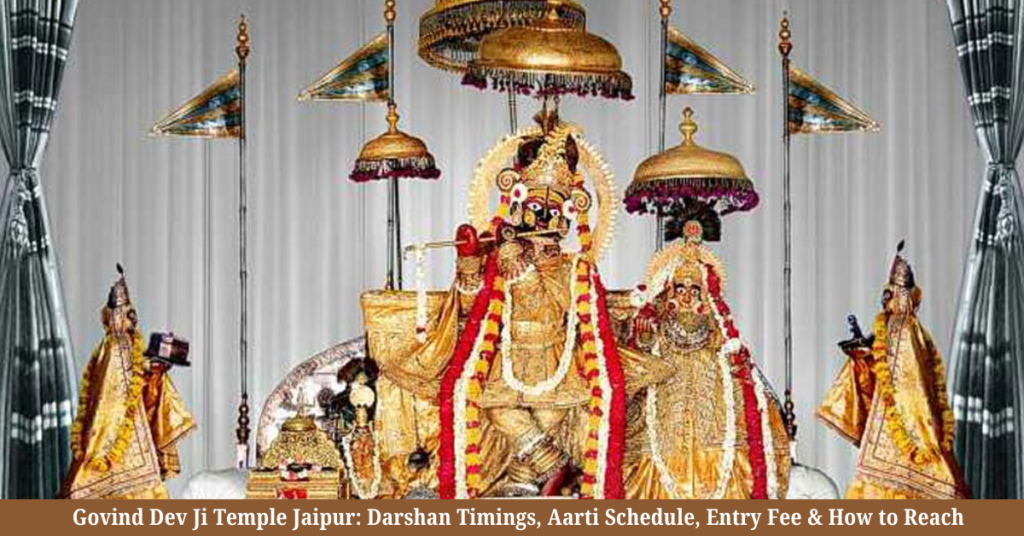
Govind Dev Ji Temple in Jaipur is one of Rajasthan’s most important Krishna temples and a major place of worship for devotees visiting the Pink City. Located at Jai Niwas Garden near the City Palace complex, the temple is dedicated to Shri Radha-Govind Dev Ji and has a particularly strong connection with Jaipur’s Kachwaha royal family.
Unlike many temples where visitors arrive at any point during broad opening hours, worship at Govind Dev Ji Temple Jaipur follows a distinctive daily sequence of seven Jhankis and aartis. Devotees therefore often plan their visit around Mangla, Dhoop, Shringar, Rajbhog, Gwal, Sandhya or Shayan darshan rather than simply checking the temple opening time.
The temple is especially busy during Janmashtami, Holi and other Krishna-related festivals, when large numbers of devotees gather for special darshan and celebrations. Ordinary darshan is free, and visitors generally do not need to purchase a ticket simply to enter the temple for regular worship.
As the Govind Dev Ji darshan timings change according to season and special occasions, anyone travelling specifically for an aarti should check the latest timetable before reaching the temple. The temple administration publishes current information through the official Shri Govind Dev Ji Temple website.
This guide covers the Govind Dev Ji Temple timings in 2026, seven daily aartis, entry fee, history, location, festivals, travel routes, nearby attractions and practical information needed to plan a visit.
Govind Dev Ji Temple Jaipur: Quick Information
| Detail | Information |
|---|---|
| Temple | Shri Govind Dev Ji Temple |
| Location | Jai Niwas Garden, Jalebi Chowk, Jaipur, Rajasthan |
| Main Deities | Shri Govind Dev Ji and Radha Rani |
| Religious tradition | Gaudiya/Madhva-Gaudiya tradition |
| Famous for | Seven daily Jhankis, Krishna worship, royal Jaipur connection |
| Entry fee | No general entry fee |
| Regular darshan | Available daily according to Jhanki schedule |
| Main festivals | Janmashtami, Holi/Phagotsav, Annakut and other Krishna festivals |
| Nearest railway station | Jaipur Junction |
| Nearest airport | Jaipur International Airport |
| Official website | https://govinddevji.net/ |
| Temple contact | 0141-2619413 |
| govind.mandir@gmail.com |
Govind Dev Ji Temple Darshan Timings 2026
The most important point to understand about Govind Dev Ji Temple darshan timings is that the temple does not operate like a sightseeing monument with uninterrupted access throughout the day.
Darshan takes place through a sequence of Jhankis associated with the daily worship of Shri Govind Dev Ji. The sanctum closes between these ritual periods, and the schedule can move according to the season.
During the warmer part of the year, commonly followed timings place morning darshan from around 4:30 AM until noon, followed by an afternoon closure and evening worship continuing until approximately 9:00–9:30 PM.
A practical summer overview is:
| Period | Approximate Darshan Time |
|---|---|
| Morning opening | Around 4:30 AM |
| Morning Jhankis | 4:30 AM–12:00 PM |
| Midday closure | After Rajbhog |
| Evening reopening | Around 5:30–5:45 PM |
| Evening Jhankis | Until around 9:00–9:30 PM |
These should not be treated as fixed year-round hours. Govind Dev Ji Temple timings in winter are adjusted, and festival-day schedules may be entirely different.
Visitors looking for Govind Dev Ji Temple timings today should therefore check the current timetable published by the temple before travelling, particularly if they want to attend Mangla or Shayan Aarti.
Govind Dev Ji Temple Aarti Timings
One of the defining features of Govind Dev Ji Temple is the observance of seven principal Jhankis every day.
The sequence is:
- Mangla
- Dhoop
- Shringar
- Rajbhog
- Gwal
- Sandhya
- Shayan
The timings vary seasonally, but the commonly followed warmer-season schedule is approximately:
| Jhanki / Aarti | Approximate Time |
|---|---|
| Mangla Aarti | Around 4:30 AM |
| Dhoop Aarti | Around 7:30 AM |
| Shringar Aarti | Around 9:30 AM |
| Rajbhog | Around 11:00 AM |
| Gwal Aarti | Around 5:30–5:45 PM |
| Sandhya Aarti | Around 6:30–6:45 PM |
| Shayan Aarti | Around 8:30–9:00 PM |
The exact opening and closing minutes of each Jhanki can change.
Mangla Aarti
Mangla Aarti at Govind Dev Ji Temple is the first darshan of the day and one of the most sought-after worship periods for devotees.
It takes place early in the morning. Jaipur summers can be extremely hot later in the day, so Mangla darshan also has the practical advantage of allowing visitors to complete their temple visit before temperatures rise.
Those planning specifically for Mangla Aarti should reach the temple well before the scheduled opening because devotees may begin gathering in advance.
Dhoop and Shringar Jhanki
The morning worship continues with Dhoop Jhanki, followed later by Shringar Jhanki.
Shringar darshan is particularly significant because the deities are presented after adornment. The clothing and decoration of Shri Radha-Govind Dev Ji form an important part of the temple’s living ritual tradition.
Rajbhog Darshan
Rajbhog marks the late-morning offering of food to the deity.
After Rajbhog, regular darshan generally stops for the afternoon interval. Visitors arriving around noon should therefore be especially careful about checking the current timetable rather than assuming that the temple remains continuously open.
Gwal and Sandhya Aarti
The temple reopens for the evening sequence with Gwal Jhanki, followed by Sandhya Aarti.
Sandhya is one of the most convenient options for travellers spending the daytime visiting Jaipur’s monuments because the temple can be combined with City Palace, Jantar Mantar and Hawa Mahal before returning for evening darshan.
Shayan Aarti
Shayan Aarti is the final Jhanki of the day and symbolically concludes the deity’s daily schedule.
Visitors wishing to attend Shayan darshan should check the exact closing time for the season because winter evening timings may be earlier than those followed during summer.
Does Govind Dev Ji Temple Have an Entry Fee?
There is no general entry fee for Govind Dev Ji Temple darshan.
Devotees can enter for regular worship without purchasing a sightseeing ticket or general darshan ticket.
This should not be confused with paid services, offerings or pooja-related facilities that may separately be available through temple-authorized channels.
For donations or religious offerings, use only official temple facilities. The temple administration itself advises devotees not to give money, gifts or other benefits to temple employees in expectation of preferential treatment.
Is Online Booking Required for Govind Dev Ji Temple Darshan?
For normal darshan, visitors should not assume that a paid online ticket is required.
The official temple website provides information relating to religious services and online offerings, but ordinary Govind Dev Ji darshan is generally accessible without buying a regular admission ticket.
Anyone searching for Govind Dev Ji Temple online booking because of a special pooja, festival arrangement or specific service should use only the official temple website:
Avoid unofficial agents or websites claiming guaranteed priority entry unless the service is clearly authorized by the temple administration.
History of Govind Dev Ji Temple Jaipur
The history of Govind Dev Ji is closely connected with both Vrindavan and Jaipur.
The present Jaipur temple was established during the reign of Maharaja Sawai Jai Singh II, the founder of Jaipur. Government temple records date its establishment to 1735 AD.
The deity had previously been worshipped in Vrindavan. During a politically unsettled period in North India, the sacred image was moved through different locations before eventually reaching the Jaipur region.
Govind Dev Ji became deeply associated with the Kachwaha rulers and came to be regarded as the presiding deity of Jaipur.
The temple occupies a prominent location in the royal precinct near Chandra Mahal. Its positioning reflects the historic relationship between the deity and Jaipur’s ruling family.
Religious Significance and the Legend of the Idol
Govind Dev Ji is worshipped as a form of Lord Krishna, together with Radha Rani.
According to temple tradition, the sacred image is associated with Bajranabh, the great-grandson of Lord Krishna. Religious tradition holds that Bajranabh attempted to create images representing Krishna based on descriptions preserved within his family.
The Govind Dev Ji image consequently carries exceptional devotional importance in the Vaishnava tradition.
Such accounts belong to religious tradition and should be understood separately from documented historical information about the temple’s later establishment in Vrindavan and Jaipur.
The temple is associated with the Gaudiya Vaishnava tradition, and Govind Dev Ji also has historical links with the devotional movement connected with Shri Chaitanya Mahaprabhu and Rupa Goswami.
Architecture of Govind Dev Ji Temple
Govind Dev Ji Temple differs noticeably from the towering stone temples often associated with Rajasthan.
Its architectural character is connected to Jaipur’s royal palace environment. Marble, stone, decorative panels, pillars and ornamental interiors contribute to its appearance, while the large worship area allows significant numbers of devotees to gather during major Jhankis.
The temple stands in alignment with the royal complex and historically allowed visual connection with Chandra Mahal.
A particularly important feature of the temple experience is the large space in front of the sanctum. During major aartis, devotees assemble facing the deity rather than moving through a narrow single-file darshan route.
The temple complex also includes gardens and associated religious spaces.
Best Time to Visit Govind Dev Ji Temple
For comfortable darshan, the early morning is usually one of the best times to visit Govind Dev Ji Temple Jaipur.
Mangla Aarti attracts dedicated devotees, but visiting early also helps avoid Jaipur’s intense daytime heat, particularly from April to June.
Those who prefer evening worship can plan around Sandhya Aarti, which is convenient after sightseeing in Jaipur’s old city.
For relatively easier movement, ordinary weekdays outside major festivals are preferable to Janmashtami, Holi and other special occasions.
Best Time for Different Visitors
| Visitor Preference | Suitable Time |
|---|---|
| Early spiritual darshan | Mangla Aarti |
| Avoiding afternoon heat | Early morning |
| Seeing decorated deity | Shringar Jhanki |
| Evening visit | Sandhya Aarti |
| Festival atmosphere | Janmashtami or Phagotsav |
| Lower crowd preference | Non-festival weekday |
Janmashtami at Govind Dev Ji Temple
Janmashtami is one of the most important festivals at Govind Dev Ji Temple Jaipur.
As a major Krishna temple, Govind Dev Ji attracts exceptionally large numbers of devotees during celebrations marking the birth of Lord Krishna. Special decorations, religious ceremonies and festival arrangements transform the temple complex.
Anyone planning a Janmashtami visit should expect much heavier crowds than on a normal day.
Road access, security arrangements and darshan procedures may also be changed temporarily. Checking current announcements before travelling is strongly advisable.
Holi and Phagotsav
Govind Dev Ji Temple is also closely associated with Holi and Phagotsav celebrations.
Krishna temples traditionally have a particularly strong connection with Holi, and celebrations at Govind Dev Ji draw large gatherings.
Festival visitors should not rely on the normal daily Jhanki schedule because special programmes can alter both worship and access timings.
Other important temple observances include Annakut, Patotsav and various Vaishnava festival days throughout the year.
Prasad at Govind Dev Ji Temple
Prasad forms an important part of a visit to Govind Dev Ji Temple.
Traditional sweets and offerings are associated with worship at the temple, and authorized facilities are available within or around the temple complex.
Visitors wishing to make offerings should use temple-approved counters and facilities instead of approaching unauthorized agents outside the complex.
Visitor Rules and Practical Tips
Because Govind Dev Ji Temple receives significant crowds, particularly during major Jhankis, a small amount of planning makes the visit much easier.
Keep these practical points in mind:
- Reach before the scheduled Jhanki rather than exactly at its starting time.
- Check the latest seasonal timetable before travelling.
- Carry only essential belongings.
- Follow security instructions displayed at the temple.
- Use authorized counters for offerings and services.
- Do not pay anyone promising unofficial preferential darshan.
- Expect substantially heavier crowds on weekends and festivals.
- Keep children and elderly family members close in large gatherings.
- Follow current instructions regarding photography, bags and electronic devices rather than relying on outdated online information.
- Allow additional travel time during Janmashtami, Holi and public holidays.
Rules relating to phones, cameras, luggage and security can change, so they should be confirmed from on-site signage or current temple instructions.
Govind Dev Ji Temple Location
The temple is located at:
Thikana Mandir Shri Govind Dev Ji Maharaj
Jai Niwas Garden, Jalebi Chowk
Jaipur, Rajasthan
It lies close to Jaipur’s City Palace, Jantar Mantar and Hawa Mahal, making it easy to combine Govind Dev Ji darshan with an Old Jaipur sightseeing itinerary.
How to Reach Govind Dev Ji Temple Jaipur
By Train
Jaipur Junction Railway Station is the nearest major railway station for most travellers.
It is roughly 4–5 km from the temple area, depending on the route taken.
Autos, taxis and app-based cabs are commonly available from the railway station toward the City Palace and Jalebi Chowk area.
Passengers arriving during busy morning or evening traffic should keep additional travel time.
By Air
The nearest airport is Jaipur International Airport.
The temple lies approximately 14–16 km from the airport, depending on the route.
Taxis and app-based cabs provide the simplest connection from the airport to the old city.
Because Jaipur traffic can become slow around the Walled City, visitors travelling directly for a scheduled aarti should avoid planning an extremely tight airport-to-temple connection.
By Road
Jaipur is well connected by road with Delhi, Gurugram, Ajmer, Pushkar, Agra, Kota and other cities in Rajasthan and neighbouring states.
Visitors arriving by intercity bus commonly reach the Sindhi Camp area. From there, local buses, autos, e-rickshaws and taxis can be used to reach the City Palace side of Jaipur.
Local Transport in Jaipur
For short-distance travel within Jaipur, visitors can use:
- Auto-rickshaws
- E-rickshaws
- App-based taxis
- Local taxis
- City buses
Traffic restrictions are sometimes introduced around the old city during major festivals and high-footfall days.
Nearest Railway Station to Govind Dev Ji Temple
The nearest major railway station to Govind Dev Ji Temple is Jaipur Junction.
It is approximately 4–5 km from the temple.
Those reaching Jaipur by train can usually complete the onward journey by auto or taxi in a relatively short time, although traffic near the Walled City can increase travel time substantially during peak hours.
Places to Visit Near Govind Dev Ji Temple
The temple’s central Jaipur location makes it particularly convenient for travellers who want to combine pilgrimage with heritage sightseeing.
City Palace Jaipur
City Palace is immediately associated with the royal precinct surrounding Govind Dev Ji Temple.
Its museums, courtyards and royal architecture provide historical context for understanding the relationship between the temple and Jaipur’s former rulers.
Jantar Mantar
The UNESCO-listed Jantar Mantar Jaipur is located nearby.
Built under Maharaja Sawai Jai Singh II, it contains monumental astronomical instruments and can easily be included in the same itinerary.
Hawa Mahal
Hawa Mahal is another major attraction within the old city and is located a short distance from the temple area.
Its famous façade and hundreds of small jharokhas make it one of Jaipur’s most recognizable landmarks.
Tripolia Bazaar and Old Jaipur Markets
Visitors interested in traditional Jaipur markets can explore the bazaars surrounding the Walled City after darshan.
Traffic and crowds can be heavy, so walking or using an e-rickshaw may sometimes be easier than travelling by car between nearby attractions.
Suggested Govind Dev Ji Temple and Jaipur Itinerary
A convenient morning itinerary can be:
Govind Dev Ji early morning darshan → City Palace → Jantar Mantar → Hawa Mahal → Jaipur old-city markets
Another option is to complete Jaipur sightseeing during the day and return for Sandhya Aarti at Govind Dev Ji Temple.
This allows travellers to experience both the heritage and devotional character of central Jaipur without making multiple long journeys across the city.
Govind Dev Ji Temple Contact Details
For current festival announcements, schedule questions and temple-related information, the official contact details published by the temple include:
| Contact | Details |
|---|---|
| Phone | 0141-2619413 |
| Mobile | 9462647452 |
| govind.mandir@gmail.com | |
| Website | https://govinddevji.net/ |
For time-sensitive information such as Govind Dev Ji Temple timings today, Janmashtami arrangements or special Jhanki schedules, the official temple website should be preferred over older travel articles.
FAQs
What are the Govind Dev Ji Temple timings in 2026?
The temple follows multiple Jhanki periods rather than uninterrupted opening hours. In the warmer season, darshan generally begins around 4:30 AM, continues through the morning Jhankis, resumes in the evening and finishes around 9:00–9:30 PM. Seasonal schedules should be confirmed before visiting.
How many aartis are performed at Govind Dev Ji Temple?
There are seven principal daily Jhankis: Mangla, Dhoop, Shringar, Rajbhog, Gwal, Sandhya and Shayan.
What time is Mangla Aarti at Govind Dev Ji Temple?
Mangla Aarti is the first morning Jhanki. During the warmer season it is commonly scheduled around 4:30 AM, but the time changes seasonally.
Is Govind Dev Ji Temple free to enter?
Yes. There is no general entry fee for regular Govind Dev Ji Temple darshan.
Is online booking compulsory for Govind Dev Ji Temple?
Regular darshan generally does not require a paid admission booking. Special religious services or festival arrangements should be checked through the official temple website.
Where is Govind Dev Ji Temple located?
The temple is located at Jai Niwas Garden near Jalebi Chowk and the City Palace complex in Jaipur, Rajasthan.
Which railway station is nearest to Govind Dev Ji Temple?
Jaipur Junction Railway Station is the nearest major railway station, approximately 4–5 km away.
Which airport is closest to Govind Dev Ji Temple?
Jaipur International Airport is the nearest airport, roughly 14–16 km from the temple depending on the route.
What is the best time to visit Govind Dev Ji Temple?
Early morning is excellent for devotees wishing to attend Mangla Aarti and avoid Jaipur’s daytime heat. Sandhya Aarti is another popular choice for evening visitors.
Is Govind Dev Ji Temple inside City Palace?
The temple is situated within Jaipur’s historic royal precinct at Jai Niwas Garden, close to the City Palace complex and Chandra Mahal.
Which deity is worshipped at Govind Dev Ji Temple Jaipur?
The principal worship is of Shri Govind Dev Ji, a form of Lord Krishna, together with Radha Rani.
Is Govind Dev Ji Temple crowded on weekends?
Weekend crowds can be heavier than ordinary weekdays, while Janmashtami, Holi and other major festival days can draw very large gatherings.
What are the major festivals at Govind Dev Ji Temple?
Janmashtami, Holi/Phagotsav, Annakut and other important Vaishnava celebrations are observed at the temple.
Can I visit Govind Dev Ji Temple and City Palace on the same day?
Yes. Govind Dev Ji Temple, City Palace, Jantar Mantar and Hawa Mahal are all located within the same general historic part of Jaipur, making them easy to combine.
What is the official website of Govind Dev Ji Temple Jaipur?
The official temple website is https://govinddevji.net/. It should be checked for current Jhanki timings, festival information and temple announcements.