
Tulja Bhavani Temple in Tuljapur is one of Maharashtra’s most important Shakti pilgrimage centres and one of the state’s revered three-and-a-half Shakti Peethas. Located in Tuljapur, Dharashiv district, the temple is dedicated to Goddess Tulja Bhavani, worshipped as Maharashtra’s Kulswamini and closely associated in regional tradition with Chhatrapati Shivaji Maharaj. The Dharashiv district administration also identifies the shrine as a major historic and religious destination visited by large numbers of devotees.
For devotees planning a Tulja Bhavani Temple visit in 2026, two current details are especially useful. The temple provides a ₹200 Donation Darshan Pass, available through the temple’s darshan arrangement, and Tuesday, Friday, and Sunday have an unusually early 1:00 AM opening for devotees. This makes those three days different from an ordinary Tuljapur visit and also explains why older guides showing a blanket 2:00 AM or 4:00 AM opening can be misleading.
On other days, devotees should plan around the normal early-morning worship sequence, including Charan Teerth, Kakad Aarti, Abhishek, and subsequent darshan periods, rather than assuming that the 1:00 AM entry applies every day.
The experience changes substantially during Sharadiya Navratri, Chaitra celebrations, and major yatra periods, when Tuljapur receives very heavy pilgrimage traffic and temple access, queues, ritual timings, and darshan arrangements can operate differently from normal days. The district administration specifically notes major gatherings around the temple’s principal annual festival periods.
This Tulja Bhavani Temple Tuljapur 2026 guide covers current temple timings, today’s opening and closing time, the 1:00 AM darshan days, ₹200 Donation Darshan Pass, online and offline darshan arrangements, Abhishek timings, Navratri planning, crowd levels, Bhakt Niwas and accommodation, and how to reach Tuljapur from Solapur, Dharashiv, Pune, Pandharpur, and Akkalkot.
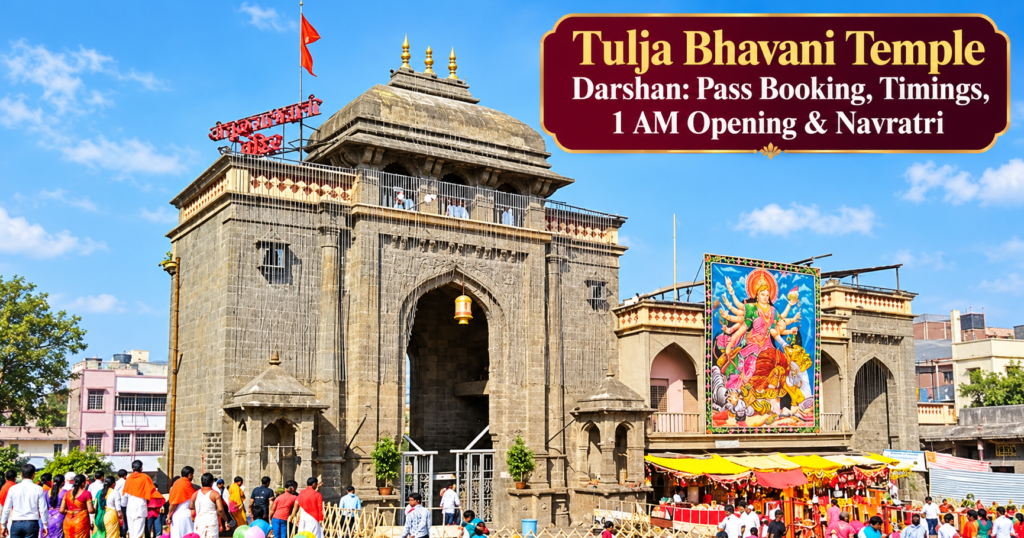
Tulja Bhavani Temple 2026: Quick Information
A visit to Tulja Bhavani Temple in Tuljapur needs slightly more planning than simply checking an opening and closing time. The shrine follows a detailed daily pooja schedule, while Tuesday, Friday and Sunday have a special 1:00 AM opening for devotees.
| Tulja Bhavani Temple Detail | 2026 Information |
|---|---|
| Temple | Shri Tulja Bhavani Temple |
| Location | Tuljapur, Dharashiv District, Maharashtra |
| Presiding Deity | Goddess Tulja Bhavani |
| Regular Early Worship | Around 4:30 AM |
| Tuesday Opening | 1:00 AM |
| Friday Opening | 1:00 AM |
| Sunday Opening | 1:00 AM |
| General Darshan | Free |
| Donation Darshan Pass | ₹200 |
| Morning Abhishek | 6:00 AM–10:00 AM |
| Vastralankar Pooja | Around 11:00 AM |
| Evening Abhishek | 7:00 PM–9:00 PM |
| Prakshal Pooja | Around 9:30 PM |
| Main Festival | Sharadiya Navratri |
| Tuljapur Navratri 2026 Begins | 11 October 2026 |
| Tuljapur Vijayadashami / Simollanghan Observance | 21 October 2026 |
| Convenient Railway Station | Dharashiv |
| Major Railway Hub | Solapur |
| Official Temple Website | Shri Tulja Bhavani Temple, Tuljapur |
The most important timing update for 2026 is the 1:00 AM opening on Tuesday, Friday and Sunday. Older guides showing a blanket 2:00 AM opening should not be used for current trip planning.
Tulja Bhavani Temple Timings 2026
Tulja Bhavani Temple does not follow exactly the same opening pattern every day. Tuesday, Friday and Sunday have a special early opening from 1:00 AM, while other regular days revolve around the early-morning ritual sequence beginning around the Kakad Aarti period.
Darshan continues around scheduled poojas and Abhishek periods through the day, so devotees attending a particular ritual should plan around the pooja schedule, not just a single opening-time figure.
Tulja Bhavani Temple Opening Time
On regular days, Charan Teerth and Kakad Aarti around 4:30 AM form the main early-morning worship period.
However, devotees visiting on Tuesday, Friday or Sunday can enter much earlier, because the temple opens from 1:00 AM on these three days.
This distinction is especially useful for pilgrims staying overnight in Tuljapur or arriving from nearby pilgrimage centres.
Tulja Bhavani Temple Closing Time
The temple’s night worship sequence includes Aarti, Vastralankar and Prakshal Pooja, with Prakshal Pooja taking place around 9:30 PM under the regular schedule.
Late-evening visitors should not treat 9:30 PM as a guaranteed last-entry time. Queue movement and sanctum access can be regulated before the final rituals, particularly on crowded days.
Tulja Bhavani Temple 1 AM Opening Days
One of the most distinctive features of the current Tuljapur darshan schedule is the early opening every:
| Day | Special Opening |
|---|---|
| Tuesday | 1:00 AM |
| Friday | 1:00 AM |
| Sunday | 1:00 AM |
| Other Regular Days | Plan around the early-morning ritual schedule |
The temple’s official information specifically highlights this 1:00 AM opening arrangement, making it an important detail for devotees planning travel from Solapur, Dharashiv, Pune, Pandharpur, Akkalkot or Karnataka-side routes.
Why Are Tuesday and Friday Important at Tulja Bhavani Temple?
Tuesday and Friday are traditionally important days for Goddess worship, and Tuljapur receives strong devotional traffic on both.
Sunday also attracts heavy pilgrimage movement because many families and groups travel over the weekend.
The 1:00 AM opening therefore provides a longer darshan window for handling larger numbers of devotees.
Is 1 AM a Good Time for Darshan?
A 1:00 AM visit can be useful if you:
- Are staying overnight in Tuljapur
- Arrive by late-night transport
- Want darshan before continuing to another pilgrimage centre
- Are specifically visiting on Tuesday, Friday or Sunday
- Prefer travelling before the hotter daytime period
However, the early opening does not guarantee a short queue. Tuesday, Friday and Sunday are also among the temple’s busier weekly days.
For visitors whose priority is simply a more relaxed darshan, a non-festival weekday morning can often be easier than one of the special early-opening days.
Tulja Bhavani Daily Pooja Schedule
Tulja Bhavani Temple follows a structured daily worship sequence, so devotees planning for a specific Aarti, Abhishek or Pooja should use the ritual schedule rather than relying only on the general darshan opening time.
| Tulja Bhavani Pooja / Ritual | Regular Timing |
|---|---|
| Charan Teerth and Kakad Aarti | Around 4:30 AM |
| Morning Abhishek Pooja | 6:00 AM–10:00 AM |
| Vastralankar Pooja, Aarti and Dhup Aarti | Around 11:00 AM |
| Evening Abhishek Pooja | 7:00 PM–9:00 PM |
| Vastralankar, Aarti and Prakshal Pooja | Around 9:30 PM |
These are regular pooja timings, not guaranteed darshan queue-entry times. Devotees attending a particular ritual should arrive before the scheduled period, while Navratri and other major festival days can follow a special worship and crowd-management schedule.
Tulja Bhavani Temple Timings During Navratri 2026
Sharadiya Navratri is the busiest and most important festival period at Tulja Bhavani Temple.
In 2026, the Tuljapur Navratri programme begins on 11 October 2026, with special rituals and pilgrimage activity continuing through the festival period.
The Tuljapur-specific programme places Vijayadashami / Simollanghan observance on 21 October 2026.
During Navratri, normal weekday timings should be treated only as a reference. Special poojas, security arrangements, queue systems and crowd-control measures can change the usual darshan flow.
Anyone visiting during the festival should prioritise the current temple programme and official announcements over a normal-day schedule.
Tulja Bhavani Darshan Pass Price 2026
General darshan at Tulja Bhavani Temple remains free, while devotees who want the temple’s separate paid-entry arrangement can use the Special Donation Darshan e-Pass.
| Tulja Bhavani Darshan Type | 2026 Price |
|---|---|
| General Darshan | Free |
| Special / Donation Darshan e-Pass | ₹200 per person |
For 2026 planning, the ₹200 Donation Darshan Pass is more useful than older guides that show a vague ₹100–₹200 range.
Because darshan charges and digital-service rules can be revised, devotees should still treat the amount displayed on the official booking screen as final at the time of reservation.
Is Tulja Bhavani Darshan Free?
Yes. Regular Tulja Bhavani darshan is free.
The paid pass is optional and is intended for devotees who prefer the temple’s separate special-darshan queue arrangement rather than the normal free queue.
This makes the ₹200 pass particularly useful on:
- Tuesday
- Friday
- Sunday
- Weekends and holidays
- Higher-crowd pilgrimage dates
- Trips where the devotee has limited time in Tuljapur
The pass should not be confused with Abhishek, pooja, donation, or accommodation services, which are separate temple facilities.
What Does the ₹200 Donation Darshan Pass Provide?
The Special Donation Darshan Pass gives access to the paid darshan arrangement managed by the temple rather than the standard general-darshan queue.
It can be practical for:
- Families
- Devotees travelling with elderly relatives
- Visitors combining Tuljapur with Pandharpur, Akkalkot or Solapur
- Pilgrims arriving on the busy Tuesday, Friday or Sunday schedule
- Travellers with a tightly planned same-day itinerary
A paid pass should still not be treated as a guaranteed zero-wait or fixed-duration darshan. Actual movement depends on crowd levels, security checks and temple arrangements.
Tulja Bhavani Darshan Pass Booking 2026
Tulja Bhavani Temple provides an official electronic system for booking the Special Donation e-Pass.
For current temple services, devotees should begin from the official Shri Tulja Bhavani Temple website.
The official devotee manual confirms that the e-Pass system allows users to choose an available visit date and time slot, enter the number of devotees, complete payment and generate the booking pass.
How to Book Tulja Bhavani Darshan Pass Online
Step 1: Open the Official Temple Booking System
Start from the official Shri Tulja Bhavani Temple website and open the Special Donation e-Pass service.
Avoid third-party websites claiming to sell priority or VIP darshan unless they are clearly linked from the temple’s own portal.
Step 2: Login to the Devotee Account
Complete the required login or registration process.
After successful login, the devotee dashboard provides access to the e-Pass booking facility.
Step 3: Select the Special Donation e-Pass
Choose the relevant e-Pass from the booking options.
Keep it separate from other temple services such as:
- Abhishek
- Accommodation
- General donations
- Other pooja bookings
Step 4: Choose the Visit Date
Select an available date from the booking calendar.
The official system uses availability indicators to show whether dates are open, selected, unavailable or fully reserved.
For Tuesday, Friday, Sunday, holidays and Navratri-period visits, booking earlier is more sensible because these are higher-demand periods.
Step 5: Select the Darshan Time Slot
Choose one of the available time slots for the selected date.
The slot shown in the system should take priority over general timing information published elsewhere.
Step 6: Enter the Number of Devotees
Enter the total number of pilgrims included in the booking.
The temple’s current devotee manual specifically states that children below 10 years do not require an e-Pass.
Step 7: Complete Payment
Pay the amount displayed by the official system for the selected Special Donation Darshan booking.
For 2026 planning, the listed pass amount is ₹200 per person, but the live portal amount should be treated as final if the temple revises the charge.
Step 8: Save the Tulja Bhavani e-Pass
After successful booking, save the confirmation or e-Pass on your phone and, if convenient, keep a printed copy as backup.
Carry:
- Special Donation e-Pass
- Valid photo identification
- Any booking-related document specifically requested by the portal
The name and identity details used during booking should match the document carried for temple entry.
Important Booking Tip
Do not create another booking immediately if the payment page is slow or the confirmation does not appear at once.
First check whether the existing transaction or e-Pass has already been generated. Duplicate bookings can make payment and entry verification unnecessarily complicated.
Tulja Bhavani Darshan Pass Offline Booking 2026
Devotees who do not book the Tulja Bhavani ₹200 Special Donation Darshan Pass online may also be able to obtain the pass through the temple’s offline counter, subject to availability.
For a walk-in visit, the practical process is:
- Reach the Tulja Bhavani Temple administrative area.
- Ask temple staff for the current Special Donation Darshan Pass counter.
- Check whether passes are available for the required darshan period.
- Pay the applicable ₹200 per devotee charge.
- Collect the issued pass or token.
- Follow the special-darshan queue indicated by temple staff.
Offline purchase is useful for devotees making a spontaneous Tuljapur visit, but availability can become less predictable on Tuesday, Friday, Sunday, public holidays and major festival days.
I would avoid hard-coding the claim that the counter is on the ground floor of the administrative building unless that location is confirmed from a current official temple notice. The temple precinct is undergoing significant redevelopment, so an exact counter location is more likely to change than the overall pass system itself.
Should You Book the ₹200 Pass Online or Offline?
For a normal weekday, buying the pass after arrival can be convenient if availability is good.
For a fixed-date pilgrimage—especially on a busy weekly darshan day or during Navratri—online booking is the safer option because it lets the devotee secure an available date and slot before travelling.
A useful approach is:
Flexible weekday visit → offline pass can work
Fixed or busy-date visit → advance e-Pass is preferable
Free Darshan vs ₹200 Special Darshan
Both free darshan and the ₹200 Donation Darshan Pass ultimately provide darshan of Goddess Tulja Bhavani. The main difference is the queue arrangement and the amount of time a devotee may need to allow.
| Visit Situation | More Practical Option |
|---|---|
| Quiet non-festival weekday | Free Darshan |
| Tuesday | ₹200 pass can be useful |
| Friday | ₹200 pass can be useful |
| Sunday | ₹200 pass can be useful |
| Tight same-day itinerary | ₹200 Special Darshan |
| Travelling with elderly family members | Paid queue may be more convenient |
| Navratri / major yatra | Expect substantial crowd even with a pass |
When Is Free Darshan Enough?
Free Tulja Bhavani darshan is usually the better-value choice when:
- You are visiting on a quieter weekday
- Your schedule is flexible
- You are staying overnight in Tuljapur
- You do not mind spending additional time in the general queue
There is no need to purchase the paid pass simply because it is available.
When Is the ₹200 Pass Worth Considering?
The ₹200 Special Donation Darshan Pass becomes more useful when saving queue time has genuine value—for example, when a family is combining Tuljapur with Pandharpur, Akkalkot or Solapur, or when the visit falls on one of the temple’s busier weekly days.
It can also be more practical for groups travelling with elderly relatives who would prefer to avoid a longer general queue.
Does the ₹200 Pass Guarantee Quick Darshan?
No fixed darshan duration should be promised.
The Donation Darshan Pass provides a separate special-darshan arrangement, but actual waiting time still depends on:
- Number of devotees
- Day of the week
- Security checks
- Pooja interruptions
- Festival arrangements
- Crowd-control measures
This becomes particularly important during Sharadiya Navratri, when Tuljapur receives very large pilgrimage crowds and even paid-pass holders should allow substantial extra time.
The ₹200 pass should therefore be understood as a faster queue option, not a guaranteed “30-minute darshan” ticket.
Tulja Bhavani Darshan Waiting Time
Tulja Bhavani Temple waiting time can change sharply depending on the weekday, festival calendar and overall pilgrimage traffic in Tuljapur.
| Visit Period | Expected Crowd |
|---|---|
| Ordinary non-festival weekday | Low to Moderate |
| Tuesday | High |
| Friday | High |
| Sunday | High |
| Public holiday / long weekend | High |
| Sharadiya Navratri | Extremely High |
| Ashwin Purnima pilgrimage period | Extremely High |
The temple itself records very large daily visitor numbers even outside Navratri—for example, more than 27,000–38,000 devotees per day on several June 2026 dates—so queue conditions should never be treated as fixed.
How Much Time Should You Keep for Darshan?
On an ordinary non-festival weekday, keeping around 1–2 hours as a planning buffer is sensible for general darshan.
This is not a promised waiting time. Actual darshan may be quicker or substantially longer depending on:
- Arrival time
- General or Special Donation queue
- Pooja interruptions
- Security arrangements
- Weekend or holiday traffic
- Sudden pilgrimage rush
If Tuljapur is only one stop in a Pandharpur–Akkalkot–Tuljapur pilgrimage, avoid scheduling the onward journey immediately after your expected darshan time.
Tuesday, Friday and Sunday Crowd
The temple opens from 1:00 AM on Tuesday, Friday and Sunday, but these are also high-demand pilgrimage days.
The longer opening window helps accommodate devotees; it does not mean the queue will remain short throughout the morning.
If quick darshan matters more than visiting on a religiously significant day, a normal non-festival weekday can be easier.
Tulja Bhavani Navratri Waiting Time
Sharadiya Navratri is one of Tulja Bhavani Temple’s most important annual pilgrimage periods, and the temple describes it as a major festival celebrated with extensive traditional observances.
During Navratri, devotees should plan for several hours of temple-related movement rather than a normal quick visit. Special queue routes, holding arrangements, security checks and temporary access controls can all affect the time needed.
If the purpose of your journey is Navratri itself, plan around the festival experience, not around normal weekday waiting expectations.
Tulja Bhavani Daily Pooja Timings
Tulja Bhavani follows a structured daily worship sequence, so devotees interested in Kakad Aarti or Abhishek should plan around the ritual schedule rather than only general darshan access.
| Tulja Bhavani Pooja | Regular Timing |
|---|---|
| Charan Teerth / Kakad Aarti | Around 4:30 AM |
| Morning Abhishek Pooja | 6:00 AM–10:00 AM |
| Vastralankar Pooja, Aarti & Dhup Aarti | Around 11:00 AM |
| Evening Abhishek Pooja | 7:00 PM–9:00 PM |
| Vastralankar, Aarti & Prakshal Pooja | Around 9:30 PM |
These are ritual timings, not guaranteed queue-entry times. Festival programmes can alter the normal sequence.
Kakad Aarti
Charan Teerth and Kakad Aarti around 4:30 AM form an important part of the early-morning worship of Goddess Tulja Bhavani.
This period is particularly relevant to devotees staying overnight in Tuljapur and wanting to begin the pilgrimage before daytime crowds increase.
Morning and Evening Abhishek
The regular morning Abhishek period is approximately 6:00 AM–10:00 AM, with another Abhishek period in the evening from about 7:00 PM–9:00 PM.
These ritual windows make Tuljapur different from temples where Abhishek is restricted to one short morning slot.
Vastralankar and Night Worship
Around 11:00 AM, the worship sequence includes Vastralankar Pooja, Aarti and Dhup Aarti.
Night worship culminates around the 9:30 PM Prakshal Pooja period, so devotees who specifically want to experience the evening rituals should plan accordingly rather than arriving only for a late general darshan.
Tulja Bhavani Abhishek Booking
Abhishek Pooja and the ₹200 Special Donation Darshan Pass are separate services.
A devotee choosing Abhishek is participating in a religious worship service; a Donation Darshan Pass concerns the darshan queue arrangement.
The distinction is:
General Darshan → free standard queue
₹200 Donation Darshan → special darshan queue
Abhishek → religious pooja service
Devotees interested in Abhishek should check the current pooja service and booking information on the official Shri Tulja Bhavani Temple website, because ritual availability, participation rules and charges can change.
Tulja Bhavani Navratri 2026 Dates
The Sharadiya Navratri festival at Tulja Bhavani Temple is not limited to a simple nine-day visitor schedule. Tuljapur follows additional rituals before and after Navratri, including Manchaki Nidra, Ghatasthapana, Vijayadashami/Simollanghan and Ashwin Purnima observances.
For the 2026 Tuljapur festival programme:
| Tulja Bhavani Festival Event | Date |
|---|---|
| Pre-Navratri Manchaki Nidra Begins | 3 October 2026 |
| Ghatasthapana / Navratri Begins | 11 October 2026 |
| Lalita Panchami | 15 October 2026 |
| Durga Ashtami | 19 October 2026 |
| Mahanavami / Khande Navami | 20 October 2026 |
| Tuljapur Vijayadashami / Simollanghan Observance | 21 October 2026 |
| Ashwin Purnima Festival | 26 October 2026 |
The temple’s official description confirms that Sharadiya Navratri begins from Ashwin Pratipada and culminates in distinctive Vijayadashami traditions at Tuljapur.
Because Tuljapur’s ritual programme can differ from a generic Navratri calendar, pilgrims should follow the temple-specific festival programme when planning an October visit.
Tulja Bhavani Navratri Crowd
Navratri is the period when normal Tuljapur planning changes most dramatically.
Expect:
- Very long darshan queues
- Overnight arrivals
- Special traffic and parking arrangements
- Heavy demand for Bhakt Niwas and hotels
- Temporary queue-management systems
- Festival-specific poojas
- Larger security presence
Anyone travelling from Pune, Mumbai, Solapur, Karnataka or another distant city should arrange accommodation and transport well before the main festival dates.
Manchaki Nidra at Tulja Bhavani Temple
Manchaki Nidra is one of the most distinctive ritual traditions associated with Goddess Tulja Bhavani.
The temple’s own description of Sharadiya Navratri connects the tradition with the belief that the Goddess rests after her battle with Mahishasura. Its Vijayadashami description also records the ceremonial arrival of the palanquin and bed, followed by the Goddess’s ritual rest.
For the 2026 pre-Navratri cycle, the Manchaki Nidra period begins on 3 October, before the Goddess is ceremonially re-established for Ghatasthapana on 11 October.
This matters practically because darshan and ritual arrangements during these special periods may differ from the normal daily schedule.
What to Carry for Tulja Bhavani Darshan
Tuljapur can involve long queues and substantial walking, particularly on Tuesday, Friday, Sunday and during Navratri. Carrying only what is actually useful makes the visit easier.
For most devotees, that means:
- Donation Darshan e-Pass, if booked
- Valid photo ID
- Only essential personal belongings
- Required pooja or booking confirmation
- Water for use outside restricted temple areas
Mobile Phones, Cameras and Photography
Electronic-item restrictions can apply in sensitive parts of the temple.
If temple security requires devotees to leave mobile phones, cameras or other restricted items outside the final darshan area, use the authorised deposit arrangement and follow the on-site instructions.
Do not plan around being able to photograph the Garbha Griha or Goddess Tulja Bhavani.
Dress for Tulja Bhavani Darshan
There is no need to manufacture a complicated dress-code section unless the temple announces a specific mandatory rule.
For ordinary darshan, devotees should wear comfortable, respectful clothing suitable for a major Shakti pilgrimage.
Practical comfort matters at Tuljapur because a busy-day visit can involve long standing periods, queue corridors and walking through the temple precinct rather than only a brief entry into the shrine.
Best Time to Visit Tulja Bhavani Temple
The best time to visit Tulja Bhavani Temple in Tuljapur depends on whether you want a comparatively easier darshan or the full atmosphere of a major Goddess festival.
| Visit Goal | Better Time |
|---|---|
| Lower Crowd | Non-festival weekday |
| Early Regular Worship | Around 4:30 AM |
| Tuesday / Friday / Sunday Visit | From 1:00 AM |
| Comfortable Weather | October–February |
| Navratri Experience | From 11 October 2026 |
| Family Visit | Non-festival weekday |
| Less Queue Pressure | Weekday; ₹200 pass if useful |
For most first-time pilgrims interested mainly in darshan, Monday, Wednesday, Thursday or Saturday morning outside major festival dates is generally easier than Tuesday, Friday or Sunday.
The 1:00 AM opening on those three days provides additional darshan time, but it also reflects the heavier pilgrimage demand.
Best Season for Tuljapur
The October to February period is generally more comfortable for a Tuljapur pilgrimage because temperatures are easier for walking, queueing and combining the temple with nearby destinations.
October, however, includes the major Sharadiya Navratri pilgrimage period, so visitors wanting comfortable weather without festival-level crowds should preferably choose a non-festival date later in the season.
History and Significance of Tulja Bhavani Temple
Shri Tulja Bhavani Temple is one of Maharashtra’s most important Shakti shrines and is traditionally counted among the state’s revered three-and-a-half Shakti Peethas.
The Goddess is worshipped in Tuljapur as Tulja Bhavani, Jagdamba, Tukai and Mahishasuramardini, and the shrine has been a major regional pilgrimage centre for centuries. The Dharashiv district administration describes Tulja Bhavani as Maharashtra’s Kulswamini and notes that large pilgrimages are held around Ashwin and Chaitra festival periods.
Its importance is therefore both religious and cultural: Tuljapur is a centre of Shakti worship, a major family-deity pilgrimage for many Maharashtra households, and a shrine closely connected with Maratha historical tradition.
Tulja Bhavani and Chhatrapati Shivaji Maharaj
One of the strongest cultural associations of Tulja Bhavani Temple is with Chhatrapati Shivaji Maharaj.
Tulja Bhavani is traditionally regarded as closely connected with Shivaji Maharaj and the Maratha tradition. A famous belief holds that the Goddess blessed him in his struggle to establish Swarajya and presented him with the sacred Bhavani Talwar.
The Dharashiv district administration itself preserves this tradition in its historical description of the temple, referring to Tulja Bhavani blessing Shivaji Maharaj and giving him the Bhavani sword.
The sword story should still be presented as revered historical-religious tradition, rather than treated as a claim established purely through contemporary documentary evidence.
This association with Tulja Bhavani and Shivaji Maharaj is one of the main reasons the shrine carries significance far beyond Tuljapur itself.
How to Reach Tulja Bhavani Temple
Tuljapur is primarily a road-access pilgrimage destination, with Dharashiv and Solapur serving as the most useful nearby transport bases.
The district administration places Tuljapur approximately 22.4 km from Dharashiv and about 42 km from Solapur.
By Train
Tuljapur does not have a major railway station of its own, so pilgrims commonly continue by road from:
Dharashiv Railway Station – the geographically closer rail option
Solapur Railway Station – the larger rail hub with broader long-distance connectivity
Dharashiv district confirms that Dharashiv Railway Station is connected with major Maharashtra cities.
For travellers coming from major cities, it is better to choose the station according to the actual train available, rather than assuming the nearest station will always offer the best connection.
By Air
Air access to Tuljapur is less straightforward than road or rail travel.
Travellers should check current scheduled flight availability to airports in the wider region before booking, because regional routes can change.
For dependable wider connectivity, the Dharashiv district administration identifies Pune International Airport as the nearest major international airport for the district.
After arrival, pilgrims continue toward Tuljapur by road or a combination of rail and road.
By Road
Road travel is the most flexible way to reach Tulja Bhavani Temple, particularly for pilgrims combining several Maharashtra temples.
Tuljapur is accessible through routes connecting:
- Solapur
- Dharashiv
- Latur
- Pune
- Pandharpur
- Akkalkot
- Other parts of Maharashtra and neighbouring Karnataka
MSRTC and private buses operate across the wider regional network, although frequency should be checked for the specific starting city.
Tuljapur Distance from Major Pilgrimage Cities
Many visitors include Tulja Bhavani in a multi-temple Maharashtra pilgrimage, so road distance is often more useful than straight-line distance.
| Route | Approximate Road Distance |
|---|---|
| Dharashiv to Tuljapur | About 22–25 km |
| Solapur to Tuljapur | About 42–45 km |
| Akkalkot to Tuljapur | Around 70 km |
| Pandharpur to Tuljapur | Around 110 km |
| Pune to Tuljapur | Around 290 km |
| Kolhapur to Tuljapur | Around 250 km |
Distances outside the officially documented Dharashiv/Solapur figures should be treated as approximate because the exact road length changes with the selected route and starting point.
Solapur to Tuljapur Temple
Solapur is one of the most practical major transport bases for Tuljapur, particularly for travellers arriving by long-distance train.
The temple is about 42 km from Solapur according to Dharashiv district information.
From Solapur, pilgrims can continue by:
- MSRTC or other bus services
- Taxi
- Private vehicle
- Available shared transport
An early departure from Solapur works particularly well for devotees wanting morning Tulja Bhavani darshan or those continuing toward another pilgrimage destination later in the day.
Dharashiv to Tuljapur
Dharashiv is closer to Tuljapur than Solapur, at approximately 22.4 km according to the district administration.
It is especially convenient for travellers whose train or road route already passes through Dharashiv.
For pilgrims choosing between Dharashiv and Solapur, the practical decision is:
Dharashiv → shorter final road journey
Solapur → stronger major-city rail connectivity
Pandharpur to Tuljapur
Pandharpur and Tuljapur are frequently combined by pilgrims visiting major Maharashtra shrines.
The road journey is roughly 110 km, depending on the route.
A practical sequence can be:
Pandharpur Vitthal Temple → Tulja Bhavani Temple → Solapur
However, the real time required depends much more on darshan queues at Pandharpur and Tuljapur than on driving distance alone.
Avoid scheduling both temples with very tight departure times, especially on Ekadashi, Tuesday, Friday, Sunday or other high-footfall dates.
Akkalkot to Tuljapur
Akkalkot is roughly 70 km from Tuljapur, making the Swami Samarth Temple + Tulja Bhavani Temple combination realistic within the same regional pilgrimage.
A same-day trip is possible with an early start, but an overnight stay in Solapur or Tuljapur gives more flexibility if darshan queues are heavy.
Popular Tuljapur Pilgrimage Circuits
Two practical pilgrimage combinations are:
Solapur → Akkalkot → Tuljapur
and
Tuljapur → Pandharpur → Kolhapur Mahalaxmi
These routes connect Tulja Bhavani naturally with other major devotional centres rather than adding unrelated tourist stops simply to lengthen the itinerary.
Trying to cover Akkalkot, Tuljapur, Pandharpur and Kolhapur in one rushed day is not practical for most pilgrims because temple queues can consume several hours even when road traffic is normal.
Tulja Bhavani Bhakt Niwas and Accommodation
Pilgrims who want to stay close to Tulja Bhavani Temple can use Temple Sansthan accommodation or private hotels and lodges in Tuljapur.
The temple’s official website currently lists:
Bhakt Niwas, Bhavani Road
Phone: 02471-244551
Jagdamba Yatri Bhakt Niwas
Phone: 9422956830 / 9067257215
These contact details are published directly by Shri Tulja Bhavani Temple Sansthan.
For the latest accommodation and temple contact details, devotees can use the official Shri Tulja Bhavani Temple website.
Who Should Stay in Tuljapur?
An overnight stay is particularly useful for pilgrims planning:
- 1:00 AM darshan on Tuesday, Friday or Sunday
- Kakad Aarti
- Early-morning Abhishek
- More than one temple visit in Tuljapur
- Navratri or Ashwin Purnima pilgrimage
- An onward trip to Pandharpur or Akkalkot
Someone making only a normal daytime darshan from Solapur may not need to stay overnight.
Bhakt Niwas During Navratri
During Sharadiya Navratri, Tuljapur receives very heavy pilgrimage traffic.
Do not depend on arriving in town and finding Temple Trust accommodation at the last moment. Contact the Bhakt Niwas in advance and keep a backup accommodation option, particularly for the main Navratri and Vijayadashami period.
This is one part of the Tuljapur trip where advance planning can matter more than the ₹200 darshan pass itself, because a confirmed place to stay makes a 1:00 AM or early-morning temple visit much easier.
Tulja Bhavani Temple Contact Details
Shri Tulja Bhavani Temple Sansthan
Mahadwar Road
Tuljapur, Dharashiv District
Maharashtra – 413601
Temple Office / Religious Enquiry: 02471-242031
Official Website: https://shrituljabhavani.org/
The administrative office normally operates from approximately 10:00 AM to 6:00 PM.
FAQs
What are Tulja Bhavani Temple timings in 2026?
Regular early worship begins around 4:30 AM, while Tuesday, Friday and Sunday have a special opening from 1:00 AM.
Does Tulja Bhavani Temple open at 2 AM?
Current temple information says 1:00 AM, not 2:00 AM, on Tuesday, Friday and Sunday.
Which days does Tulja Bhavani Temple open at 1 AM?
The temple opens for devotees from 1:00 AM every Tuesday, Friday and Sunday.
Is Tulja Bhavani darshan free?
Yes. General darshan is free.
What is the Tulja Bhavani special darshan pass price?
The official Donation Darshan Pass costs ₹200 per person.
Can I book Tulja Bhavani darshan online?
Yes. The temple provides electronic Special Donation Darshan Pass booking.
Can I get a ₹200 pass offline?
Yes. ₹200 Donation Darshan Passes are also available from the temple’s administrative building subject to current availability.
Is ₹100 VIP darshan available at Tulja Bhavani?
Current official temple information specifically lists a ₹200 Donation Darshan Pass, so older ₹100–₹200 ranges should not be treated as the current fixed tariff.
What time is Tulja Bhavani Kakad Aarti?
Charan Teerth Kakad Aarti takes place around 4:30 AM.
What are Tulja Bhavani Abhishek timings?
Morning Abhishek is approximately 6:00 AM–10:00 AM, with another Abhishek period from 7:00 PM–9:00 PM.
When does Tulja Bhavani Navratri 2026 begin?
Sharadiya Navratri begins with Ghatasthapana on 11 October 2026.
When is Vijayadashami at Tulja Bhavani in 2026?
Vijayadashami and Simollanghan fall on 21 October 2026.
Which days are most crowded at Tulja Bhavani Temple?
Tuesday, Friday and Sunday are particularly busy, while Navratri sees the heaviest annual crowds.
What is the best day for less crowd?
An ordinary Monday, Wednesday, Thursday or Saturday morning outside major festivals is generally easier.
How far is Tuljapur from Solapur?
Tuljapur is approximately 45–50 km from Solapur.
How far is Tuljapur from Dharashiv?
The distance is approximately 25–30 km.
Which railway station is best for Tuljapur?
Dharashiv is closer, while Solapur is the larger and better-connected railway junction.
Does Tuljapur have an airport?
Tuljapur itself does not have an airport. Solapur Airport is the nearest regional airport and currently has limited scheduled connectivity.
Can Tuljapur and Akkalkot be visited together?
Yes. Akkalkot is around 70 km away, making the two temples a practical pilgrimage combination.
Can I visit Pandharpur and Tuljapur on the same trip?
Yes. Pandharpur is around 110 km from Tuljapur, and the two are frequently included in the same Maharashtra pilgrimage circuit.
Final Thoughts
A Tulja Bhavani Temple visit in 2026 is easiest to plan once the temple’s special weekly opening pattern is understood. The most important current update is that Tuesday, Friday and Sunday darshan begins from 1:00 AM, rather than the 2:00 AM timing still shown on some older pages.
General darshan remains free, while the official Donation Darshan Pass costs ₹200 per person and provides access through the temple’s special darshan arrangement. It can be especially useful on the three high-crowd weekly days or when your pilgrimage schedule is limited.
Daily worship includes Kakad Aarti at about 4:30 AM, morning Abhishek from 6:00 AM to 10:00 AM, Vastralankar Pooja around 11:00 AM, evening Abhishek from 7:00 PM to 9:00 PM and Prakshal Pooja around 9:30 PM.
Visitors travelling in October should pay particular attention to the festival calendar. Sharadiya Navratri begins on 11 October 2026, Vijayadashami falls on 21 October, and the wider Tulja Bhavani festival programme continues toward Ashwin Purnima.
For an easier first visit, choose a normal weekday morning outside Navratri. For a larger pilgrimage, Tuljapur combines naturally with Solapur, Akkalkot and Pandharpur, but keep enough time between temples because queue conditions matter far more than road distance alone.